
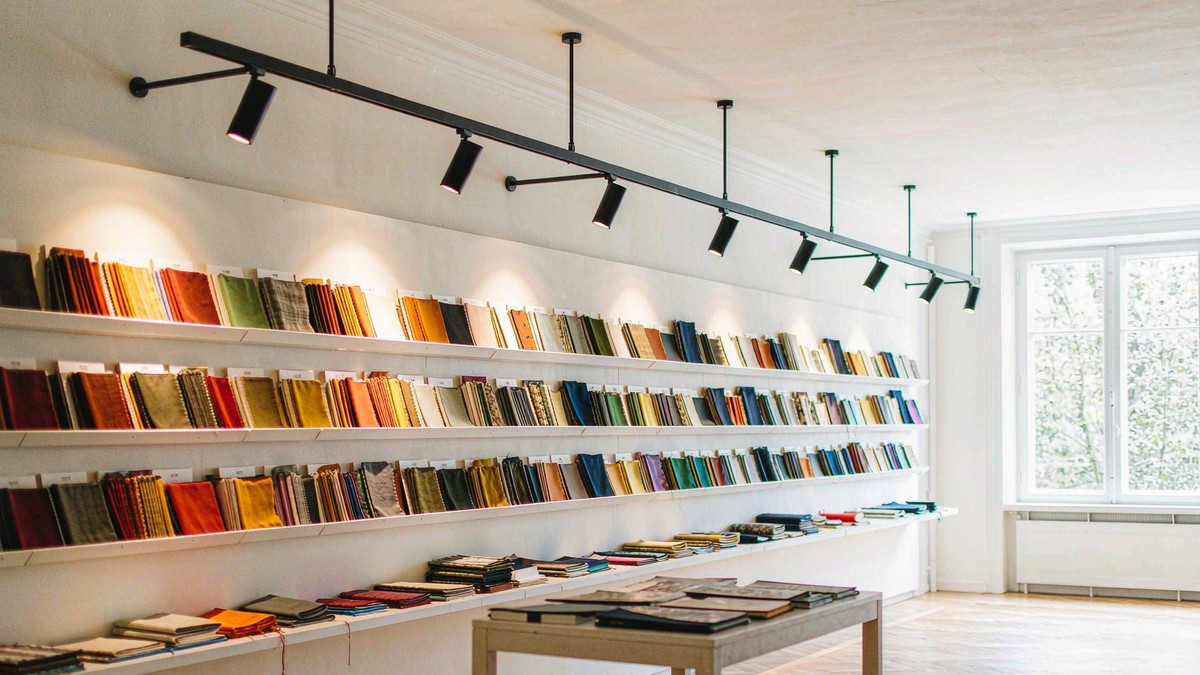
Answer first: TM-30 splits color quality into two independent numbers — Rf (fidelity, 0–100, 100 = perfect match to a reference light) and Rg (gamut area, 100 = same saturation spread as the reference). A 90 CRI track light typically posts Rf 88–91 with Rg 95–98: technically accurate, visually flat. That gap is why a grey cashmere sweater reads taupe in your fitting room. CAIMETA’s AIColor W+R+GB COB publishes CRI 95, R9 ~95, Rg ~110 and GAI(BB15) ~110 — roughly double the gamut area of a standard 80 CRI lamp, whose GAI sits in the 50s.
If your spec sheet still says “CRI > 90”, you are buying a number that stopped describing light sources well two decades ago. This is the practical guide to reading TM-30 the way a lighting designer, a visual merchandiser and a procurement manager each need to read it — with the numbers to put in the tender document.
Why CRI ran out of road
CRI (CIE 13.3-1995) was designed to grade fluorescent tubes against an incandescent reference. It uses 14 test color samples, and the headline Ra is the average of only the first eight — all low-saturation pastels: faded rose, mustard, yellow-green, light blue. Score well on eight muted swatches and you get Ra 95, even if your deep reds, your navy and every skin tone in the store are being rendered by a spectrum built to win that one contest.
R9 — saturated red — was deliberately excluded from Ra because early fluorescent lamps could not produce it. That single decision is why the industry spent a decade quoting “CRI 90” fixtures with R9 of 12, and why red silk, red wine, raw beef and Indian skin tones looked dead under them. (We covered that failure mode in detail in our R9 color rendering breakdown.)
Two more structural problems: CRI cannot be compared across color temperatures, and it has no gamut term at all. It measures accuracy. It says nothing about whether a color is alive.
What TM-30 actually measures
IES TM-30 (first published 2015, revised as TM-30-20) throws out the 14 swatches and evaluates a light source against 99 Color Evaluation Samples — real-object spectra spanning saturated and desaturated colors across the full hue circle, plus skin, foliage, and textile references. Every sample is compared to a reference illuminant of the same correlated color temperature, which is what finally makes cross-CCT comparison legitimate.
Out of that come three outputs that matter commercially:
- Rf — Fidelity. One number, 0–100. How closely the 99 samples match the reference. This is the honest successor to CRI.
- Rg — Gamut. One number, 100 = reference gamut area. Below 100 means colors are muted relative to the reference; above 100 means they are pushed wider and read more saturated.
- Rcs — Fidelity by hue bin. Sixteen bars around the hue circle showing which colors fail. This is where you catch a spectrum that boosts red while quietly ruining everything green.
Rf: the number that tells you whether colors are right
Rf does the job CRI was supposed to do: 99 samples instead of 8, against a same-CCT reference.
Practical reading across the commercial LED market:
- Rf below 80 — fails almost every retail or hospitality spec. Colors are visibly off-hue, not just dull.
- Rf 80–86 — the volume end of the market. Common in 80 CRI product where the phosphor was tuned for lumens, not color.
- Rf 87–91 — where most good 90 CRI fixtures land. Accurate, safe, and completely unremarkable on a shop floor.
- Rf 92+ — premium rendering territory. You are now paying for spectrum, not efficacy.
Here is the trap: Rf and CRI are not the same scale, and Rf punishes the shortcuts CRI rewards. A fixture quoting “CRI 95” can legitimately measure Rf 87, because CRI’s pastel samples are easy while TM-30’s saturated samples are not. If a supplier only gives you CRI, you have not been told how the light renders the 91 colors CRI never tested.
Rg: the number that tells you whether colors are alive
Rg is the metric most buyers ignore and the one that decides whether a store looks expensive. It measures the total area the 99 samples occupy in color space, relative to the reference. Rg 100 is neutral. Rg 92 means the light is compressing the color world by roughly 8%. Rg 110 means it is opening it up by around 10%.
Most 80 CRI LEDs land around Rg 95–99. Most 90 CRI LEDs land around Rg 95–100. So the honest summary of the last ten years of “high CRI” retail lighting is: the industry got more accurate and never got more vivid. Accurate-but-compressed is exactly the look that makes a £400 cashmere scarf read like a £40 one under a 3000K 90 CRI spot.
CAIMETA’s approach with AIColor adaptive spectrum is a W+R+GB five-channel COB rather than a blue-pump phosphor. Adding a genuine red channel and a green channel is what widens the gamut: the catalog states Rg ~110 with color enhancement for specified colors, and a GAI(BB15) of ~110 against “standard 90 CRI LEDs in the 50s” on that same index. It also states CRI 95 and R9 up to ~95, both cross-checkable on a TM-30 report for the specific CCT you order.
Reading Rf and Rg together: the four quadrants
Neither number is meaningful alone. Plot them as a two-dimensional map and every fixture you are comparing falls into one of four behaviors:
| Rf / Rg | What it looks like on a shop floor | Where it belongs |
|---|---|---|
| High Rf / High Rg (e.g. 92 / 108) | Colors are recognizable and saturated. Cashmere reads as cashmere, leather grain separates from stitching. | Apparel, leather goods, jewellery, grocery fresh, premium showrooms. |
| High Rf / Low Rg (e.g. 91 / 92) | Correct but chalky. Safe for photography, flat for selling. The classic “CRI 90” look. | Back-of-house, stockrooms, offices, corridors. |
| Low Rf / High Rg (e.g. 78 / 112) | Vivid but lying. Blues drift purple, greens go acid. Sells on first glance, fails on second. | Never in a fitting room. Acceptable in entertainment and some QSR. |
| Low Rf / Low Rg (e.g. 72 / 88) | Dull and wrong. Products look used. | Parking, plant rooms, exterior. |
Specify the pair, always. “Rf ≥ 90 and Rg ≥ 100” is a sentence a supplier cannot quietly interpret in their favour, and it eliminates roughly 90% of the “high CRI” catalogue in one line.
Where Rg 110 helps — and where it hurts
Wide gamut is not universally good, and a supplier who tells you it is has not been in a fitting room at 8pm.
Where it wins: textiles where weave and saturation carry perceived value; leather and patent finishes where depth of color is the product; coloured gemstones; fresh produce, where yellows and reds drive freshness perception; and any category where the customer compares the product to a phone photo shot in daylight.
Where it needs dialling back:
- Skin tones under Rg 110. A gamut-expanded spectrum can push foundation and lipstick shades 1–2 steps past reality. Customers notice this in the mirror, not on the shelf.
- Food inspection. Deliberately exaggerating red can mask browning in meat and oxidation in fish — a compliance question, not an aesthetic one.
- Art and conservation. Where the brief is “show the work as it is”, Rf matters and gamut expansion does not.
The reason this is manageable rather than a compromise is that a multi-channel spectrum can be re-tuned per scene. CAIMETA’s AIColor engine stores 1000 auto-sensing lighting chromaticities; the on-board color sensor reads the merchandise and selects the spectrum, and a “Take a Picture” mode lets you match a spectrum to a reference image in one shot. In a mixed store — cashmere on the ground floor, cosmetics at the entrance — the same fixture serves both scenes instead of forcing two SKUs. That is the operating argument for the Kano Magic auto-spectrum track light: gamut has become a controls conversation.
Rcs: the 16-bin graph that exposes a fake “full spectrum”
Ask for the Rcs bar chart. It is the most useful page in a TM-30 report and the one suppliers hope you will not request.
Rcs plots fidelity across 16 hue bins. A well-built wide-gamut source shows a smooth, deliberately elevated curve — a gentle lift around red, a modest dip near cyan-green, because that is what an extra red channel does. A phosphor-only “full spectrum” lamp shows something different: a respectable average with a collapsed red bin (Rcs.1 or Rcs.16 under 80) and a spike elsewhere. That is the signature of a spectrum tuned to pass an average while abandoning a hue family.
For a retail floor, read three bins and ignore the rest: the red bins (do reds hold up or blow out), the green-yellow bins (does olive fabric turn khaki) and the blue bins (does navy drift purple, the most common complaint in menswear).
What CAIMETA AIColor publishes — and what to verify
Numbers below are taken from the current Kinglumi / CAIMETA product catalogue (Adaptive Light Spectrum section). They are manufacturer-published specifications, not an independent lab report, and should be confirmed against a TM-30 test report for the exact CCT and wattage you order.
| Parameter | Published value | How to read it |
|---|---|---|
| LED architecture | W+R+GB COB (5-channel) | Real red and green channels, not phosphor conversion — the mechanism behind the gamut figure. |
| CRI | 95 | Legacy index, kept for tender compatibility. Do not stop here. |
| R9 (saturated red) | up to ~95 | Confirms deep reds are not being sacrificed. Anything under 80 fails apparel. |
| Rg (TM-30 gamut) | ~110 | ~10% wider than reference. Expect visibly richer saturation, not just accuracy. |
| GAI (BB15) | ~110 vs “50s” for standard 90 CRI | Independent gamut index pointing the same direction — useful cross-check on Rg. |
| Spectrum library | 1000 chromaticities, auto-sensing | Gamut is a setting, not a fixed property of the fixture. |
| Rf | Not stated in catalogue | Ask for it per CCT. Any serious supplier has it; a refusal is an answer too. |
Note the last line. Publishing Rg and GAI but not Rf is common in this category — not automatically a red flag, but a buyer who asks for Rf, Rcs and the test lab name separates a measured product from a marketed one.
How to request a TM-30 report from any supplier
Seven lines. Send them as written; the reply tells you most of what you need to know.
- “TM-30-20 report, not TM-30-15, for the exact CCT and CRI variant quoted.”
- “Rf, Rg and the full 16-bin Rcs graph at 3000K and 4000K.”
- “Which integrating sphere and which lab produced the report?”
- “Is the report from the production LED bin, or a hand-built sample?”
- “R9 value measured on the same sample.”
- “Beam angle and CCT drift at 100%, 50% and 10% dim.” (Gamut collapses at low dim on cheap drivers.)
- “Tolerance: what ±Rf are you willing to put in the PO?”
Item 6 is the one that catches people. A fixture measured at full output can lose several Rf points at 10% dim — exactly the level a boutique runs at after 8pm. If your lighting is dimmed most of the day, the full-output report is marketing, not engineering.
Spec language you can paste into a tender
“Track-mounted LED spotlight, 3000K, CRI ≥ 95, R9 ≥ 90, TM-30-20 Rf ≥ 90, Rg ≥ 105 at full output and Rf ≥ 87 at 10% dim; 16-bin Rcs report to be supplied with submittal; spectrum adjustable across a minimum of 5 selectable CCT/spectrum presets with on-board color sensor; flicker < 1% at all dim levels.”
Everything in that sentence is measurable, which is the point. “High CRI” is not a specification; it is a hope.
Frequently asked questions
What is a good TM-30 Rf and Rg for retail lighting?
For selling floors, target Rf ≥ 90 and Rg ≥ 100. Below Rf 87 you get hue errors on saturated goods; below Rg 95 even accurate colors read flat. Stockrooms and back-of-house are fine at Rf 80.
Is Rg 110 too saturated?
Not for merchandise — for skin tones, sometimes. Rg 110 widens color by roughly 10% versus the reference: a selling advantage on textiles, leather and produce, and a risk on foundation shades and food inspection. Specify wide gamut where the product benefits, and keep a neutral (Rg ~100) scene for fitting rooms.
Does CRI 95 guarantee a good R9?
No, and that is the whole problem. Ra averages only R1–R8, all low-saturation pastels, and R9 is excluded from that average. A lamp can post Ra 95 with R9 of 10–20. Always quote R9 separately, and always alongside TM-30 Rf, because a genuinely high Rf (92+) is very hard to reach with a broken red channel.
Can I compare Rf between different color temperatures?
Yes — that is one of TM-30’s main improvements over CRI. Each measurement is compared to a reference illuminant of the same CCT, so a 3000K and a 4000K fixture can be compared on equal terms. CRI cannot do this: the same Ra at two CCTs does not mean equivalent rendering, which is why cross-CCT CRI comparisons in tender documents are close to meaningless.
Does TM-30 replace CRI in specifications?
Not yet in practice — most tender templates still ask for CRI. The workable approach in 2026 is to specify both: keep CRI and R9 for compatibility with legacy documents, add Rf and Rg as the performance gate, and require the Rcs graph as evidence. Suppliers who only have CRI numbers will self-select out of the process, which saves you a round of samples.
Why does the same fabric look different in the fitting room than on the shop floor?
Three variables: a different fixture with a different spectrum, a lower dim level (fidelity and gamut both drift at low output on cheap drivers), and a different surround — a mirror booth with white walls removes the contrast that made the color read richly outside. Check dim-level Rf first; it is the easiest to prove with a meter.
The bottom line
CRI told you whether a light was acceptable. TM-30 tells you whether it is sellable. Rf is the accuracy gate, Rg is the richness gate, Rcs is the evidence. Put all three in the PO and ask for them at 10% dim — the difference between a store that looks premium and one that looks lit stops being a matter of taste.
If you are specifying a retail, hospitality or showroom project and want the TM-30 numbers for the exact CCT you need — including the Rf figure that is not on the catalogue page — talk to the CAIMETA team. CAIMETA is the AIoT lighting brand of Kinglumi, and the AIColor engine, the Kano track range and the Luka and Lulu downlight families all ship with the same spectral platform behind them.