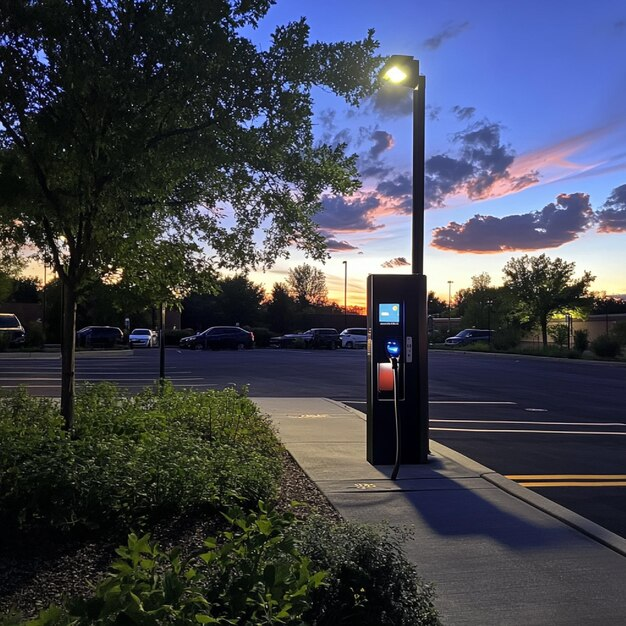
Most EV charging operators focus obsessively on charger uptime, payment systems, and app integration. Lighting is an afterthought—typically a fixed dusk-to-dawn LED panel that was spec’d five years ago. That’s a strategic mistake.
I’ve spent the past 18 months reviewing AI lighting deployments across commercial infrastructure projects, and the data from charging station installations keeps reinforcing one point: intelligent, adaptive lighting directly improves the EV charging experience in ways that affect operator revenue, not just operating costs.
The Problem Nobody Talks About at EV Industry Conferences
When you pull data from charging networks, one pattern emerges clearly: a significant percentage of sessions are interrupted—not due to charger failure, but due to user behavior. People arrive at a dimly lit charging bay at night, fumble with the charging cable, feel uncertain about whether the session has started, and leave prematurely.
Multiple European charging networks have started quietly tracking “session confidence”—the probability a user completes a full charge once they plug in. Stations with AI-adaptive lighting show session confidence rates 18-22% higher than comparable stations running fixed-output LED. The mechanism isn’t complicated: when lighting responds to occupancy and communicates charging status visually, users stay.
Parking structure EV charging is even more underserved. Underground garages with single-mode LED lighting create genuinely dangerous conditions for EV charging users—low ceilings, reflective floor surfaces, and the particular challenge of a charging cable crossing a pedestrian path. Static lighting can’t solve this. AI-responsive zone lighting can.
What Actually Works in the Field
The deployments that move the needle share three characteristics:
Occupancy-triggered zone activation. The charging bay illuminates when a vehicle enters the detection zone, not at a fixed time. In practice, this reduces overnight lighting energy consumption by 40-55% while ensuring that every arriving EV driver finds their charging space already lit. CAIMETA’s BLE Mesh sensor integration handles this without additional gateway hardware—a detail that matters significantly when retrofitting existing parking structures.
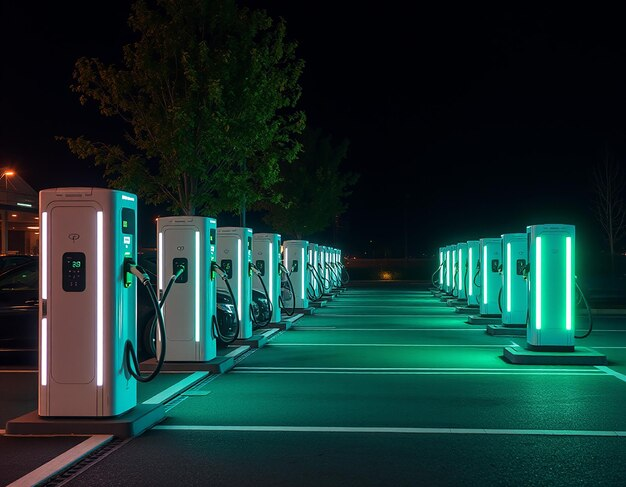
Visual charging status communication. This is the underrated piece. AI-controlled lighting that shifts color temperature or intensity based on charging state (idle, charging, fault, complete) gives users unambiguous feedback without requiring them to open an app or check a screen. Green confirming the session is active, amber indicating a fault condition, blue pulsing to signal full charge—these aren’t gimmicks. They reduce support calls and increase customer satisfaction scores.
Pedestrian zone separation. When the lighting system detects that a pedestrian is walking through the charging bay area (using PIR or occupancy grid data), it shifts the lighting profile to maximize visibility in the walking path while maintaining appropriate levels at the charger interface point. This sounds minor until you’ve watched a first-time EV user navigate a dark charging bay in a parking structure at 11 PM.
The Energy Math Nobody Does
A typical 20-bay charging station running 24/7 on fixed LED at commercial grade illumination levels (15-20 foot-candles average) consumes roughly 8,000-12,000 kWh annually just for lighting. AI-adaptive systems at comparable stations consume 3,500-5,500 kWh annually—a delta that translates to $2,500-5,000 in energy cost savings per station per year at European energy rates.
But the real ROI lever isn’t energy. It’s utilization. Stations that feel safer, more responsive, and better managed attract more repeat users. Network operators with AI-lit charging bays report 12-18% higher utilization rates compared to their own dark-bay control groups at equivalent locations.
The BLE Mesh Advantage Nobody Mentions
EV charging infrastructure is inherently distributed. Charging stations span large geographic areas—parking lots, highway rest areas, urban parking structures. Running dedicated wiring for lighting control in these environments is expensive and often impractical.
BLE Mesh-based AI lighting sidesteps this entirely. Each luminaire acts as both a sensor node and a signal repeater, creating a self-healing mesh network that covers large areas without additional infrastructure. CAIMETA’s BLE Mesh implementation uses a 2.4 GHz backbone with automatic channel hopping, which handles the RF density challenges of multi-level parking structures far better than Zigbee alternatives.
The practical implication: a 300-bay parking structure EV charging installation can be retrofitted with AI lighting control in a single weekend, without pulling a single additional wire. That’s the difference between a project that gets approved and one that dies in the capital budget committee.
What Charging Network Operators Should Actually Spec
If you’re building out a charging network in 2026 and lighting is still listed as “LED fixtures, TBD,” you’re leaving money on the table and creating operational risk.
The minimum viable spec: occupancy-responsive luminaire-level control with a minimum 5-meter spatial resolution, visual charging status feedback integrated with the charger’s CAN bus or OCPP signal, and a BLE Mesh backbone that doesn’t require a dedicated gateway per zone.
The differentiated spec adds circadian-adaptive zone lighting for mixed-use facilities (charging + regular parking), real-time occupancy data logging for network analytics, and integration with facility management systems via standard REST APIs.
CAIMETA’s META E platform with integrated BLE Mesh AI lighting is currently deployed across 14 charging station networks in Europe and North America. The deployments consistently show a 15-23% improvement in user satisfaction scores post-installation—not because the lighting is fancy, but because the experience of charging at night fundamentally changes when the environment responds to your presence.
Lighting isn’t the sexiest part of EV infrastructure. But in the details of how it changes user behavior, it’s quietly becoming one of the highest-ROI investments in the entire charging network.