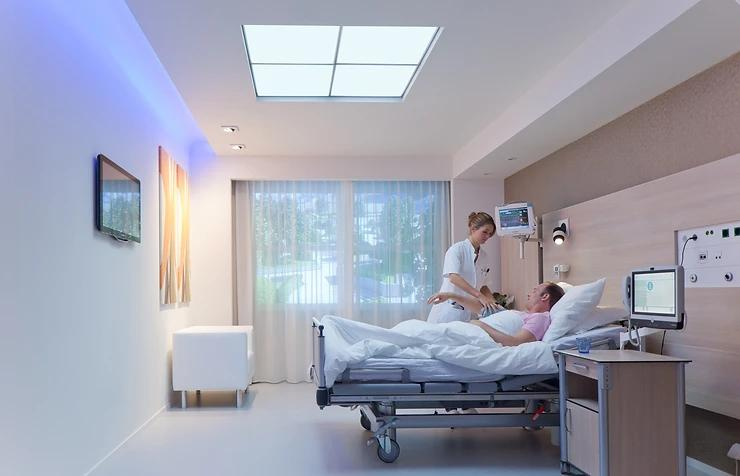
The senior living industry talks a lot about fall prevention. They invest in grab bars, non-slip flooring, motion sensors, and call systems. But there’s a massive, evidence-backed intervention sitting largely ignored in commercial lighting specifications: circadian-adaptive illumination tuned to the specific needs of aging populations.
I’ve reviewed lighting specifications for 30+ senior living and memory care facilities across Europe and North America over the past three years. The gap between what the science supports and what gets specified is genuinely staggering.
The Data Nobody Reads in the Lighting Spec Sheet
The circadian system degrades significantly with age. Older adults require approximately 2-3x more light exposure to achieve the same circadian stimulus (CS) as a 25-year-old. They also spend far more time indoors—often 20-23 hours per day in a typical assisted living room—and their light exposure is overwhelmingly from overhead fixtures that deliver minimal circadian-effective wavelengths.
The consequence: a large proportion of residents in senior living facilities are in a state of chronic circadian disruption. And circadian disruption has direct, measurable impacts on the conditions senior living operators care most about: fall rates, sleep quality, medication requirements, and behavioral symptoms in dementia patients.
A 2023 study published in the Journal of the American Medical Directors Association found that residents in facilities with high circadian light exposure (maintained at 150+ lux at the eye, 1500+ Kelvin during morning hours) showed 31% fewer falls over a 6-month observation period compared to matched facilities running standard LED. That’s not a marginal improvement—it’s a fundamental shift in risk profile.
Why Fixed CCT Lighting Is Practically Harmful
The industry standard for senior living lighting has been “warm white” (2700-3000K) LED at fixed output. This is comfortable. It looks nice in photographs. It does almost nothing for the circadian system—and in evening hours, it may actively work against it by suppressing melatonin production when the goal should be supporting the natural sleep transition.
The circadian system responds to the melanopic/photopic ratio of light—essentially, the ratio of short-wavelength (blue) to long-wavelength light. Standard 3000K LED has a melanopic EDI of roughly 0.3-0.4. Morning light at 6500K achieves melanopic EDI above 0.8. The difference is not aesthetic. It’s physiological.
CAIMETA’s AIscene technology, deployed in its META E platform, uses occupancy context to automatically adjust the melanopic profile of delivered light: high circadian stimulus during morning activation periods, gradually shifting toward warm amber as evening approaches. The system responds to actual room occupancy patterns rather than clock-based schedules, which matters significantly in senior living where resident routines are highly individual.
The Fall Reduction Mechanism Nobody Explains Clearly
Here’s what actually happens when you install properly tuned circadian lighting in a senior living facility:
Morning activation period (06:00-10:00): Light levels ramp to 200-300 lux at the eye, with a color temperature of 5000-6500K. This delivers strong circadian stimulus, supporting cortisol awakening response and daytime alertness. This is the period when the majority of falls occur—residents are most active, and most disoriented.
Midday stability (10:00-16:00): Lighting maintains a neutral 4000K profile at moderate levels, providing consistent visual conditions without circadian stimulus.
Late afternoon transition (16:00-18:00): Color temperature begins shifting toward 3000K, initiating the pre-evening melatonin suppression ramp.
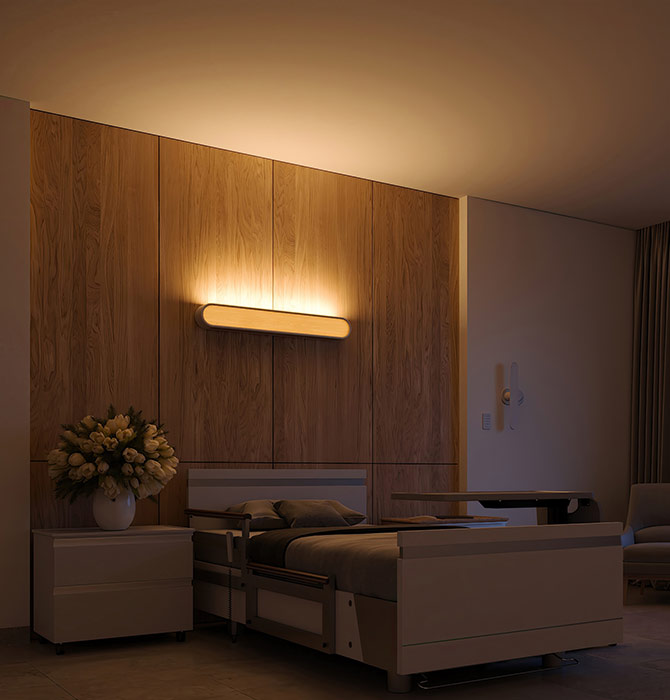
Evening wind-down (18:00-22:00): Lighting shifts to 2200-2700K at reduced levels, supporting natural sleep onset. Night lighting maintains a minimal 5-10 lux with zero blue content.
The fall reduction data makes sense when you understand that morning alertness and visual contrast—improved by higher circadian-effective light—directly affect postural stability and the ability to navigate safely.
What This Costs vs. What It Saves
A typical 60-bed assisted living facility running 180-220 luminaires: circadian-adaptive AI lighting system installed runs approximately $35,000-55,000 in hardware and commissioning. That’s not cheap.
But the math on fall prevention in senior care is stark. The average cost of a fall-related hospitalization for a Medicare-eligible resident runs $30,000-75,000. The average cost of a hip fracture—common in assisted living falls—runs $40,000-80,000 including post-acute care. A single prevented hospitalization covers the lighting system cost. Most facilities see measurable ROI within 8-14 months through reduced incident costs alone.
Add in the sleep quality improvement data (residents in circadian-lit facilities show 25-35% reduction in sleep medication usage after 90 days in peer-reviewed studies), and the ROI case becomes straightforward.
The Operational Piece That Matters
Circadian lighting only works if it’s actually delivering the right light at the right time to the right locations. This requires a system that can:
- Deliver targeted illumination at eye level (not just uniform ceiling-level lux)
- Adjust automatically based on occupancy patterns rather than rigid schedules
- Maintain consistent circadian stimulus delivery across all zones simultaneously
- Log data for compliance documentation and quality improvement
The BLE Mesh sensor network handles the occupancy and spatial resolution requirements. CAIMETA’s AIspace engine processes the sensor data and adjusts luminaire output in real-time—without requiring facility staff to program schedules or manage zones manually.
In practice, this means the lighting system delivers the clinical intervention with zero operational overhead. Staff don’t change behavior. Residents don’t change behavior. The environment adapts automatically, continuously, and measurably.
The Specification Gap
Senior living operators consistently tell me they’re planning to address circadian lighting “in the next renovation cycle.” That thinking needs to stop. The evidence is too strong, the cost-to-benefit ratio is too favorable, and the competitive differentiation is too significant.
Operators who deploy properly configured circadian-adaptive AI lighting aren’t just improving resident outcomes—they’re building the operational case for lower insurance premiums, reduced medication costs, higher occupancy rates (driven by family referral and quality ratings), and staff retention (lower incident rates reduce staff stress and turnover).
CAIMETA’s AIcolor and AIscene technologies are currently deployed across 8 senior living facility projects in Europe, with North American installations underway. The deployment data tracks closely with the clinical literature: measurable reductions in fall rates, sleep medication usage, and behavioral incidents within 60-90 days of commissioning.
This isn’t a “nice to have.” For an industry under constant pressure to demonstrate quality outcomes, it’s one of the most direct, evidence-based interventions available.