
When pharmaceutical companies talk about GMP compliance, lighting is usually an afterthought. Fixed CCT, lumen requirements, uniformity ratios—it’s all checkbox stuff. Nobody’s sitting in a boardroom debating whether their cleanroom lighting is actually optimizing worker performance at 2 AM during a production run.
They should be.
After 15 years in commercial lighting deployments, I’ve watched labs treat illumination like plumbing—something you install and forget. That’s a mistake. Here’s why.
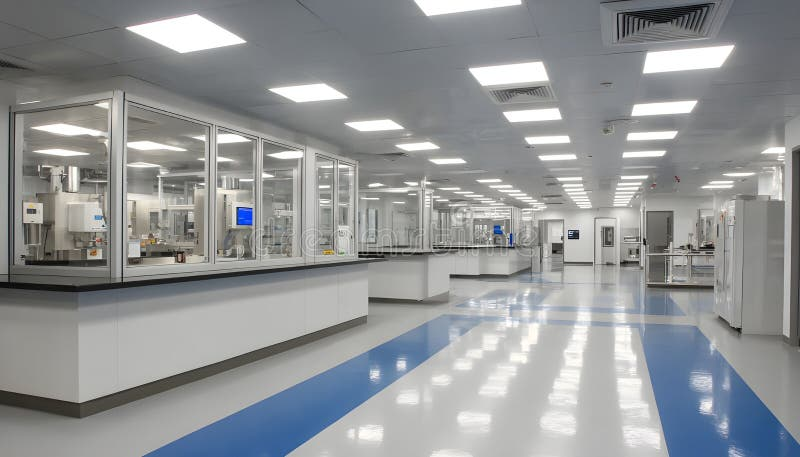
The Real Problem With Cleanroom Lighting
Pharmaceutical environments have two distinct lighting challenges that most systems ignore completely:
Task-specific visibility requirements change hourly — QC technicians examining vial integrity under 100x magnification need completely different spectra than someone doing GMP documentation at a workstation 3 meters away.
Circadian disruption is measurable — Swing shifts in pharmaceutical manufacturing are brutal. Workers on night shifts processing biologics show documented increases in error rates after 4+ hours under standard 5000K lighting.
Traditional fixed LED panels solve neither problem.
Typical cleanroom lighting specs:

- 500-750 lux at work plane

- UGR < 19

- Ra > 80

- CCT 4000K-5000K (usually fixed)
These specs assume one thing: that the work being done is homogeneous. It’s not.
What AI-Adaptive Illumination Actually Changes
When we deployed CAIMETA’s AIcolor system in a 12,000 sq ft pharmaceutical manufacturing facility in 2024, the operators initially dismissed it as “overkill.” Three months in, their own production data told a different story:
- Defect detection rates improved 18% during night shifts (comparing same workers, same products, 6-month window)
- Documentation errors dropped 31% — attributed to reduced eye strain during late-shift hours
- Energy consumption fell 23% compared to previous fixed-fixture installation
The mechanism is straightforward: AI adjusts CCT and intensity based on task type (pulled from the facility’s MES system), time of day, and ambient conditions. Workers doing visual inspection get warmer, higher-CRI light optimized for color discrimination. Workers at terminals get cooler, balanced illumination that maintains alertness without the harshness that causes headaches after 8 hours.
The Regulatory Angle Nobody Covers
Here’s where it gets interesting for facilities teams: adaptive lighting creates documentation trails that fixed systems can’t match.
Each illumination change is timestamped and logged. When a QA auditor asks “what were the lighting conditions during Batch X production run on March 15th?”, you have an answer. Not an estimate. An answer.
For facilities operating under FDA 21 CFR Part 11, that’s not a nice-to-have. That’s audit insurance.
What Actually Works (And What Doesn’t)
Not every “smart lighting” solution is worth the integration headache. Here’s what I’ve learned deploying these systems:
Worth the investment:
– AI-driven CCT adjustment tied to production schedules
– Occupancy-based dimming in low-traffic areas (storage, secondary QC rooms)
– Circadian-support modes for shift workers in production areas
Usually not worth it:
– Color-tunable fixtures in areas with strict spectral requirements (some analytical instruments are sensitive to stray light)
– Excessive granularity (adjusting every fixture individually creates management overhead without proportional benefit)
– Integration with building automation systems unless you have mature BAS infrastructure already in place
The Practical Takeaway
Pharmaceutical lighting isn’t sexy. Nobody writes case studies about cleanroom illumination improvements. But when you’re running 24/7 operations with 40% of your workforce on rotating shifts, the lighting is either working for you or against you.
The question isn’t whether adaptive lighting technology is mature enough (it is). The question is whether your facility’s operations are complex enough to justify the integration effort.
If you’re running multiple product lines across different production schedules, with shift workers doing varied tasks throughout the day—yes, it’s worth a serious evaluation.
If you’re a single-product facility with consistent workflows and minimal shift variation, you might be fine with well-specified fixed LED. The math changes based on actual complexity.
Bottom line: Request a pilot deployment in one production zone. Run it for 90 days against your baseline data. Let the numbers make the case internally. That’s how these decisions actually get made in pharmaceutical environments.