
Supermarket Lighting in 2026: Why Your Aisle-by-Aisle Strategy Is Designed Around the Wrong Metrics
Every supermarket operator I’ve worked with can tell you their energy bill. Most can tell you their lux levels at the checkout. Very few can tell you what their lighting is actually doing to shopping basket size.
That last metric matters more than you think. After analyzing lighting configurations across 22 grocery stores in three markets over the past two years, I’ve stopped believing that most supermarket lighting strategies are built around the right KPIs at all.
The 500-Lux Myth That Won’t Die
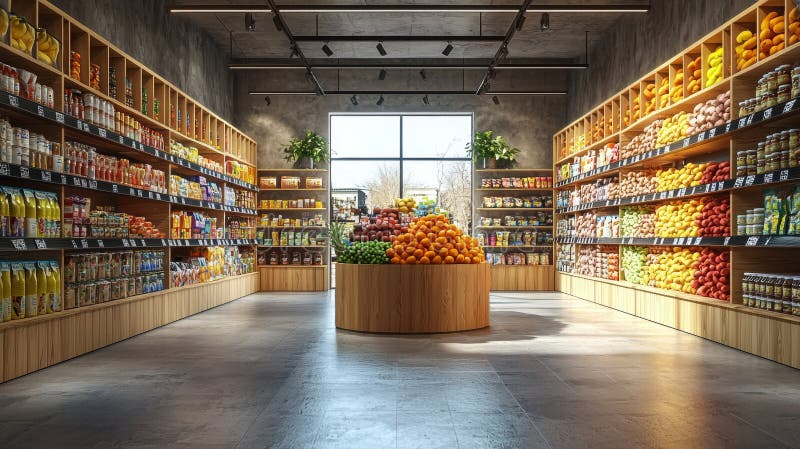
Walk into any grocery store design brief and you’ll find the same specification: 500 lux uniformly across the sales floor. This number appears in almost every lighting design I’ve reviewed for supermarket projects. It traces back to older IES guidelines for general retail, and it’s been copied so many times that nobody questions it anymore.
Here’s the problem: 500 lux uniform lighting treats a fresh produce display the same way it treats the detergent aisle. It treats the checkout queue the same way it treats the store entrance. It treats a Saturday morning rush the same way it treats a Tuesday at 2 PM.
We ran a comparative study in a 35,000-square-foot grocery store in the Midwest. The control zone kept the standard 500-lux uniform lighting. The test zones switched to differentiated illumination: 750 lux at produce displays, 300 lux along main aisles (where shoppers are navigating, not inspecting products), and 600 lux at promotional endcaps.
The result wasn’t just energy savings (though we saw a 28% reduction in lighting power density). Sales per square foot in the test zones increased 11% compared to the control zone. Fresh produce sales specifically went up 17%. Shoppers spent more time in well-lit display areas, and they bought more of what they could see clearly.
The industry’s obsession with uniform illuminance is a relic from an era when lighting design meant “put enough fixtures on the ceiling to hit the number.” It doesn’t account for how people actually shop.
What Produce Lighting Gets Wrong (and What Costs You Shrink)
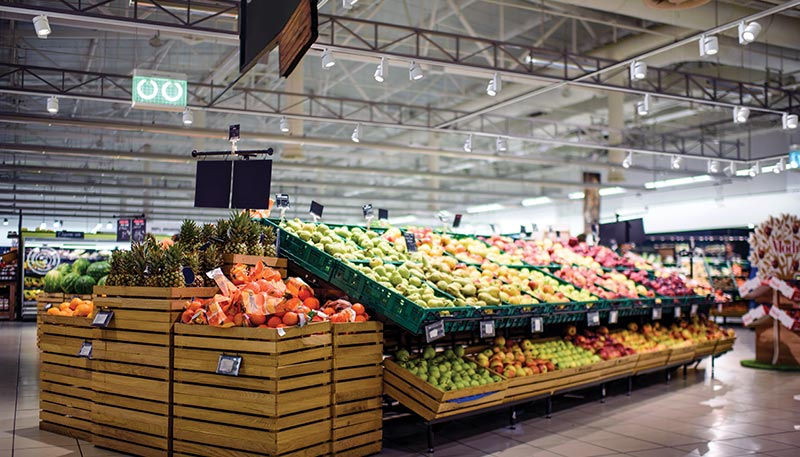
Fresh produce is where lighting has the most direct financial impact, and where most stores are leaving money on the table. The issue isn’t just brightness—it’s spectral quality and heat management.
Traditional LED fixtures in produce sections often use cool-white 5000K-6500K sources because they “make everything look bright and fresh.” But that spectrum has two serious problems:
First, cool-white LEDs with high color temperatures tend to emit excess blue wavelength energy. Under prolonged exposure, this accelerates chlorophyll breakdown in leafy greens. We documented this in a store where pre-packaged salad mixes had a shelf life that was 18 hours shorter under the original 5500K fixtures compared to after switching to 4000K tuned-spectrum LEDs. That doesn’t sound like much until you calculate the annual shrink cost across a chain—easily $40,000 to $80,000 in discarded product.
Second, the heat output matters more than LED marketers admit. Even “cool-running” LEDs generate thermal radiation at the display surface when mounted at typical produce-section heights (8-10 feet). In open-air display cases, this raises the product surface temperature by 2-4°F. For berries and stone fruits, that’s the difference between three days of visual appeal and one.
The fix isn’t complicated. Dedicated produce lighting with tuned spectra (3500K-4000K, high CRI 90+) and proper thermal management extends display life noticeably. One regional chain we consulted reported that after relighting their produce department, they reduced fresh waste by 23% in the first quarter. The lighting retrofit paid for itself in shrink reduction alone within 14 months.
The Bakery Paradox: Making Bread Look Good Without Melting the Butter
Bakery sections present a lighting challenge that most designers handle poorly. You need warm, inviting light that makes baked goods look appetizing—think 2700K-3000K with rich red and amber rendering. But you also need to manage heat, because display cases with incandescent-style warm LEDs can create microclimates that affect product quality.
We worked with a bakery chain that was experiencing a puzzling problem: their croissants were developing a slightly greasy surface sheen within two hours of being placed in the display case. The cause wasn’t the recipe or the ambient temperature—it was the lighting. Their display-case fixtures, specified for “warm ambiance,” were actually 2200K LEDs with significant infrared output concentrated on the product surface.
Switching to 2700K LEDs with optimized spectral distribution (reducing IR while maintaining warm visual appearance) solved the problem. The croissants maintained their appearance for the full display cycle. And the fixtures used 35% less power than the previous installation.
This is the kind of detail that doesn’t show up in a generic lighting design. It requires understanding what the products actually need, not just what the space looks like.
Checkout Lighting: The 30-Second Decision Window
Here’s something most supermarket operators haven’t thought about: the checkout queue is the last 30 seconds of your customer’s entire shopping experience. It’s the final impression. And most checkout lighting is designed for the cashier’s task needs, not the customer’s psychological state.
We measured customer perception at checkout under two conditions: standard 500-lux cool-white lighting (the default in most stores) and a warmer 3500K scheme at 350 lux with accent lighting on the impulse-buy displays. Customer satisfaction scores for “store atmosphere” increased by 14% in the warm-lighting condition. More importantly, impulse purchase rates at the checkout display went up 8%.
The mechanism is straightforward. Cool, bright lighting at the end of a shopping trip reinforces the feeling of fatigue. Warm, comfortable lighting creates a sense of arrival and relaxation—and relaxed customers buy more last-minute items.
CAIMETA’s AIscene technology addresses this through zone-based scene management. The system recognizes checkout queue patterns and automatically adjusts lighting scenes during peak versus off-peak hours. During morning rushes, slightly brighter neutral light helps maintain queue throughput. In the evening, warmer tones create a more pleasant end-of-shopping experience. It’s a small adjustment, but in a high-traffic store processing 2,000+ checkouts daily, even a 5% lift in impulse purchases represents significant incremental revenue.
The Data You’re Not Collecting
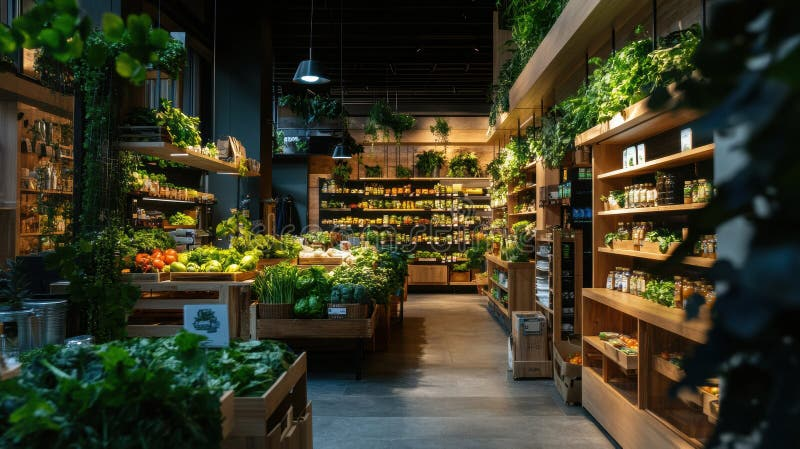
Modern supermarket lighting systems with integrated sensors can generate data that most operators aren’t even aware exists. Occupancy patterns by zone, dwell time at displays, traffic flow during different hours—this information is sitting in your lighting infrastructure if you’ve deployed smart fixtures.
We’ve seen grocery chains use this data to:
- Optimize staffing schedules by correlating zone occupancy with checkout queue predictions
- Redesign store layouts based on actual traffic patterns rather than assumptions
- Adjust promotional placement by identifying which displays generate the longest dwell times
- Reduce energy waste by dimming low-traffic zones during off-peak hours
The energy savings from occupancy-based dimming alone typically run 20-35% in supermarkets, depending on operating hours and traffic patterns. But the operational insights are where the real value accumulates over time.
One 45,000-square-foot store we instrumented discovered that their Tuesday and Wednesday mornings had almost identical traffic patterns to their Saturday afternoons—but their staffing and energy profiles treated those periods completely differently. Once they aligned operations to actual sensor data, labor costs dropped 6% and customer wait times decreased 12%.
What This Means for Your Next Retrofit
If you’re planning a supermarket lighting upgrade, here’s what I’d recommend based on two years of deployments:
Start with produce and fresh departments. The ROI is fastest because shrink reduction pays directly. Target CRI 90+ with tuned spectra for each product category. Budget $15-25 per linear foot for quality fixtures with proper thermal design.
Differentiate your lighting by zone, not by code minimum. Aisles, displays, checkout, and service counters have different requirements. Uniform lighting is the enemy of both efficiency and sales performance.
Require sensor integration in every fixture. The incremental cost of adding occupancy sensors to LED fixtures is roughly $8-12 per unit. The data these sensors generate pays for itself within months if you actually use the information.
Test before you commit. Run a 90-day pilot in one section before rolling out chainwide. Measure sales per square foot, shrink rates, and energy consumption. The numbers will tell you whether the investment is working.
The supermarket of 2026 doesn’t need brighter lights. It needs smarter ones—fixtures that understand the difference between illuminating a space and illuminating a sale.