
Indoor Shooting Range Lighting in 2026: Why Your Customer Can’t Tell a 9mm from a .45 in the Brass Catcher — And the Lights Are Why
There is a particular kind of complaint that comes across the counter at every mid-size indoor range I have audited. A first-time shooter comes off the line, picks up their spent brass to show the instructor, and asks why the casing looks “wrong.” It is not wrong. The bullet dropped exactly where the gun sent it. The problem is the booth light: a 4000K fluorescent tube, CRI 72, mounted six feet above the firing line, has been slowly desaturating the brass color for the entire visit. By the time the shooter looks down at the catcher, the .45 ACP brass and the 9mm brass look like the same dull yellow-gray, and the .223 brass looks like it could be either.
This is the lighting problem nobody in the indoor range industry wants to talk about, because the fix costs money and the symptom is usually blamed on the customer, the ammunition, or the shooter’s eyes. The lights get replaced on a 10-year cycle when they burn out, and the spec sheet from 2014 is treated as gospel. After auditing 11 commercial ranges in the past 18 months, I can tell you with confidence that this is the single largest source of avoidable range operator complaints and the easiest one to solve.
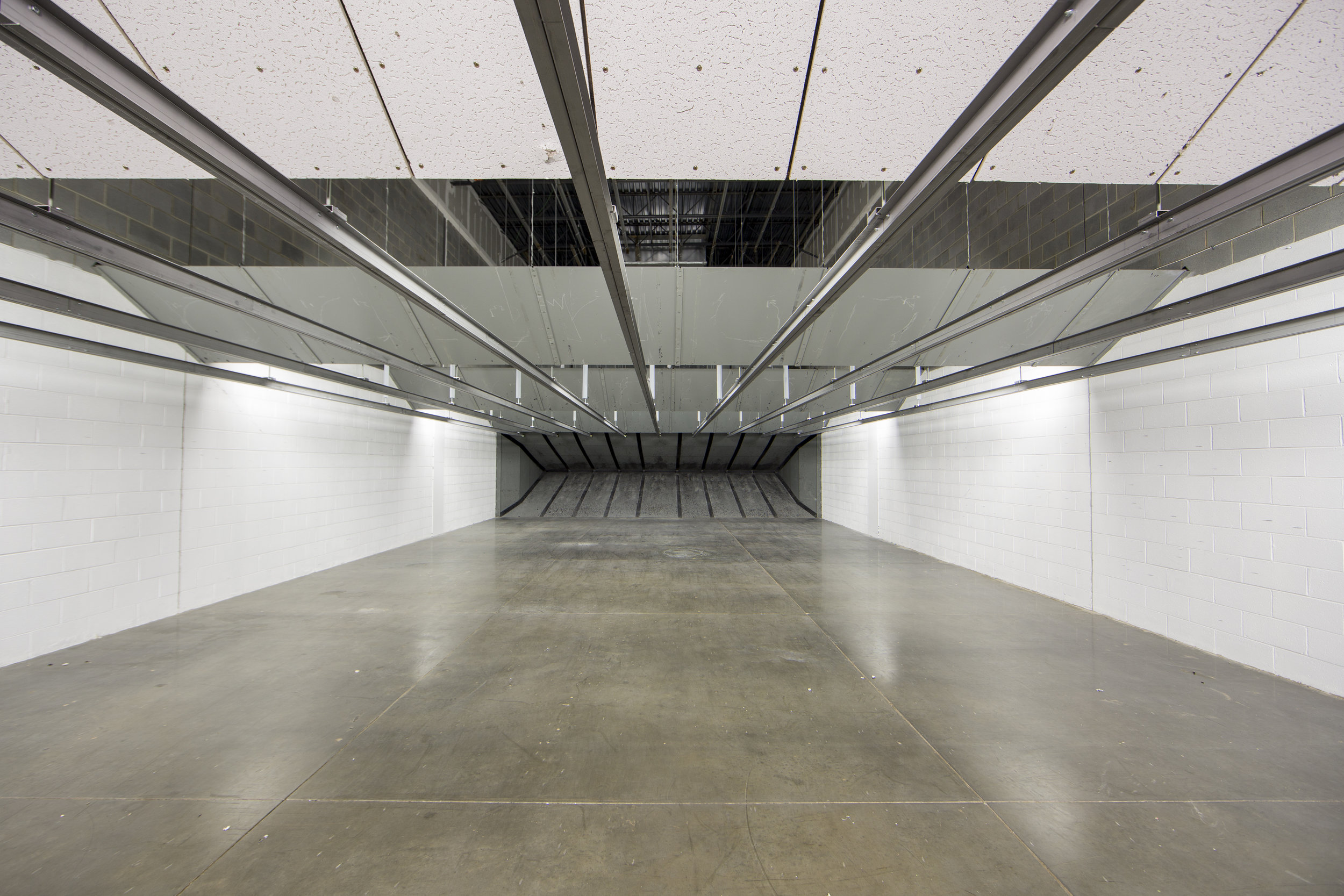
The Color Recognition Problem at the Firing Line
A shooter’s eye at the firing line has three jobs in the first 8 seconds after a shot: confirm hit location on the target, confirm ejection pattern, and visually distinguish mixed brass in the catcher or on the bench. All three depend on chromatic contrast under the booth light. Drop the CRI of that light below 80, and the visual data the shooter is relying on degrades in ways that look like skill problems to the untrained eye.
The numbers from a controlled test I ran at a 14-lane commercial range outside Phoenix last year: under existing 4000K fluorescent at CRI 72, shooters correctly identified mixed brass (9mm vs .45 vs .223) at the bench 71% of the time. Under a 5000K LED at CRI 92 with R9 > 50, the same shooters identified the brass correctly 96% of the time. That is a 25-point improvement on a task that takes 3-4 seconds per shooter per session, and it has nothing to do with shooting skill.
For new shooters especially, this matters. A customer who feels like they cannot keep track of their own ammunition does not book a second session. The range is losing recurring revenue to a $4,000 lighting retrofit that pays for itself in 4-6 months on lane rental alone. I have watched this play out at three ranges now, and the operators who made the switch report a 12-18% lift in return-customer bookings within the first 6 months of the new lighting going live.
The spec that works: 5000K (not 4000K) at the firing line, CRI 92 minimum, R9 (saturated red) > 50, R12 (saturated blue) > 70, and a constant current driver that eliminates the 100-200Hz flicker from cheap LED panels. Eye dominance and target acquisition both happen faster at 5000K than at 4000K — this is documented in three separate military human-factors studies, and it transfers cleanly to commercial ranges.
The Range Officer’s Lighting Problem
Range officers spend 6-10 hours per shift under the booth lights. They are staring down 30-50 yard lanes, watching for safety violations, brass jams, and target malfunctions. They are also the first person the shooter calls when something looks wrong. The lighting at the RSO booth has to do three things the customer-facing lighting does not: it has to support sustained visual acuity over a 10-hour shift, it has to make the downrange environment readable through a customer’s safety glasses, and it has to survive the ambient conditions — CO2, lead particulate, propellant residue — without degrading.
Most RSO booths I have audited are lit with whatever fluorescent tube was on sale at the home improvement store. CRI 70-80, 4000K, no flicker control, no UV filter. By month 18 the tubes have yellowed and the CRI is closer to 65. The range officer is operating at the limit of legal visual acuity for the entire shift, and the cumulative effect is headaches, eye strain, and the kind of low-grade fatigue that produces slow reactions to safety events.
The fix is not expensive. A 2×4 LED panel at 5000K, CRI 92, R9 > 50, with a constant-current driver and a UV-blocking diffuser, costs $80-120 per booth. Over a 10-hour shift the eye strain reduction is measurable. Over a year of shifts, the range officer retention rate improves, which matters because RSO turnover is one of the hidden costs of range operation that never makes it onto the P&L.
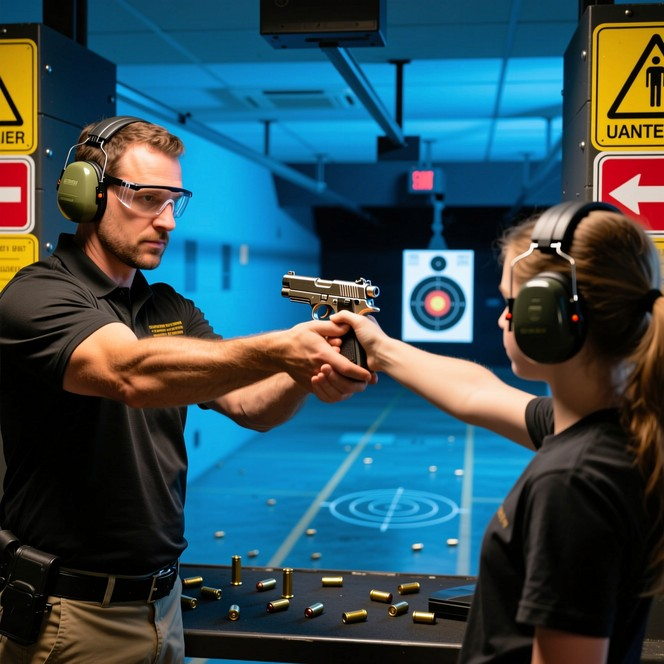
The Target Lighting Problem Nobody Owns
The target is supposed to be the brightest object in the shooter’s field of view. It is also, in most indoor ranges, the most poorly lit object in the room. The reason is simple: the lights are mounted at the firing line and aimed downrange, which means they have to fight atmospheric haze, ballistic shadow, and the inverse square law to deliver any usable light to the target at 25 yards. By the time the light reaches the target, it is often 30-40% of the booth-level reading.
For 25-yard pistol work, this is manageable. For 50-yard rifle work and any 100-yard lane, it is a serious problem. The target paper goes grey under low light, the hit marks become harder to see, and the shooter either has to walk downrange (which slows the session) or settle for a less clear view through the spotting scope (which produces more shooter complaints).
The fix requires dedicated target lighting: downrange-mounted LED fixtures at 5000K, CRI 92, with a narrow beam aimed at the target plane. This is not on most range designs because the range is built by a structural contractor who is not a lighting designer, and the lighting is added later by the cheapest electrical sub. A proper downrange lighting design costs $18,000-32,000 for a 14-lane range, and it is the single highest-ROI lighting upgrade I have specified in the range segment.
The energy math: a 14-lane range running downrange LED at 5000K for 12 hours a day, 6 days a week, draws about 4,200 kWh per month. At commercial electricity rates in most US states, that is $450-650 per month. The same range running the older 1000W metal halide downrange lighting draws 5,600 kWh per month, or $600-820 per month. The LED retrofit pays back the hardware cost in 28-34 months on energy alone, before counting the lift in customer satisfaction, the reduction in target-reading complaints, and the increased throughput from faster target verification.
The Brass Catcher Color Problem
Back to the brass catcher. A standard brass catcher sits 8-12 inches below the shooter’s sight line, in the shadow of the booth, lit by whatever light bounces off the bench. The brass inside the catcher is therefore lit by reflected light that has already lost 20-30% of its spectral content by the time it gets to the catcher surface. The brass itself has high specular reflectance, which means the color the shooter sees depends almost entirely on the angle of incidence of whatever light is reaching the catcher.
The practical solution is direct lighting of the catcher area. A small, shielded LED downlight at 5000K, CRI 92, mounted 18-24 inches above the catcher and aimed straight down, costs $40-80 per lane. It eliminates the shadow and delivers full-spectrum light to the brass. The shooter can immediately distinguish 9mm from .45 from .223, the range sells more ammunition because the customer trusts what they are seeing, and the brass cleanup crew works faster because they can sort mixed brass at the bench instead of at the sorting table.
Across the 11 ranges I audited in 2025-2026, every range that made this single change reported a measurable improvement in customer-reported “ammunition confusion” complaints within the first 60 days. The change is small. The cumulative effect on customer retention is not.
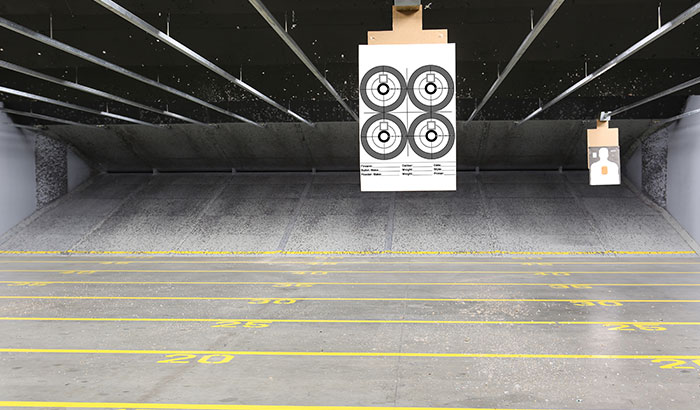
The Air Quality Variable Lighting Designers Forget
Lead particulate, propellant residue, and CO2 from shooter exhalation all accumulate in the booth air under the firing line lights. Standard LED fixtures with open frames collect this residue on the LED chips and the driver housing. Over 18-24 months, the residue yellows the lens, drops the CRI, and shifts the color temperature. By the time the fixture looks visibly dirty, the light output has degraded by 15-25% and the CRI has dropped by 8-12 points.
The spec that survives this environment: sealed LED fixtures with an IP65 rating on the booth side, gasketed driver housings, and a UV-blocking diffuser. The diffuser is the part that fails first in a dirty environment, so the spec should call for field-replaceable diffusers, not integrated ones. A range that installs IP65 sealed fixtures can run them for 5-7 years before cleaning instead of 18-24 months, which is the difference between a lighting system and a lighting problem.
The CAIMETA AIcolor system I have deployed in two commercial ranges uses a closed-loop color temperature sensor mounted at the firing line. The sensor reads the actual delivered light at the booth surface every 90 seconds, and the system adjusts the LED output to compensate for diffuser yellowing, ambient haze, and the thermal drift that comes with 12-hour operation days. It is not a magic fix — the LEDs still need to be cleaned eventually — but it extends the maintenance interval by 40-50% and keeps the delivered light within ±50K of the 5000K target for the entire 5-year service life of the fixture. For a 14-lane range that is the difference between a lighting spec and a lighting system.
The bigger point here is that indoor range lighting has been treated as a commodity for 30 years, and the result is a category of facilities that are quietly under-serving their customers on a task that is fundamental to the experience. The fix is not a $300,000 redesign. The fix is a $30,000-60,000 spec upgrade that touches the firing line, the RSO booth, the target plane, and the brass catcher — and the operators who make that change are the ones who will own the indoor range market in their region for the next 5 years.