
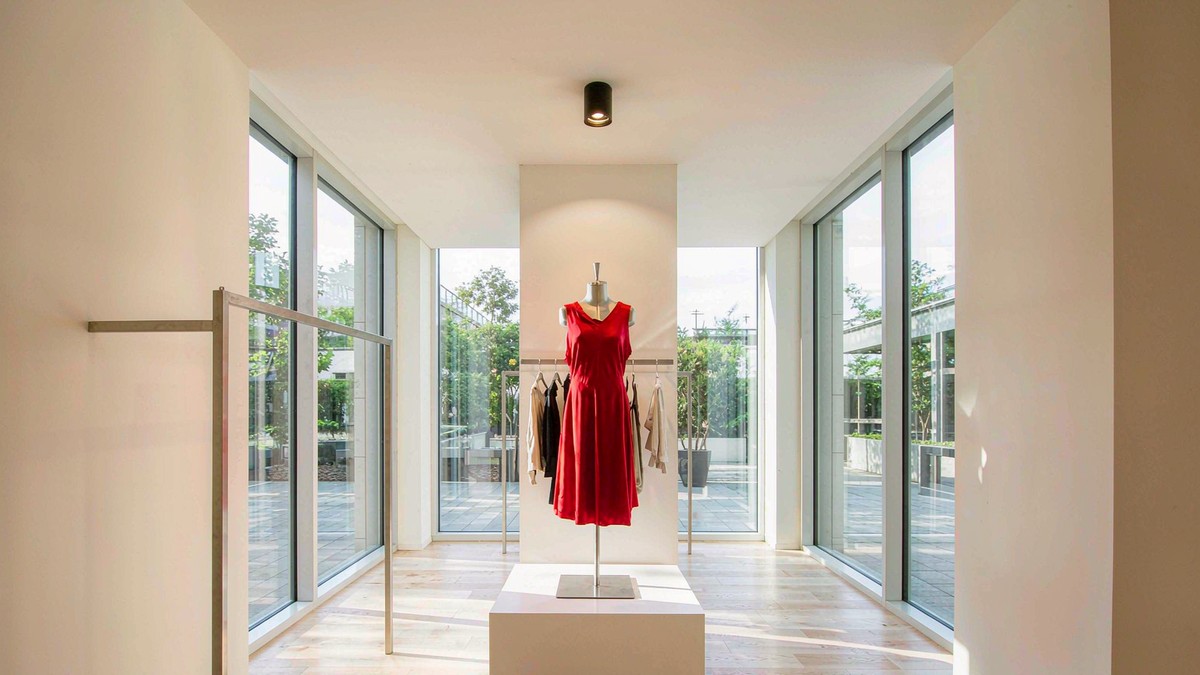
Answer first: an anti-glare downlight that actually works in a retail store is defined by three hard numbers — a 50° shielding angle, a 52° total cut-off, and flicker control of SVM<0.4 / Pst<1 / <3% flicker percentage (IEEE 1789). The CAIMETA Lulu G2 AI Smart LED Downlight hits all three while still delivering 750 lm from just 12W at CRI 90, with an AI color sensor that adapts the light spectrum to the merchandise below it — all inside a 3.75-inch (95 mm) ceiling cut-out. That combination is why it has become our default answer for fashion stores, jewelry counters and galleries where the ceiling must disappear.
Glare is the most expensive lighting mistake in retail because it is invisible in the showroom. The downlight you approved under a warehouse ceiling looks perfect on the sample wall. Installed at 3 meters over a white blouse on a dark wood table, it becomes a black hole with a bright ring — and your customer squints at the ceiling instead of the price tag. This guide breaks down what “anti-glare” actually means in 2026, which numbers belong in your purchase order, and how the CAIMETA Lulu G2 solves the problem optically instead of cosmetically.
What “anti-glare” actually means (and what most spec sheets hide)
Glare in a downlight comes from one source: the bright LED chip and its inner reflector being directly visible to a person standing in the store. Every honest anti-glare design attacks this with geometry, not marketing:
- Shielding angle. The angle at which the reflector or baffle blocks direct view of the light source. Below roughly 30° of shielding, a seated or distant customer sees straight into the LED. Professional retail and hospitality practice calls for 40–50°; commodity downlights often ship with no meaningful shielding at all.
- Total cut-off. The aggregate angle above which no light source or bright reflector surface is visible. The Lulu G2 is specified at 52° total cut-off — meaning from 52° and steeper viewing angles, the emitter is fully hidden.
- Darklight optics. A reflector geometry that directs all emitted light downward through a narrow exit aperture, so the visible aperture reads dark while the floor stays bright. This is why a genuinely low-glare downlight can look “off” from the side and still hit 1700 cd of center-beam intensity.
- Color and finish of the baffle. A white inner reflector bounces light — including glare — back into the eye. A matte black metallic baffle absorbs stray rays. The Lulu G2 uses a flexible double black metallic baffle with a 50° shielding angle as standard.
If a supplier’s datasheet quotes none of these numbers, the word “anti-glare” on the box is decoration. Ask for the shielding angle and the cut-off angle in writing before the PO.
Why glare quietly costs retail sales
Glare does not just annoy — it changes shopping behavior. Under high-glare downlights, customers spend less time looking at products at eye level, perceive colors less accurately because their pupils are partially contracted against the fixture, and photograph the store in a way that flattens merchandise. In fitting rooms and jewelry counters the effect doubles: the customer is close to the light source, so the shielding angle matters more than raw lumen output.
There is also a second, less-known cost: flicker. Downlights with poor drivers produce temporal light modulation that shoppers rarely notice consciously but experience as eye fatigue and headaches after 15–20 minutes in the store — enough to shorten dwell time. This is why the Lulu G2’s driver is certified flicker-free according to EEP 2024 (SVM<0.4, Pst<1) and IEEE 1789 (<3% flicker percentage): anti-glare that stops the visible light from hurting, and flicker control that stops the invisible light from tiring.
The CAIMETA Lulu G2: anti-glare by optics, intelligence by sensor
The Lulu G2 is CAIMETA’s AI Smart LED Downlight in the Kinglumi AIColor family — the same adaptive-spectrum platform that powers our Kano AI track lights. Four features do the anti-glare work:
- Flexible double black metallic baffle with a 50° shielding angle — field-changeable, magnetically held.
- Darklight optics delivering the highest visual comfort at a 52° total cut-off.
- Interchangeable lenses at 15°, 24°, 36° and 50° beam angles — swap the optic, keep the fixture.
- ±25° vertical tilt, so the anti-glare aperture stays aimed at the merchandise even when the accent angle is steep.
Then the intelligence layer: a built-in color sensor reads the merchandise below and the AI algorithm adapts the light spectrum so the goods present at their best — richer reds over leather, cleaner whites over garments, warmer tones over wood. The Lulu G2 runs the 2700K–6500K adaptive range (W+RGB platform), and offers RGB-W and tunable white versions, with wireless control over CAIMETA BLE Mesh controllers from iOS and Android. You can read how the adaptive spectrum engine works in our AIColor smart lighting overview.
Lulu G2 vs Lulu Uni G2: full specifications
Both versions share the same trimless spring-mount housing, the same interchangeable optics and the same anti-glare baffle system. The difference is the spectrum platform: the G2 carries the full W+RGB adaptive engine, the Uni G2 carries the W+CW (tunable white) engine with slightly higher output.
| Specification | Lulu G2 | Lulu Uni G2 |
|---|---|---|
| Sensor | One AI color sensor | One AI sensor |
| Dimming / control | Bluetooth mesh | Bluetooth mesh |
| Installation | Spring trimless | Spring trimless |
| Wattage | 12 W | 12 W |
| Luminous flux | 750 lm | 780 lm |
| Max. intensity | 1700 cd | 2200 cd |
| CCT | 2700K–6500K (W+RGB) | 2700K–6500K (W+CW) |
| Ceiling cut-out | 3.75 in (95 mm) | 3.75 in (95 mm) |
| Beam angles | 15° / 24° / 36° / 50° interchangeable | 15° / 24° / 36° / 50° interchangeable |
| Finishes | Texture white / texture black | Texture white / texture black |
Shared across both versions: CRI 90, PF 0.9, 220–240VAC 50/60Hz input with a remote driver, ±25° vertical tilt, 52° total cut-off with 50° black baffle shielding, and flicker-free compliance per EEP 2024 (SVM<0.4, Pst<1) and IEEE 1789 (<3%). For North American projects, the Lulu G2 is offered as remodel, new-construction non-IC, and new-construction IC (on request) installation kits.
How the Lulu G2 compares to a commodity “anti-glare” downlight
| Checklist item | Typical commodity 3–4″ downlight | CAIMETA Lulu G2 |
|---|---|---|
| Shielding angle | Often none or ~30° | 50° (double black metallic baffle) |
| Total cut-off | Open or unspecified | 52° |
| Inner reflector | White (bounces glare) | Darklight black optics |
| Beam angle | Fixed | 15°/24°/36°/50° field-changeable lens |
| Spectrum | Fixed CCT | AI adaptive, 2700K–6500K, W+RGB |
| Flicker | Rarely specified | SVM<0.4, Pst<1, IEEE 1789 <3% |
| Tilt | Fixed, vertical only | ±25° vertical |
| Color rendering | CRI 80 typical | CRI 90 (TM-30 reports on request) |
One note on color data: we publish CRI 90 for the Lulu G2 platform and can supply TM-30 Rf/Rg reports for project tenders. If color fidelity is your deciding factor, read our TM-30 buyer’s guide first — it explains why a single CRI number no longer tells the whole story, and which figures to request from any supplier.
Where the Lulu G2 earns its ceiling hole
The catalogue’s recommended applications are restaurants, hotels, fashion stores, cafes, bars, retail stores, hospitality spaces, museums and art galleries — and the pattern is always the same: viewers close to the light source, merchandise that must look expensive, and a ceiling that should stay quiet.
- Fashion retail: 15°–24° optics at 1–1.2 m spacing for runway-level accenting on mannequins; 36°–50° for general wash. The adaptive spectrum shifts automatically between denim (cool, crisp) and camel wool (warm, deep).
- Jewelry and watches: the 1700–2200 cd center intensity puts a tight, high-contrast pool on the counter while the 52° cut-off keeps the fixture invisible from the customer’s seat.
- Hospitality and galleries: 2700K scenes over dining, 3500K over art — set once, controlled from the BLE Mesh app, changed per season without touching a ladder.
Because the lens and the magnetic baffle are both field-changeable, a store refresh does not require new fixtures: swap 24° optics for 15°, deepen the baffle, re-aim with the ±25° tilt, and the same downlights cover a completely different floor plan.
Frequently asked questions
1. What shielding angle counts as genuinely anti-glare in retail lighting?
Professional practice calls for 40–50° of shielding angle for fixtures installed over counters, tables and anywhere customers come within two meters. The Lulu G2 specifies 50° via its double black metallic baffle plus a 52° total cut-off, which covers both standing and seated sightlines. Anything below 30° will put the LED directly in a customer’s view.
2. Is 12W and 750 lm enough output for a retail store?
Yes — because retail lighting is designed by intensity and spacing, not raw watts. The Lulu G2’s 1700 cd center-beam intensity (2200 cd for the Uni G2) delivers strong accent pools; at 12W it also keeps air-conditioning loads and energy bills down. Typical fashion-store layouts run 15°–24° optics at 1–1.2 m spacing for accents and 36°–50° optics at 1.5–2 m spacing for ambient wash.
3. Can I change the beam angle after installation?
That is one of the G2’s core design features. The lenses at 15°, 24°, 36° and 50° are field-changeable, and the black baffle is magnetically held, so both can be swapped from below the ceiling without removing the fixture. Plan optics per zone during commissioning and re-optimize free of charge at the next store refresh.
4. What ceiling cut-out does the Lulu G2 need, and can it be trimless?
The Lulu G2 requires a 3.75-inch (95 mm) ceiling cut-out and installs with a trimless spring mount, so the plasterboard edge is the only visible trim — the fixture itself reads as a clean dark aperture. For North American projects, remodel, new-construction non-IC and new-construction IC (on request) housing kits are available, with the driver mounted remotely.
5. Does “anti-glare” mean the downlight is dim?
No, and this is the most common misconception. Anti-glare is achieved with darklight optics: all light exits through a controlled aperture aimed where you need it, while the visible opening reads dark. The Lulu G2 still delivers 1700 cd of center intensity at CRI 90 — brighter on the merchandise than most open-faced 12W downlights, precisely because no light is wasted into the customer’s eyes.
6. Which spectrum versions are available, and how do they compare with the tunable-white model?
Three builds share this platform: the Lulu G2 with the full AI adaptive spectrum on the W+RGB engine (2700K–6500K), the Lulu Uni G2 with AI-driven tunable white on the W+CW engine (780 lm, 2200 cd), and RGB-W and tunable-white configurations for projects with special color needs. If your priority is merchandise-adaptive color rendering, choose the G2; if it is pure circadian CCT control, the Uni G2 is the match. Both are managed from the same CAIMETA Bluetooth mesh app.
The bottom line
“Anti-glare” is not a trim depth — it is a set of published numbers: 50° shielding angle, 52° total cut-off, SVM<0.4, Pst<1. The CAIMETA Lulu G2 publishes all of them, then adds the part commodity downlights cannot: an AI color sensor that adapts the spectrum to the merchandise, interchangeable 15°–50° optics, and a 3.75-inch trimless cut-out that disappears into the ceiling. Full specifications and configurator options are on the Lulu AI downlight product page; for TM-30 reports, IC housing options or a layout review, contact the CAIMETA team and tell us the store type, ceiling height and mounting centers — we will return an optics plan, not a quote for boxes.