
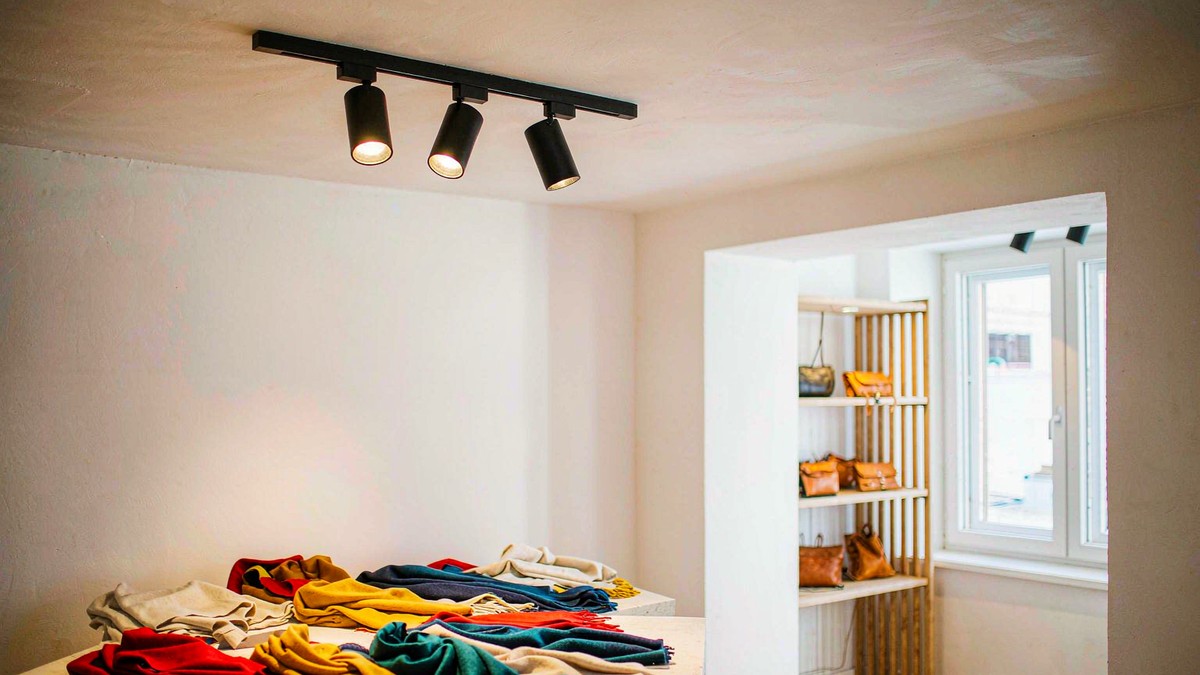
An adaptive spectrum luminaire does not “know” colour temperatures. It stores a table of 1,000 target chromaticity points and mixes four LED channels — warm white, red, green and blue — until the delivered spectrum lands on the point that matches the merchandise in front of it. That one mechanism is why a single CAIMETA Kano Magic 35 W track spotlight can hold Ra >95, Rf >97, Rg >100 and a Gamut Area Index of about 110 at 2,500 lm, instead of forcing a retailer to stock six fixed-CCT variants and a drawer of colour filters.
This is the part of the AI lighting story that usually gets skipped. Most articles explain that the light changes colour to flatter the product. Very few explain how the change is generated, which is the only part a specifier can actually verify. Below is the mechanism, in the order it happens inside the fixture, followed by the numbers the catalogue publishes and the checks that separate a working installation from an expensive demo.
How a spectrum is generated: four steps, in order
Strip away the app and the marketing and there are four steps in a CAIMETA AIColor fixture. Every claim of “1,000 spectra” resolves to these:
- Sense. A colour sensor behind the lens reads the light reflected off the object in its beam — not the room, the object. In the catalogue’s own wording, the sensor detects the product only when the light is turned on.
- Classify. Firmware compares that reading against a commodity reference set — fabric, leather, produce, baked goods, metal — and derives a target CCT and chromaticity coordinate pair.
- Mix. The driver sets current ratios across four channels on one COB: a warm-white phosphor channel for fidelity, plus saturated red, green and blue dies for gamut.
- Trim. The sensor re-reads the result and nudges the ratios until the delivered point matches the target. This is a closed loop, not an open-loop preset.
Everything else — the four operating modes, the group behaviour, the phone app — is interface layered on top of those four steps. If a supplier cannot describe their product in these terms, they are selling a preset wheel with better copywriting.
Why a CCT dial cannot produce a spectrum
Tunable white moves a fixture along the blackbody locus. That is one degree of freedom: warm to cool, and back again. Two fixtures sitting at 3000 K can render the same red handbag completely differently, because CCT says nothing about how much energy sits at 620–660 nm or whether there is a dip at 480 nm. This is exactly why the colour metrics of the last five years exist — Rf and Rg under TM-30, plus R9 and GAI. They describe the shape of the curve, not one number sitting on it.
The three traditional answers to this gap all share a weakness:
- Gels and filters are subtractive. You lose lumens to gain a hue, the filter fades under heat, and changing the effect needs a ladder and a stock of gels.
- Fixed CCT SKUs are additive but discrete. Six variants means six spectra, and the one the new collection needs is usually the one nobody ordered.
- RGB-only fixtures buy gamut at the cost of fidelity. Saturated primaries lift Rg, but a three-channel mix struggles to hold Ra 95 through the whites, so cream cashmere and skin tones go slightly plastic.
Adaptive spectrum is the fourth answer: keep the primaries for gamut, keep a warm-white channel for fidelity, and choose the mix per object rather than per purchase order.
Inside the light engine: W + RGB on one COB
CAIMETA AIColor runs on a W+RGB COB — one chip-on-board package carrying a warm-white phosphor emitter alongside red, green and blue dies, driven as four independent channels. The catalogue calls this a W-RGB COB LED solution that broadens the lighting spectrum; the mechanism is more specific than that. The phosphor channel supplies the broad, continuous background that fidelity metrics reward, while the R/G/B dies push energy into the narrow bands where phosphors are weakest: deep red for R9, cyan-green for Rg.
Name the trade-off honestly, because it is real: efficacy. Four channels with saturated dies cost lumens per watt against a single 90 CRI phosphor channel. Which is why the output figures matter. Kano Magic is published at 35 W, 2,500 lm and 14,600 cd at a 36° setting, with interchangeable 24°/36°/50° optics and a shielding angle under 30°. Those numbers sit in the same class as a conventional 35 W retail spotlight, so the adaptive engine is not a low-output compromise you accept in exchange for colour tricks.
What “1,000 chromaticities” actually means
It means 1,000 calibrated target points in chromaticity space, each with a stored channel-ratio recipe. It does not mean 1,000 products, and no store uses 1,000 of them — a real installation settles on ten or twenty and revisits them when the collection changes. The catalogue states that AIColor has enabled auto-sensing of 1,000 different lighting chromaticities, with infinite customisation available through DIY formulas. That is the honest way to describe it: a finite table, plus interpolation between the points.
| Method | How the spectrum changes | Granularity | What you stock | Where it fails |
|---|---|---|---|---|
| Tunable white (CCT only) | Slides along the blackbody locus | 2–3 presets or a slider | 1 fixture, several presets | Same CCT, different colour; no control of R9 |
| Colour filter / gel | Absorbs unwanted wavelengths | One filter, one effect | 1 fixture plus a filter drawer | Loses lumens, fades, needs a ladder to change |
| Fixed CCT SKUs | Swap the whole fixture | One spectrum per SKU | 4–6 variants per model | Wrong SKU on site, dead stock at season end |
| Adaptive spectrum (AIColor) | Mixes four channels to a target point | 1,000 stored points plus DIY | 1 fixture | Needs sensor line of sight; higher cost per head |
The commercial consequence sits in the last row. Because the points are stored rather than manufactured, the same head can be re-aimed at a new colour story when the autumn collection lands. Nobody re-lamps the denim wall, and nothing goes obsolete because the buying team changed its mind.
The four ways to drive the loop
The catalogue documents four operating modes, and the differences matter more than the copy. They are also the part most specifiers get wrong at commissioning:
- Auto-mode (default). The sensor detects the product when the light is switched on and adjusts CCT and chromaticity automatically. It ships active, so the basic behaviour works without anyone opening an app.
- Take a Picture. The same adjustment, triggered manually from the app. Crucially, once used, auto-mode is disabled until it is re-activated — a detail that catches out teams who demo a fixture and then wonder why a whole rail stopped adapting.
- Primary & Secondary. One sensor-equipped fixture is set as primary and the rest of the group follows its spectrum. This is the cost lever: you buy sensors on perhaps one head in six and still get a visually uniform wall.
- Colour Selection / DIY. Build a formula, save it as a colour code, share it to other devices and other stores. This is how a chain with forty shops keeps them looking like one shop.
The numbers, and what each one buys you
Two sources publish figures, and they are not the same kind of figure. The AIColor technology page states typical values for the platform; the Kano Magic datasheet states minimums for that specific SKU. Read them that way, and ask for the test report of the variant you are actually buying.
| Metric | CAIMETA figure | Typical 90 CRI retail LED | What it controls |
|---|---|---|---|
| CRI (Ra) | 95 | 90 | Average fidelity across eight pastel samples |
| R9 | ~95 | Often 50–60, frequently unstated | Saturated red: leather, tomato, lipstick |
| Rf (TM-30) | >97 on the Kano Magic datasheet | 85–90 | Fidelity across 99 real-object samples |
| Rg (TM-30) | ~110 technology typical; >100 per Kano Magic SKU | ~95–100 | Gamut: saturation and colour separation |
| GAI (BB15) | ~110 | In the 50s, per the catalogue | Colour area against the reference illuminant |
| Stored spectra | 1,000 chromaticities | n/a — fixed spectrum | Re-targeting without new hardware |
The GAI row is the one worth pausing on. An index in the 50s against roughly 110 is not a marginal difference in how a shop looks — it is the difference between colours reading as separate and colours collapsing into one soft grey-beige mass. It is also the part a phone camera on the shop floor will show you in three seconds.
What it changes on the shop floor
Take a worked example, labelled as an example rather than a quote from anyone’s project: an apparel brand with 12 stores, 18 track heads per store, and six fixed CCT variants of the same head. That is 1,296 heads committed to six stock buckets, and at season end the surplus is always the wrong bucket. Collapse the range to one adaptive SKU and the same 1,296 heads cover every colour temperature the merchandising calendar asks for.
There is a second, quieter saving. Re-merchandising stops being a lighting project. When a jewellery counter moves to the front of the store, the fixtures above it do not need re-specifying — they need pointing and leaving in auto. And with primary/secondary grouping the sensor count stays low: on a typical wall of six to ten heads, one sensor-equipped primary pulls the whole group into a single spectrum.
Seven checks before you specify one
- Sensor line of sight. The sensor reads the object, not the room. Glass cases, deep shelving and 4 m mounting heights all degrade that reading. Ask for sensing distance and field of view — neither appears on a typical cut sheet.
- Behaviour at switch-on. Detection happens when the fixture powers up. Confirm what happens on a dimmed circuit, and with strong daylight falling across the display.
- Mode interaction. Take a Picture disables auto-mode until re-activated. Write the commissioning sequence down, or one demo leaves forty heads in manual.
- Group architecture. Primary/secondary needs a control link. Confirm the protocol (BLE mesh on the CAIMETA platform), the maximum group size, and what happens when the primary loses power.
- Drift over life. Ask for LM-80 data and whether the loop re-references the sensor. A closed loop can compensate for output depreciation only if somebody told it to.
- Metrics per SKU, not per platform. Get Rf, Rg and R9 for the exact variant, at the exact CCT you will run, from a test report rather than a technology page.
- Aiming is still your job. An adaptive spectrum does not rescue a 36° beam pointed at the floor between two shelves. Photometrics — 14,600 cd at 36° on Kano Magic — still decide whether the product is lit at all.
Where adaptive spectrum lighting still loses
Four honest limits, because a specifier who only hears the upside stops trusting the source:
- Cost per head. Sensors and four-channel drivers are not free. The payback is inventory and re-merchandising, not watts saved.
- Anything behind glass. Enclosed cases need a remote sensor or a fixed recipe; the on-board sensor sees the glass, not the object.
- Anything that must not move. Conservation-grade displays want a locked spectrum. Here the right answer is a fixed formula with auto disabled — which the platform supports, but a careless commissioning will not default to.
- Pure efficacy projects. If the only number on the scorecard is lumens per watt, a single-channel 90 CRI fixture still wins, and pretending otherwise damages credibility.
Frequently asked questions
How many spectra can an adaptive spectrum spotlight actually produce?
The CAIMETA AIColor platform stores 1,000 calibrated chromaticity points, each with its own channel-ratio recipe, and the catalogue describes infinite customisation through DIY formulas that interpolate between them. In practice a store runs ten to twenty — enough to cover a full seasonal colour calendar without new hardware.
Does the light change colour while customers are watching?
No. The loop runs at switch-on and when re-triggered in the app, then holds. Auto-mode re-detects the product on power-up, so the sequence a shopper experiences is: lights come on, spectrum settles, and stays there for the trading day.
Is adaptive spectrum the same thing as tunable white?
No, and the distinction is the whole point. Tunable white moves colour temperature along the blackbody locus — one degree of freedom. Adaptive spectrum moves the chromaticity coordinate and the shape of the spectral power distribution together, which is what changes R9 and Rg rather than just warmth.
What colour-rendering numbers come with it?
The AIColor technology page publishes CRI 95, R9 ~95, Rg ~110 and a GAI (BB15) of ~110, against standard 90 CRI LEDs the catalogue places in the 50s. The Kano Magic 35 W datasheet publishes minimums of Ra >95, Rf >97 and Rg >100 for that specific SKU.
Can one sensor control a whole rail?
Yes, through Primary & Secondary grouping: one sensor-equipped fixture is set as primary and the others follow its spectrum. That is the standard way to keep sensor count — and cost — down on a long wall while keeping the lighting visually uniform.
Will it work on the track I already have?
It depends on the adapter, not the light engine. Kano Magic ships in an EU 4-wire 3-circuit version, a JP 2-wire 3-circuit version and a US H/D adapter version, so the answer is decided by which rail is on your ceiling — check that before you check the CRI.
The bottom line
Adaptive spectrum lighting is not a smarter CCT dial. It is a stored target table plus a closed loop over four channels, and once you hold it to that description the evaluation gets simple: three numbers for the exact SKU (Rf, R9, Rg), one behaviour (what the sensor can actually see), and one cost (sensors per rail, not per head). Get those right and a single CAIMETA Kano Magic replaces a wall of fixed-CCT variants without trading away output or comfort. Get them wrong and you have bought a very well-made spotlight that happens to change colour.
CAIMETA is the AIoT lighting brand of Kinglumi, and both sides of that claim are published: the AIColor technology overview and the per-SKU datasheets. If you are specifying a store, a showroom or a chain refresh, send the layout and the merchandise mix — the useful reply is a photometric plan plus a spectrum schedule for each zone, not a brochure.