
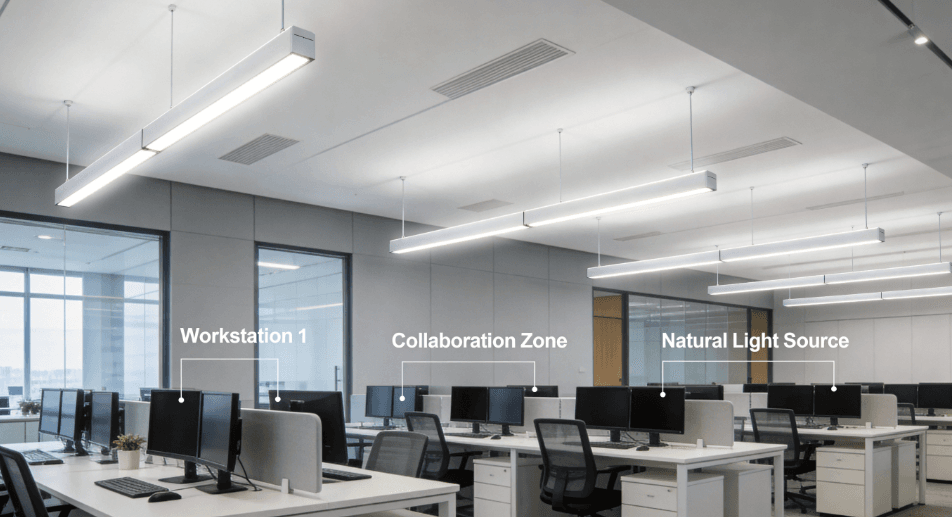
Office Lighting Design Guide 2026: Complete Standards, Technologies & Best Practices
From lux levels to circadian design: Everything commercial lighting professionals need to know about modern office illumination.
The modern office lighting paradigm has shifted dramatically. Gone are the days of uniform fluorescent grids. Today\’s office lighting must address visual comfort, energy efficiency, human health, and smart building integration—all while meeting stringent certification requirements.
Understanding Modern Office Lighting Standards
Illuminance Requirements by Space Type
The European Standard EN 12464-1 and IESNA Lighting Handbook provide detailed guidelines:
| Space Type | Recommended Lux (Europe) | Recommended Foot-Candles (US) |
|---|---|---|
| Open Office | 500 lux | 50 fc |
| Task Areas | 500-750 lux | 50-75 fc |
| Conference Rooms | 500 lux | 50 fc |
| Reception/Lobby | 200-300 lux | 20-30 fc |
| Corridors/Stairways | 100-150 lux | 10-15 fc |
| Archives/Storage | 100-200 lux | 10-20 fc |
UGR (Unified Glare Rating) Requirements
Glare control is critical for visual comfort and productivity:
- UGR < 19: Computer workstations (standard requirement)
- UGR < 16: Fine detail task areas
- UGR < 22: Reception and casual areas
- UGR < 28: Maximum permissible for any space
Color Temperature Guidelines
| Application | Recommended CCT | Kelvin Range |
|---|---|---|
| General Office | Neutral White | 3500K-4500K |
| Task Lighting | Cool White | 4000K-5000K |
| Focus Areas | Tunable White | 2700K-6500K (dynamic) |
| Wellness Areas | Warm White | 2700K-3000K |
Color Rendering Index (CRI)
- CRI > 80: Minimum for general office spaces
- CRI > 90: Recommended for color-critical tasks
- CRI > 95: Art galleries, design studios
Lighting Design Strategies for Different Office Types
1. Open Plan Offices
Challenges:
- Varied task requirements across the space
- Multiple glare sources (monitors, windows)
- Individual vs. ambient lighting needs
Recommended Approach:
- Layered lighting: Combine general ambient (300 lux) with task lighting (500 lux at desk)
- Zoning controls: Divide space into 3-4 lighting zones minimum
- Tunable white: Implement circadian-aligned color temperature
- Daylight harvesting: Integrate photosensors for daylight-responsive dimming
2. Private Offices and Executive Spaces
Considerations:
- Higher illuminance flexibility
- Aesthetic integration with interior design
- Individual control expectations
Recommended Approach:
- Direct/indirect luminaires: Ceiling-mounted or pendant
- Task + ambient layering: Desk lamp + general room lighting
- Scene controls: 3-4 preset scenes (presentation, meeting, focus, break)
- DALI dimming: Individual fixture control
3. Conference and Meeting Rooms
Special Requirements:
- Video conferencing lighting (critical for camera exposure)
- Presentation mode (dimmed for projection)
- Flexible configuration support
Recommended Approach:
- Uniform vertical illuminance: 300-500 lux on faces (critical for video)
- No direct glare: Position fixtures to avoid reflections in screens
- Ceiling grid consistency: Match existing ceiling layout
- Scene integration: Connect with AV systems
4. Collaborative and Creative Spaces
Design Philosophy:
- Flexible, adaptable lighting
- Visual energy and creativity stimulation
- Zone-based activity support
Energy Efficiency and Sustainability
Mandatory Energy Requirements
ASHRAE 90.1 and EN 15193 set maximum lighting power density (LPD):
| Space Type | ASHRAE 90.1-2022 LPD | EU EN 15193 LPD |
|---|---|---|
| Office | 0.64 W/sqft | 8-12 W/sqm |
| Conference | 0.81 W/sqft | 10-15 W/sqm |
| Corridor | 0.35 W/sqft | 3-6 W/sqm |
Energy Saving Strategies
- LED First: Mandatory in all new construction
- Lighting Controls: Required by code in most jurisdictions
- Occupancy/vacancy sensors
- Daylight harvesting
- Time-based scheduling
- Demand response
- Task Tuning: Install fixtures capable of 50-70% of design lumen output
- Luminaire Efficacy: Target >130 lm/W for general ambient fixtures
Certification Requirements
| Certification | Lighting Requirements |
|---|---|
| LEED v4 | 30% better than ASHRAE 90.1, advanced lighting controls |
| WELL v2 | Circadian lighting, individual lighting control, glare mitigation |
| BREEAM | Energy efficient lighting, controllability credits |
| Passive House | <10 W/sqm total building, high efficacy luminaires |
Smart Lighting Integration
IoT-Enabled Office Lighting
Modern office lighting goes beyond simple dimming:
Data Collection Capabilities:
- Occupancy patterns and space utilization
- Energy consumption by zone
- Fixture health and predictive maintenance
- Environmental conditions (temperature, CO2)
Integration Points:
- HVAC systems (occupancy-based HVAC联动)
- Window shades (daylight-responsive)
- AV systems (scene control)
- Building management systems (BACnet, KNX)
- CAFM (computer-aided facility management)
Human-Centric Lighting (Circadian Design)
Implementation Options:
- Tunable White Systems:
- DALI DT8 or Bluetooth Mesh
- Automatic color temperature scheduling
- Manual override capability
- 2700K (morning) → 5000K (midday) → 2700K (evening)
- Biological Effectiveness Factor:
- Melanopic/Photopic ratio (M/P ratio)
- Target: 0.8-1.0 for daytime alertness
- Target: <0.3 for evening relaxation
Common Mistakes to Avoid
- Uniformity Over Everything
- Avoid designing for maximum lux everywhere
- Ignoring Glare at Monitor Height
- Test fixtures for reflected glare in monitors
- Underestimating Maintenance Factors
- Plan for 0.9-0.95 maintenance factor
- Forgetting about Future Flexibility
- Provide extra circuiting capacity
- Poor Color Temperature Zoning
- Separate warm and cool zones intentionally
Project Checklist
Before finalizing your office lighting specification:
- [ ] Illuminance levels meet EN 12464-1 / IESNA standards
- [ ] UGR calculated and compliant for all task areas
- [ ] Color temperature appropriate for space function
- [ ] CRI >80 for general areas, >90 for critical tasks
- [ ] Controls strategy documented and specified
- [ ] Energy modeling shows compliance with ASHRAE 90.1 / EN 15193
- [ ] Integration with HVAC, BMS, AV specified
- [ ] Maintenance access planned and documented
- [ ] Emergency lighting design integrated
- [ ] Glare analysis completed for monitor positions
Conclusion
Modern office lighting design requires balancing technical standards, human factors, energy efficiency, and smart building integration. Success comes from:
- Understanding user needs across different work modes
- Applying appropriate standards without over-designing
- Integrating controls from day one
- Planning for flexibility in a changing workplace
- Considering human health through circadian design
For assistance with your specific office lighting project, our technical team provides custom lighting designs and specification support.