
The commercial lighting industry is undergoing a quiet revolution. Behind the seamless dimming and color-tuning that building occupants experience lies a sophisticated wireless infrastructure—and BLE (Bluetooth Low Energy) mesh networking has emerged as the de facto standard for intelligent commercial lighting systems. Unlike point-to-point WiFi or proprietary protocols, BLE mesh enables thousands of luminaires to self-organize into resilient, self-healing networks without central controllers, making it ideal for large retail environments, office complexes, and warehouse facilities.
What Is BLE Mesh, and Why Does It Matter for Commercial Lighting?
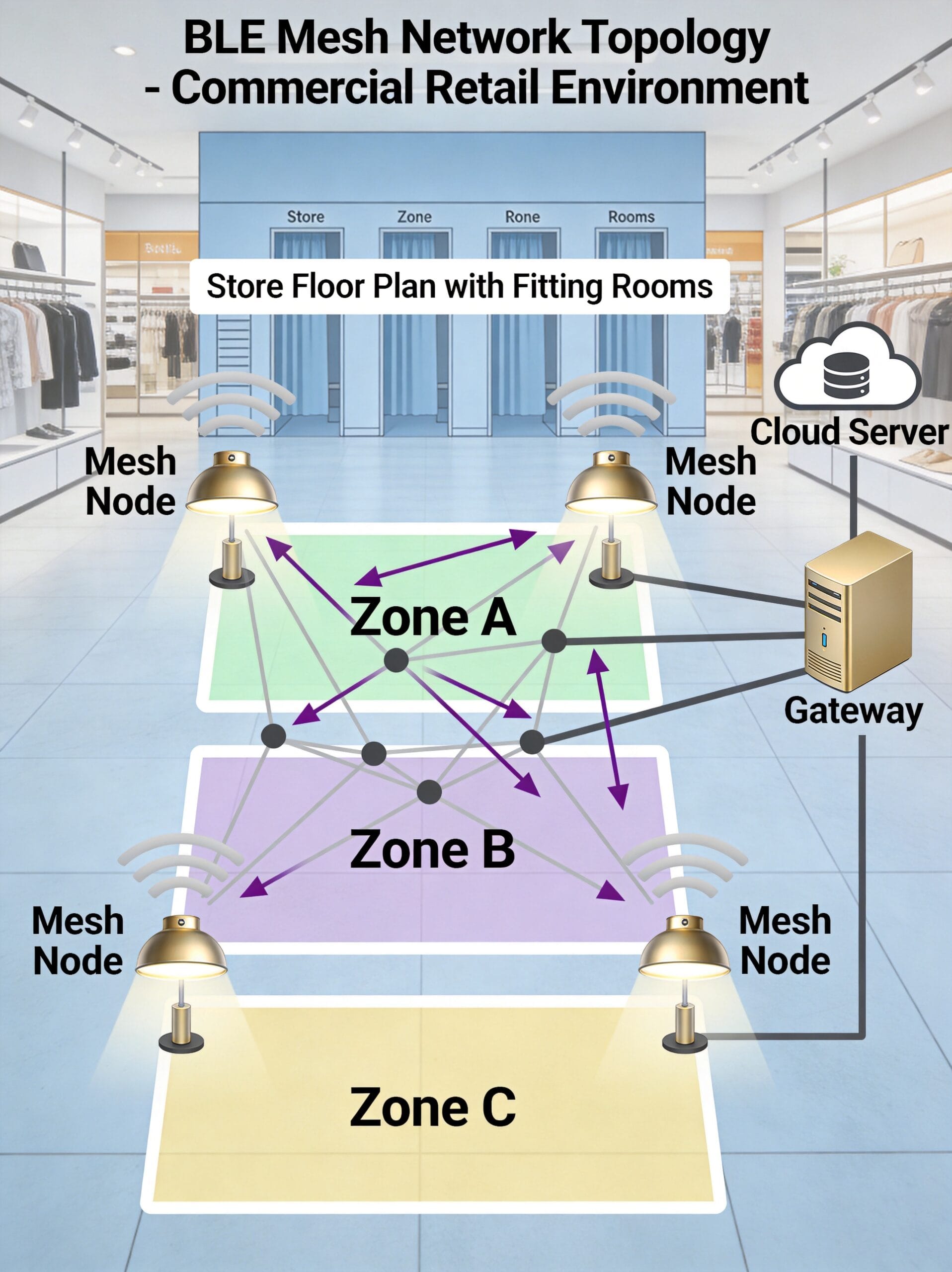
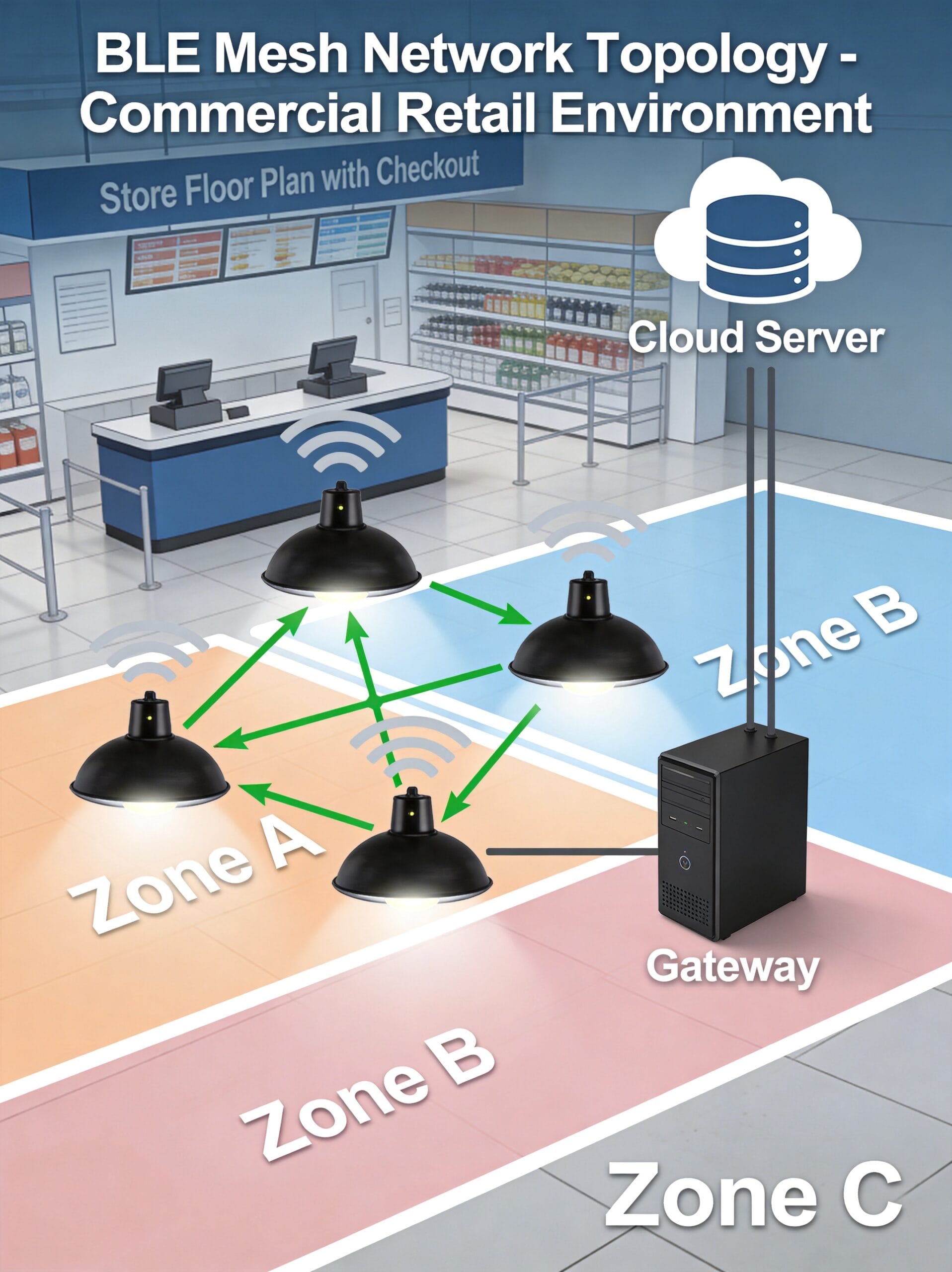
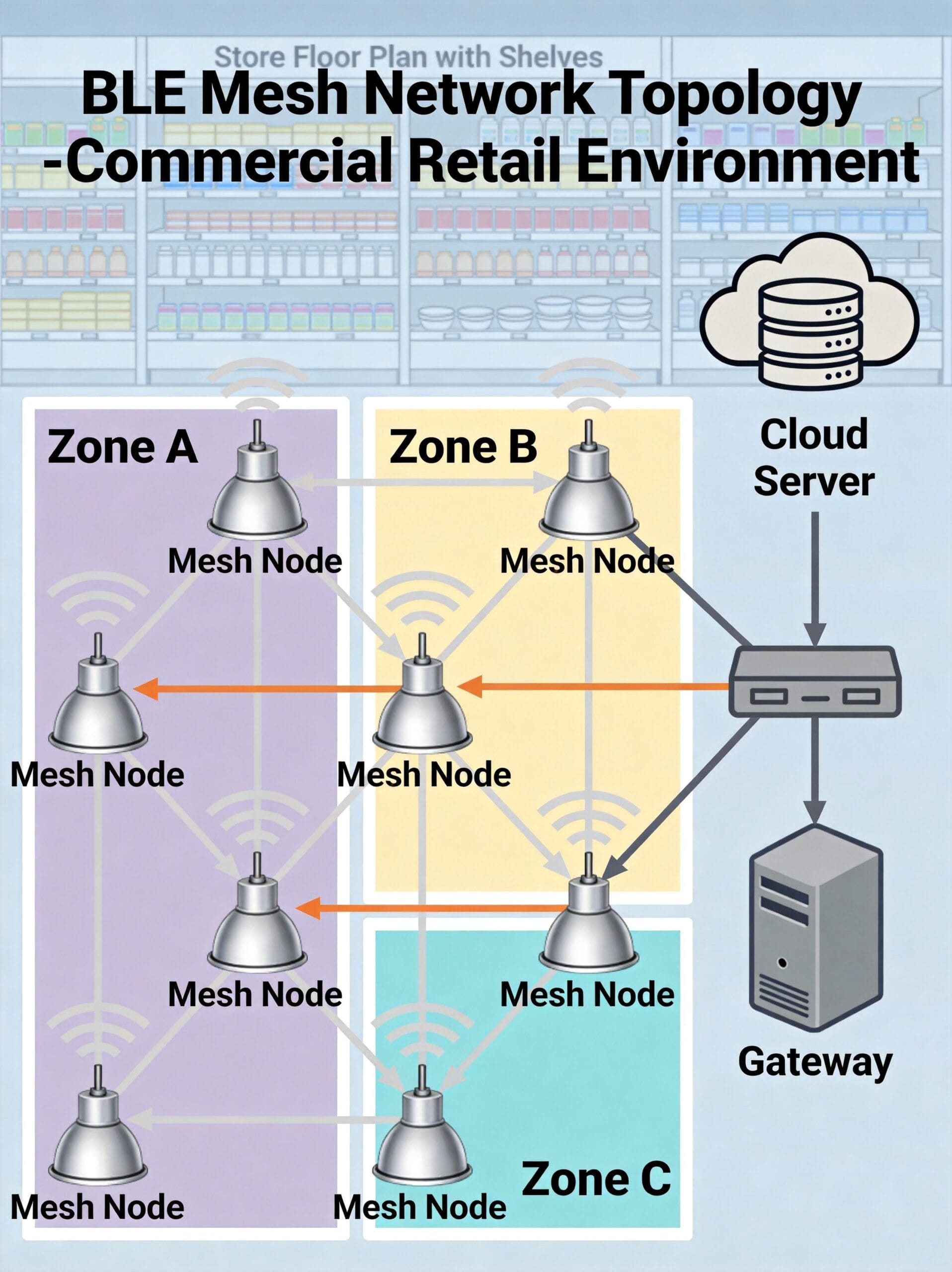
BLE mesh is a protocol defined by the Bluetooth Special Interest Group (SIG) that allows BLE devices to communicate with each other in a many-to-many topology. In practical terms, this means every light fixture in a building becomes both a transmitter and a relay station. When one fixture receives a command or sensor reading, it passes that information to neighboring fixtures, which in turn relay it further. This “flooding” approach ensures that messages reach their intended destinations even if individual fixtures fail or are blocked by physical obstructions.
For commercial lighting operators, BLE mesh delivers three decisive advantages over previous-generation control systems:
Scalability without central points of failure. A traditional DALI or 0-10V system requires a dedicated controller and wiring to every fixture. BLE mesh luminaires self-organize, enabling networks of 1,000+ nodes from a single gateway. If one luminaire loses power, the rest of the network continues operating unaffected.
Sub-meter spatial resolution for analytics. Because each luminaire functions as an independent sensor node, BLE mesh networks can pinpoint occupancy and movement within 1-2 meter zones—far more granular than PIR (passive infrared) motion sensors that cover broad areas indiscriminately.
Energy efficiency at the protocol level. BLE’s low-power radio design, combined with mesh’s efficient message routing (using “managed flood” algorithms), keeps average power consumption per node below 10mW during idle transmission—critical for battery-powered sensors in hard-to-wire locations.
Network Architecture: How CAIMETA Implements BLE Mesh Across Commercial Spaces
Modern BLE mesh lighting networks follow a layered architecture that separates radio communication from application logic. Understanding this layering is essential for specifying and deploying commercial-grade systems.
The Three-Layer Model
Radio and Physical Layer. All CAIMETA BLE Mesh luminaires operate in the 2.4GHz ISM band, utilizing 40 channels with Adaptive Frequency Hopping (AFH) to avoid interference from WiFi networks that share the same spectrum. CAIMETA’s hardware implements Class 1.5 radios (4dBm typical output, up to 10dBm with power boost), achieving reliable mesh node ranges of 8-15 meters in open retail environments and 5-8 meters through drywall partitions in office buildings.
Network Layer (Mesh Stack). The Bluetooth Mesh Profile specification (HDP) defines how devices form and maintain mesh networks. Key features relevant to commercial lighting include:
– Publication/subscription model: Each luminaire publishes its sensor data (occupancy, lux level, temperature) and subscribes to group addresses (e.g., “Zone 3 lighting,” “Emergency exit corridor”). Commands sent to a group address are received by all subscribed members simultaneously, enabling zone-based control without individual fixture addressing.
– 消息中继(Message Relay): Nodes can be configured as relays, retransmitting messages they receive to extend network coverage. The Bluetooth SIG recommends a maximum of 3 relay hops for latency-sensitive applications like emergency lighting.
– 低功耗节点(Low Power Node): Battery-powered sensors attach to a “Friend” luminaire that buffers messages for them, allowing sensors to sleep 99% of the time while remaining reachable.
Application Layer. At this level, vendors implement proprietary or standardized models for lighting control. CAIMETA’s AIBBS (AI Business Brain System) uses a custom sensor data model that standardizes lux readings, occupancy state, energy consumption, and device health into a unified JSON schema, which is then transmitted to the cloud platform via MQTT over TLS.
Integration with DALI: Bridging Legacy and Modern Systems
Many commercial retrofit projects cannot replace an entire DALI installation cost-effectively. CAIMETA addresses this with DALI-2 gateway controllers that bridge the two protocols. The gateway acts as a BLE mesh node on one side and a DALI control gear interface on the other, translating commands bidirectionally:
– BLE mesh group commands → DALI broadcast or group addressing
– DALI sensor feedback (lux, occupancy) → BLE mesh publication for AIBBS aggregation
This hybrid approach is particularly valuable for phased retrofits: a facility can install BLE Mesh luminaires in a pilot zone while maintaining DALI control in the existing installation, with the gateway enabling unified management from a single dashboard.
OTA Firmware Updates: Managing 1,000+ Devices at Scale
The ability to update firmware across thousands of luminaires is a critical operational requirement for any commercial IoT deployment. CAIMETA implements Over-The-Air (OTA) firmware updates using the Bluetooth Mesh Device Firmware Update (DFU) profile, with the following workflow:
1. Firmware binary upload to the CAIMETA cloud platform, validated against the device model and hardware revision.
2. Distribution with rollout scheduling: Updates are staged in waves (e.g., 10% of network per night) to maintain lighting availability. IT administrators can schedule updates for off-peak hours.
3. Verification and rollback: Each luminaire confirms successful firmware application by reporting a SHA-256 hash of the installed image. If verification fails, the device automatically reverts to the previous firmware version stored in a protected boot partition.
OTA updates eliminate the need for manual firmware reprogramming—a single warehouse retrofit with 800 luminaires that previously required weeks of on-site programming can now be completed in a single overnight update cycle.
Cloud Management: MQTT, TLS, and AWS IoT Core
CAIMETA’s cloud infrastructure runs on AWS IoT Core, a managed service designed for IoT device connectivity. Each luminaire maintains a persistent TLS 1.3 connection to the AWS IoT message broker using X.509 certificate-based mutual authentication. This architecture provides several security and scalability benefits:
– MQTT over TLS ensures all command-and-control traffic is encrypted end-to-end. The CAIMETA cloud never transmits plaintext credentials; devices authenticate using pre-provisioned certificates.
– Device Shadows in AWS IoT Core maintain a virtual representation of each luminaire’s state (on/off, brightness, CCT, sensor readings). This enables the dashboard to query device status without polling the physical device, reducing network traffic and enabling sub-second response for mobile app controls.
– Rule Engine processes incoming sensor telemetry and triggers downstream actions: alerting facilities managers when occupancy patterns suggest HVAC adjustment opportunities, generating automated节能 reports, or triggering AIscene scene transitions.
Security: ETSI EN 303 645 and Beyond
IoT security is not optional in commercial environments—it is a regulatory requirement and a business imperative. CAIMETA’s BLE Mesh implementation complies with ETSI EN 303 645, the European Union’s cybersecurity standard for consumer IoT devices, which is increasingly adopted as a procurement requirement for commercial building systems. Key compliance measures include:
– Unique device identity: Every CAIMETA luminaire ships with a unique ECC (Elliptic Curve Cryptography) identity certificate, preventing clone or spoof attacks.
– Secure provisioning: Network enrollment uses Out-of-Band (OOB) authentication, typically via QR code scanned during installation, ensuring that only authorized devices join the production network.
– Network segmentation: The BLE mesh network is logically isolated from the building’s IT network via a border gateway that implements firewall rules and deep packet inspection for MQTT traffic.
For facilities requiring data residency compliance (e.g., European retail chains subject to GDPR), CAIMETA offers regional AWS deployments in EU-West-1 (Ireland) and EU-Central-1 (Frankfurt), ensuring that all sensor telemetry remains within the required jurisdiction.
The Bottom Line: Why BLE Mesh Is the Right Investment for Commercial Lighting
For retail operators, lighting procurement managers, and facilities directors evaluating smart lighting infrastructure, BLE Mesh represents a future-proof foundation. Its open-standard nature (maintained by the Bluetooth SIG, not a single vendor) protects long-term investment, while its proven scalability—from a single boutique store to a 50-property retail chain managed from one dashboard—supports growth without architecture changes.
CAIMETA’s implementation adds critical AI analytics layers on top of the reliable BLE Mesh physical network, transforming lighting infrastructure from a cost center into a data-driven decision-making platform. When every luminaire is both a light source and an intelligence node, the building itself becomes an analytics engine.
Ready to explore how CAIMETA’s BLE Mesh AI lighting solutions can transform your commercial space? [Contact our team](https://caimeta.net/contact/) for a customized IoT lighting assessment.