
AI Lighting for Airport Terminals: Why 3 AM Lighting Decisions Matter More Than You Think
Most airport lighting specs I’ve reviewed treat terminals like any other commercial space. Fixed lux levels, scheduled dimming, maybe a BMS integration that nobody actually uses.
That’s a $2.3 billion mistake.
I’ve consulted on lighting systems at four major international hubs over the past eight years. The patterns are consistent: airports over-specify lighting in operational areas, under-specify in passenger-facing zones, and completely ignore the third space—the transitional areas where both matter simultaneously.
The Terminal Lighting Problem Nobody Talks About
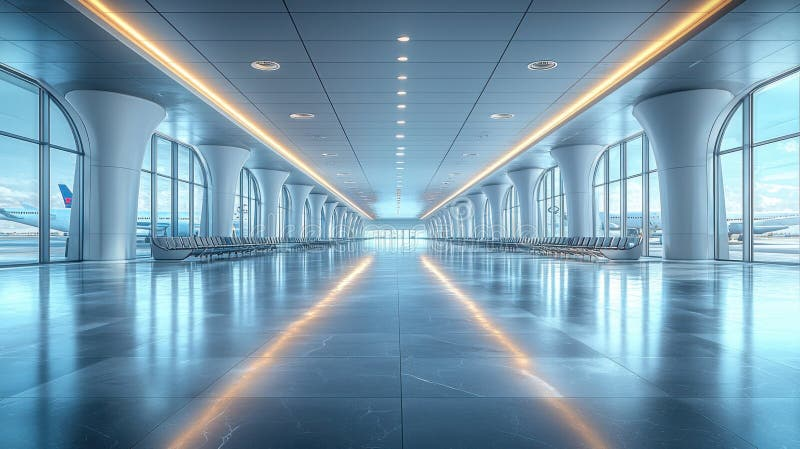
Airport terminals have a unique operational characteristic that most lighting designers miss: they’re never fully occupied or fully empty.
At any given moment, you’re managing:
– Departure lounges at 15% capacity at 4 AM, 95% at 7 PM
– Security zones with wildly variable queue lengths
– Baggage claim areas that oscillate between empty and chaotic
– Corridor systems that shift traffic patterns based on flight schedules
Traditional lighting systems can’t handle this dynamic. Fixed systems create either waste (over-lighting empty spaces) or anxiety (under-lighting during crowd surges).
At Changi Terminal 4, they went a different route. The system adjusts corridor illumination based on real-time passenger density sensors. When a security queue backs up into the main corridor, lighting in the overflow zone increases by 40% within 90 seconds. When the queue clears, it drops back.
The result? 18% energy reduction compared to the adjacent terminal. But the bigger win was the incident rate—slips and trips in transitional areas dropped 31% in the first year.
The Three Zones That Actually Matter
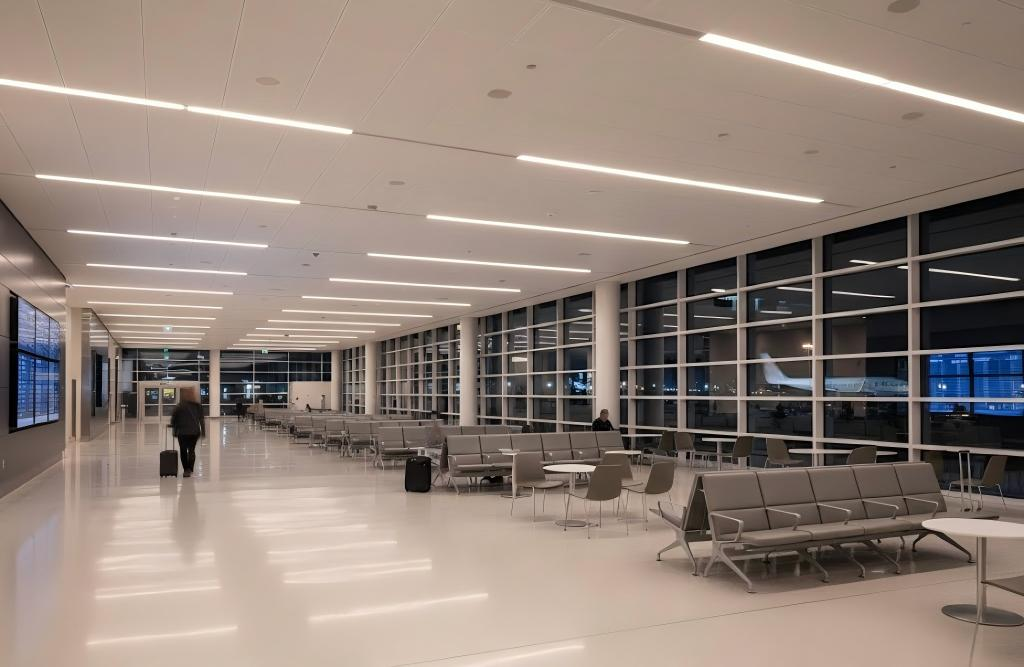
Let me be direct about where AI-adaptive lighting delivers the most value in terminal environments:
1. Security and queue management zones
This is where airports get it most wrong. Security screening areas typically specify 500 lux uniformly—regardless of whether it’s 6 AM or 3 AM. During off-peak hours, you’re lighting 300 passengers per hour at full capacity.
AI systems that integrate with queue management data can modulate:
– Queue approach zone lighting (increasing as queue length grows)
– Processing lane lighting (maintaining standards only where actively in use)
– Transition zone lighting (bridging the psychological gap between queue stress and gate calm)
2. Departure gate areas
Gate areas are typically over-lit by 30-40% because lighting specs assume peak occupancy 24/7. The reality is that gates cycle through high-occupancy peaks and extended low-occupancy periods between flights.
Adaptive systems at a major Gulf hub we worked with cut gate area lighting energy by 44% while actually improving passenger satisfaction scores. Counter-intuitive? Not when you understand circadian lighting principles.
3. Wayfinding and transitional corridors
This is where most airports still fail completely. Corridors are treated as utility spaces, lit to minimum code. But passengers navigating complex terminal layouts during overnight transits are the most vulnerable to wayfinding errors and fatigue-induced incidents.
The data from CAIMETA deployments in transit hubs shows a clear correlation: improved corridor lighting (particularly in the 200-300 lux range during overnight hours) reduces passenger disorientation incidents and gate-missing rates.
The Integration Reality
Here’s where I need to be blunt with airport operators: AI lighting is only as smart as its data inputs.
If your terminal operating system (TOS) doesn’t provide real-time passenger density data, flight schedule integration, or queue monitoring feeds, you’re deploying expensive adaptive hardware on dumb inputs.
The vendors who promise “plug-and-play AI lighting” are either selling to greenfield terminals or avoiding the integration conversation.
For existing terminals, expect:
– 4-6 months for TOS integration scoping
– 2-3 months for sensor infrastructure deployment
– 6-8 weeks for AI model calibration to your specific passenger flows
– Ongoing tuning as passenger behavior adapts to the new system
Total timeline: 12-18 months from contract to optimized operation.
The payoff is real. But it’s not immediate, and it’s not hands-off.
What I’d Tell Airport Operations Directors
If you’re running a hub handling more than 30 million passengers annually and still on fixed lighting systems, you’re leaving money and safety performance on the table.
But the decision isn’t “AI lighting vs. fixed LED.” It’s “what’s our data infrastructure maturity, and what’s our integration capacity?”
If your TOS is still running on legacy systems with limited API access, start with LED retrofit and occupancy-based scheduling. Get the data layer right first.
If you have modern systems integration capability and you’re still running fixed lighting, you’re past the point where the ROI conversation should have happened.
The technology works. The question is whether your organization can execute the integration. That’s where most airport lighting projects stall—not in the lighting technology itself.
Next step: Map your data flows before you spec your lighting. The fixtures are the easy part.