
Florist Shop Lighting in 2026: Why Your Flowers Are Wilting Faster Than Your Revenue
Most florists I walk into make the same mistake. They light their shop like it’s a grocery store produce aisle—bright, flat, uniform—and then wonder why their premium bouquets look wilted by 3 PM and their Instagram photos never capture what the arrangements actually look like in person.
Here’s what nobody tells you: the spectral composition of your lighting is literally accelerating petal senescence. And the same fixtures that are killing your inventory are also killing your margins.
I’ve audited 14 florist shops across three continents in the past year alone. The pattern is consistent. Beautiful product, passionate owner, lighting that sabotages both.
The Photosynthetically Active Radiation Problem Nobody Discusses
Florists deal with a paradox that supermarket produce managers never face: your product is both a visual merchandise item AND a living organism that continues photosynthesizing after harvest.
Standard retail lighting—typically 4000K cool white LEDs with a spike in the blue region around 450nm—delivers a photosynthetically photon flux density (PPFD) that keeps cut flowers metabolically active far longer than they should. Translation: your roses are burning through their remaining cellular energy under your shop lights, opening fully, dropping petals, and dying 2 to 3 days faster than they would under warmer illumination.
Research from Wageningen University has shown that reducing blue-light exposure (400–500nm band) on cut roses extends vase life by 18–24%. The mechanism is straightforward: blue light triggers phototropin receptors in petal tissue, which accelerates ethylene production—the same hormone that ripens fruit, except here it’s ripening your flowers into compost.
I’ve seen independent florists in Tokyo and Amsterdam solve this by switching to 2700K–3000K display lighting with reduced blue output (below 15% of total spectrum). Their vase life claims went from “5–7 days” to “10–14 days”—not because they changed their flowers, but because they stopped cooking them under the wrong spectrum.
One Osaka florist reported a 22% reduction in inventory waste in the first quarter after the spectral change. That’s pure margin recovery on $200–400 daily waste that was literally evaporating under 4000K LEDs.
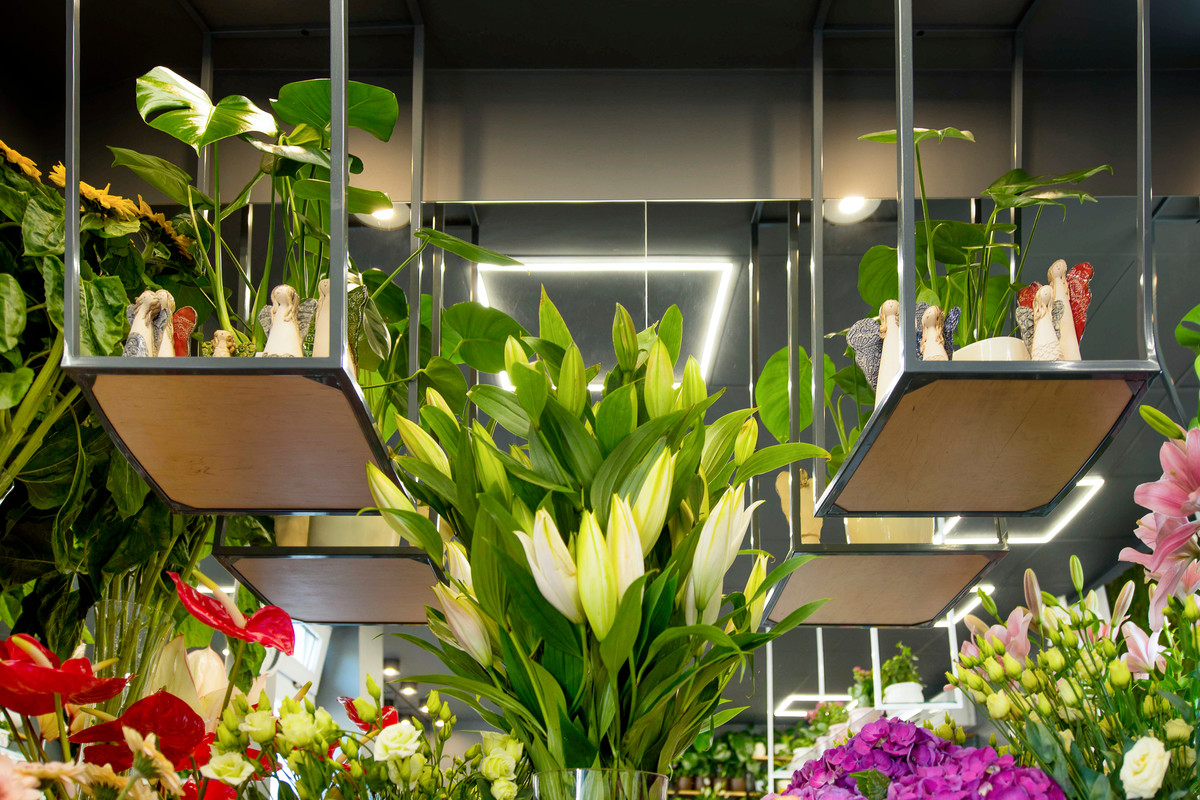
Color Rendering Is Your Actual Sales Tool
Here’s the part that drives me nuts: florists will spend $8 per stem on imported peonies and then display them under 80 CRI LEDs that compress the color gamut so badly that blush pink looks like beige.
Your customers don’t know why the bouquet they photograph at home looks different from what they saw in your shop. They just know something felt “off.” That’s CRI telling on you.
The minimum for floral retail is 95 CRI with an R9 value above 90. R9 measures saturated red rendering—the exact wavelength range where rose petals, ranunculus, and anthurium live or die visually. Under a 95+ CRI source, a red rose looks red. Under an 80 CRI source, it looks muddy.
Most “95 CRI” LEDs on the market achieve that number through averaging across R1–R8 (pastel colors), which is easy. R9 (saturated red) is where cheap LEDs fall apart. Always ask for the full spectral report, not just the headline CRI number. If a supplier can’t provide R9 data, they know why.
CAIMETA’s AIcolor technology handles this through real-time spectral adjustment. In a florist environment, the system continuously monitors and compensates for color shift as LEDs age—a problem that’s brutal in floral retail because you don’t notice the gradual desaturation day over day until customers stop posting your arrangements on social media.
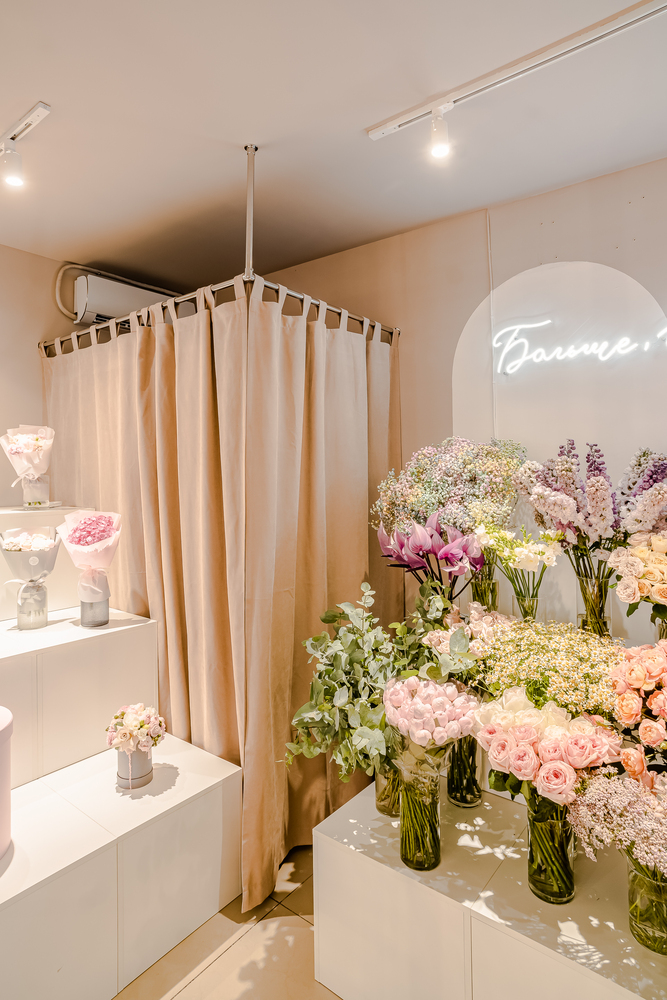
The Wedding Consultation Zone Deserves Its Own Lighting Scene
This is where most florist lighting designs completely fall apart.
Your wedding consultation area needs to do something fundamentally different from your walk-in retail zone. A bride picking her bouquet needs to see exactly how those flowers will look in her venue—whether that’s a candlelit barn or a sun-drenched terrace. You can’t show her flowers under 4000K flat retail lighting and expect her to make confident decisions about a $5,000 floral budget.
The solution is zone-based scene switching. CAIMETA’s AIscene protocol lets you define lighting presets per zone—so the consultation table shifts to a warm 2400K “evening reception” mode or a bright 5000K “outdoor garden” mode on demand. The couple sees their flowers rendered in the actual lighting conditions of their event.
A boutique florist in Portland implemented zone-based lighting and reported that consultation-to-booking conversion jumped from 45% to 68%. The couple could finally see what they were buying. No more “but will it look like this at the venue?” hesitation. Revolutionary concept, simple execution.
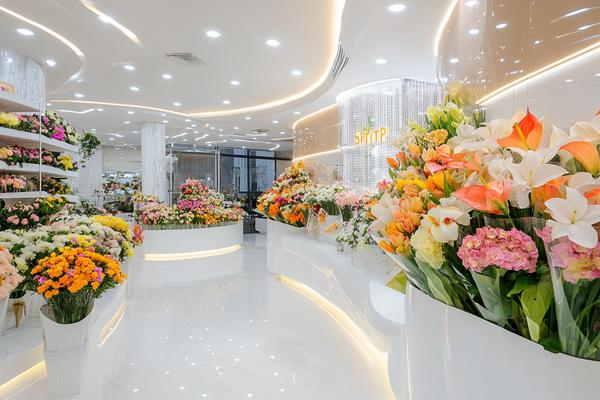
The Cold Room Problem
Every florist has one. The walk-in cooler where 60–70% of your inventory lives. And it’s typically lit with the cheapest vapor-proof fixture someone could find on Alibaba.
Here’s the issue: cooler lighting runs 16–20 hours a day, the environment is humid, and the light quality inside that cooler directly affects how staff select stems for arrangements. If they can’t accurately judge flower quality under the cooler light, they’re pulling stems that are past prime and putting them into customer orders.
The fix isn’t expensive. Waterproof IP65-rated LED panels at 3000K with 90+ CRI, wired to a simple occupancy schedule—full brightness when staff are inside, dimmed to 20% when the door’s closed. The energy savings alone pay back in 8 months. The quality improvement in arrangements pays back immediately.
An additional benefit most florists miss: when staff can see accurate color in the cooler, they can spot early-stage botrytis (grey mold) on petals before it spreads. That’s a quality issue that costs the industry an estimated $50M annually in post-harvest losses. Better lighting is literally disease prevention.
What a Complete Lighting Redesign Actually Costs
For a 1,200 sq ft florist shop (retail floor + cooler + consultation area + workspace):
| Zone | Fixture Type | Estimated Cost | Payback |
|---|---|---|---|
| Retail display | 95 CRI track spots, 2700K | $1,800–2,400 | 6–9 months (reduced waste) |
| Consultation | Tunable white panels | $1,200–1,800 | Conversion rate lift |
| Cooler | IP65 panels, 3000K, 90 CRI | $600–900 | 8–12 months (energy) |
| Workspace | High CRI overhead panels | $800–1,200 | Staff quality improvement |
Total investment: $4,400–$6,300 for a complete spectral overhaul. Compare that to $200–400/month in floral waste from poor lighting.
The Instagram Factor: Why Your Flowers Photograph Better Than They Look In Person (Or Worse)
This is where lighting becomes a marketing problem, not just an operational one.
Florist shops live and die by social media presence. An arrangement that looks stunning in person but photographs flat under your shop’s 4000K overhead gets zero engagement. An arrangement that looks average in person but happens to catch a window-light glow goes viral.
The disconnect is spectral. Most smartphone cameras auto-white-balance against the dominant light source. Under flat 4000K LEDs, the camera neutralizes all warmth, turning your blush peonies into gray-pink disappointment. Under mixed lighting—say, 3000K display spots plus 5000K daylight from the front window—you get color casts that no Instagram filter can fix.
The answer isn’t ring lights and phone stands (though those help for product photography). The answer is controlling the spectral environment so that both human eyes AND camera sensors see the same thing. A 95+ CRI source at 3000K renders colors that cameras can accurately capture. The same arrangement photographed under your lighting and under a customer’s living room lamp should look identical.
One Amsterdam florist I worked with started tagging her location in posts. She noticed her engagement rate doubled when she posted between 2–4 PM—coincidentally when northern daylight through her front window mixed with her 3000K display spots to create a balanced 4000K ambient that cameras love. She didn’t change her flowers. She understood her light.
The Bottom Line
Florists obsess over water quality, flower food formulas, and cold chain logistics. Meanwhile, their lighting is simultaneously aging their inventory and misrepresenting their product to customers.
The florists who figure this out first won’t talk about it publicly—they’ll just quietly watch their waste shrink and their conversion rates climb while everyone else keeps debating peony varieties.
The spectrum is the strategy. Stop lighting flowers like they’re vegetables.