
Auto Detailing Studio Lighting in 2026: The $150 Inspection Light That Separates a $500 Detail from a $5,000 Ceramic Coating
Walk into any auto detailing studio and you’ll see the same pattern. The owner invested $40K in the buildout—epoxy floors, climate control, premium wash bay—and then lit the entire space with generic LED panels from a big box store.
Then they wonder why customers question the $5,000 ceramic coating quote, why paint correction results look different in the parking lot than in the bay, and why their Google reviews mention “good work” but never “wow.”
Here’s the uncomfortable truth: your lighting is the single most important investment in your detailing studio, and it’s probably the cheapest thing in the room.
Why Paint Correction Demands a Completely Different Lighting Philosophy
Paint correction—the process of removing swirl marks, scratches, and oxidation from clear coat—is essentially a visual inspection task performed at micron-level precision. You’re abrading a transparent layer that’s 1.5–2.0 mils thick. Missing a defect by 3 inches means the customer drives into sunlight and sees what you missed.
The lighting standard for professional paint correction is well-established in the industry:
- Color temperature: 5000K–6000K (neutral to slightly cool, matches daylight)
- CRI: 95+ minimum, 98+ preferred
- Illuminance: 1,500–2,000 lux at the vehicle surface
- Angular coverage: Light from minimum 4 directions to eliminate shadows
Most shops hit maybe 500 lux from overhead and call it a day. That’s like a surgeon operating under a desk lamp.
The problem compounds with darker vehicles. A midnight blue or black car absorbs 85%+ of incident light. Under 500 lux ambient, the effective reflectance at the paint surface drops to under 75 lux—barely enough to distinguish between a hologram buffer trail and a genuine scratch.
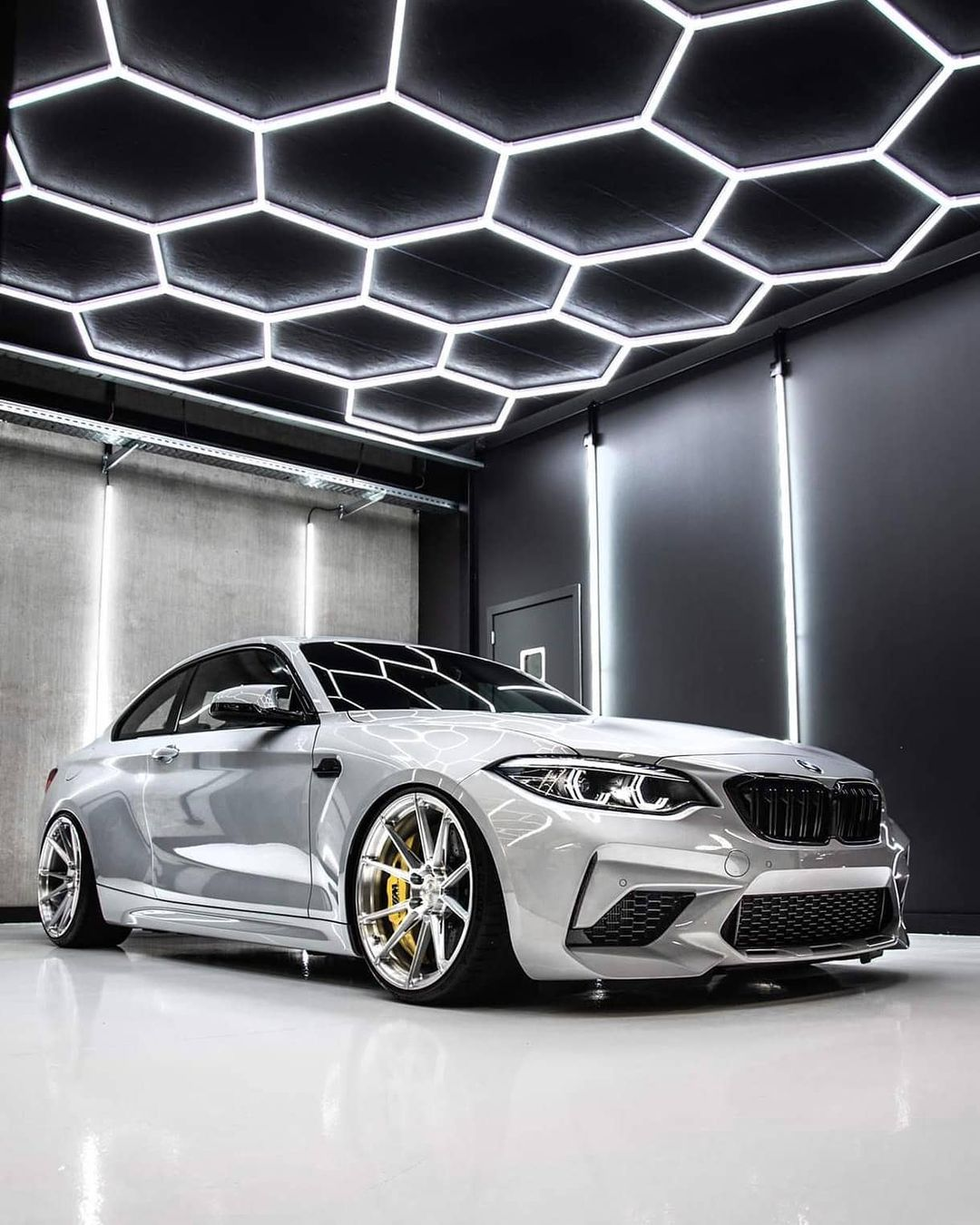
I visited a detailing studio in Shenzhen that restructured their lighting for paint correction work. They went from 4 overhead panels to a 6-point system: 2 overhead linear arrays (5000K, 98 CRI), 2 wall-mounted adjustable bars at 45° angles, and 2 mobile LED columns for targeted inspection. Their rework rate on ceramic coatings dropped from 12% to 2%. Not because their technicians improved—the lighting finally let them see what was already there.
The Ceramic Coating Application Bay Is a Different Environment Entirely
Here’s where detailing studios confuse themselves. The bay where you correct paint and the bay where you apply ceramic coating have opposite lighting requirements.
Paint correction needs high-intensity, multi-directional, cool-white light to reveal defects. Ceramic coating application needs controlled, even, warm-white illumination that lets you see coverage without creating hot spots that flash-cure the product unevenly.
Silica-based ceramic coatings cure through solvent evaporation and cross-linking. If your overhead LED creates a 65°C hotspot on one panel of the hood while the fender stays at 35°C, the coating cures at different rates across the same panel. That’s how you get high spots, streaking, and uneven hydrophobic performance.
The solution is simple but almost nobody does it: separate coating bays with diffused, indirect lighting at 3500K–4000K, no more than 800 lux at surface level, and zero direct line-of-sight from LED arrays to the vehicle surface.
CAIMETA’s AIscene technology addresses this through automated bay switching. When the technician selects “correction mode,” the system activates full-intensity multi-angle lighting at 5500K. When they switch to “coating mode,” it transitions to the diffused warm-white application profile—no manual fixture adjustments, no miscommunication between staff about which bay state they’re in.
The Customer Handoff Moment: Where Lighting Makes or Breaks a $5,000 Invoice
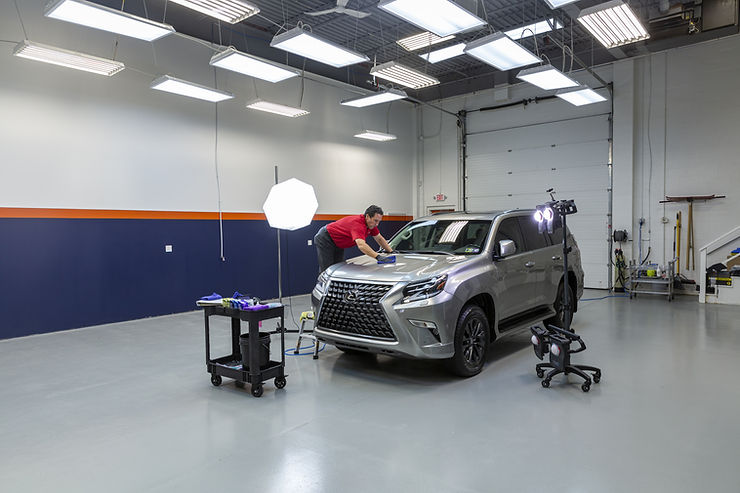
You’ve spent 8 hours on a full paint correction and ceramic coating. The car is flawless. You wheel it out to the handoff area—which, let’s be honest, is probably the same bay with the garage door open and daylight pouring in.
Wrong. The handoff area is the most profitable 50 square feet of your entire studio. It’s where the customer’s perception of value crystallizes into a payment decision and, more importantly, into the Google review and Instagram post that brings you the next 10 customers.
The handoff zone needs theatrical lighting. Not in a gaudy way—in a way that makes the vehicle look like it did when it rolled out of the factory, times ten.
- Overhead: Tunable LED array at 5000K, dimmable to create a showroom glow
- Accent: Two 45° wall-mounted spots to create highlight reflections on body lines
- Background: Dark walls (charcoal or matte black) to eliminate competing visual noise
- Floor: Polished concrete or epoxy with low reflectance to avoid floor glare competing with the car
A studio owner in Los Angeles added a dedicated handoff bay with this setup. His average ticket on ceramic coating jobs increased 35% because customers could see the depth and gloss they were paying for—and immediately photographed it. Those photos became his marketing.
Mobile Detailing Lighting: The Growing Segment Nobody’s Engineering For
The mobile detailing sector grew an estimated 28% in 2025. These operators work in driveways, parking garages, and carports—environments with zero controlled lighting.
The portable lighting market for detailers has exploded, but most solutions are still just bright flashlights on sticks. What mobile operators actually need is a deployable lighting environment:
- Pop-up LED columns (at least 4) that create multi-angle coverage in any space
- Battery-powered operation with at least 4 hours of runtime at correction-level intensity
- Consistent color temperature across all units (5000K ±200K) so defects look the same regardless of which light you’re working under
- CRI 95+ because you can’t correct what you can’t see accurately
The operators who invest in proper mobile lighting infrastructure charge 30–50% more than those who don’t, because their results are consistently visible. You’re not paying for the light—you’re paying for the ability to deliver and prove quality anywhere.
What a Proper Lighting Setup Actually Costs
For a 2-bay detailing studio (1,200 sq ft per bay):
| Component | Correction Bay | Coating Bay | Handoff Zone |
|---|---|---|---|
| Overhead linear arrays | $2,400–3,200 | $1,200–1,600 | $1,800–2,400 |
| Wall-mounted adjustable | $1,600–2,000 | N/A (indirect only) | $1,200–1,600 |
| Mobile inspection columns | $800–1,200 | $800–1,200 | N/A |
| Controls & dimming | $600–900 | $600–900 | $400–600 |
| Total per bay | $5,400–7,300 | $2,600–3,700 | $3,400–4,600 |
For context, a single ceramic coating job at this studio runs $3,000–5,000. If proper lighting eliminates even 2 reworks per month, the correction bay pays for itself in 6 weeks.
The PPF Myth: Why “More Light” Doesn’t Mean “Better Light”
There’s a persistent myth in the detailing community that cranking up the lumens solves everything. You’ll see shops running 3,000+ lux on overhead panels, thinking they’re giving their technicians the best possible working conditions.
They’re not. They’re creating glare.
Above 2,000 lux on a high-gloss painted surface, the reflected light intensity exceeds what the human eye can process for fine detail discrimination. It’s the equivalent of trying to read text on a phone screen in direct sunlight—the information is there, but the contrast is blown out. Your technician’s eyes fatigue faster, they miss defects in the glare, and they compensate by working slower—which kills your throughput.
The sweet spot for paint correction is 1,500–2,000 lux measured at the vehicle surface, with light arriving from multiple angles. This gives you enough illuminance to resolve 50-micron defects without washing out the surface in reflected glare. Above 2,000 lux, you’re paying for electricity and generating heat, not quality.
The Reality Check
Most detailing studios treat lighting as an afterthought—a line item to minimize after the expensive epoxy floor and the fancy pressure washer. That’s backwards. The floor is cosmetic. The lighting is operational infrastructure that directly controls your quality output, your pricing power, and your customer perception.
The shops that understand this are pulling away from the pack. They’re charging more, reworking less, and generating organic marketing through customer photos that actually capture what their work looks like.
Invest in the photons first. Everything else is just soap and polish.