
Your Treatment Room Light Is Sabotaging Your Consultation Close Rate
A client walks into your med spa for a Botox consultation. She’s sitting in your treatment chair, looking at the mirror, and she sees… harsh shadows under her eyes. A slightly yellow cast to her skin. The overhead panel makes her look five years older and ten times more tired than she feels.
She’s just paid you $200 for a consultation. She’s hearing your pitch about looking refreshed, youthful, radiant. And every instinct in her body is screaming that the person in the mirror looks anything but.
This is the lighting problem that med spa owners don’t talk about. It’s not about aesthetics. It’s about clinical accuracy and patient psychology — and it’s silently killing conversion rates.
The Fluorescent Hangover
Most med spas inherited their lighting from the previous tenant — usually a dental office or dermatology clinic running T8 fluorescent tubes or cheap LED panels at 5000K. The logic was “clinical white means professional.”
That logic was wrong in 2010. It’s catastrophically wrong in 2026.
Here’s the reality: 5000K lighting in a treatment room does three damaging things simultaneously.
First, it casts blue-heavy light that makes skin look washed out and ashy. Clients with darker skin tones are particularly affected — the blue spectrum flattens their complexion in ways that make them look unhealthy rather than rejuvenated.
Second, it creates harsh shadows that exaggerate wrinkles, pores, and skin irregularities. This sounds like it might help your case (“see how bad it is? you NEED this treatment”), but research in environmental psychology tells a different story. When patients feel exposed and unflattering under harsh light, they associate that discomfort with the space — not with their skin condition. They leave feeling worse about the room, not more motivated to book.
Third, and this is the one that keeps me up at night: inconsistent lighting makes before/after photos unreliable. If your treatment room has one light setup during the “before” photo and a different ambient light during the “after” photo, your results documentation is garbage. Patients notice. Referring physicians notice. And in an industry where before/after photos are your primary marketing asset, unreliable documentation is a slow death.
What Actually Works: The 3500K–4000K Compromise
After reviewing lighting setups across 40+ med spas, the facilities with the highest consultation-to-booking conversion rates cluster around a specific range: 3500K–4000K for treatment areas, with CRI above 90.
This is warm enough to render skin tones naturally — patients see themselves as they actually look, not as a fluorescent nightmare — while still maintaining the clinical precision needed for procedural work. It’s the sweet spot between “spa relaxation” and “medical accuracy.”
But here’s the critical detail most people miss: the color temperature needs to be consistent across all light sources in the room. A 4000K overhead panel combined with 3000K wall sconces creates mixed-color rendering that distorts skin tones in unpredictable ways. Every fixture in the treatment room — overhead, task, ambient, accent — must match within a 200K range.
The Before/After Photo Problem (And Its $50K Solution)
Let’s get specific. A med spa doing $500K in annual revenue typically generates 2,000–3,000 before/after photo pairs per year. These photos are used for:
- Social media marketing (Instagram, TikTok, website)
- Patient consultation presentations (“here’s what we did for someone with similar concerns”)
- Insurance documentation (for medically necessary procedures)
- Referral communications with other physicians
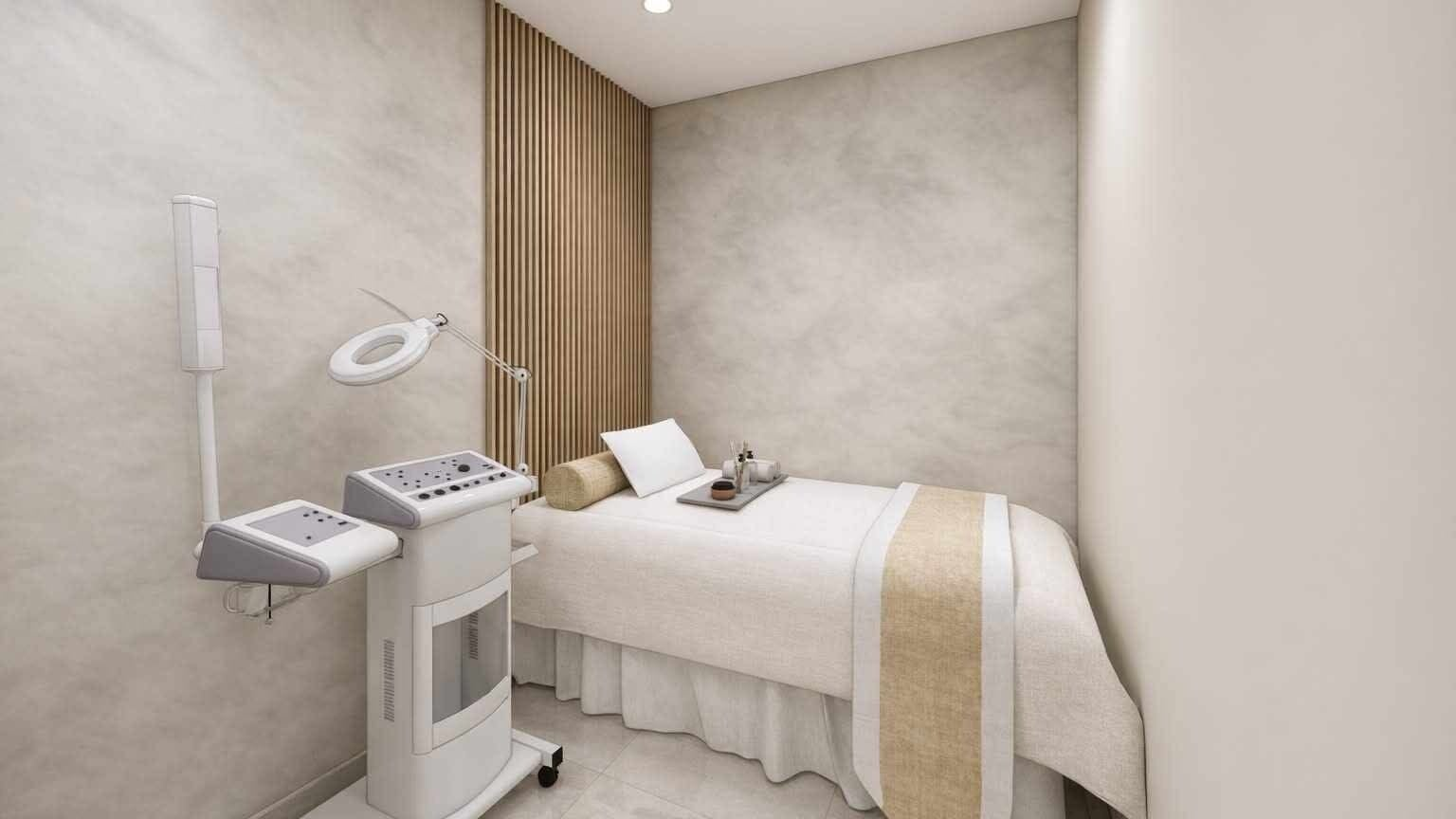
Now here’s the issue. If your treatment room lighting changes between the “before” and “after” sessions — because a bulb was replaced, because someone opened a blind, because the sun went behind a cloud — the color comparison is invalid. A before photo taken under 5000K daylight-balanced light versus an after photo under 4000K warm light will show different skin tones, different contrast, different everything.
The solution isn’t just “keep the lights the same.” It’s standardized, controllable, repeatable lighting for every single photo session.
This is exactly the kind of problem that AI-controlled lighting systems were designed to solve. With a preset “documentation mode” — fixed color temperature, fixed intensity, fixed angle — you eliminate the lighting variable entirely. The CAIMETA AIscene system handles this through scene presets: one tap activates the standardized photo protocol, and every parameter stays locked until you switch it back.
A med spa owner in Austin implemented standardized photo lighting after realizing that 30% of their before/after pairs had visible color temperature mismatches. After switching to a controlled setup, their patient conversion rate from consultation photos increased by 27% — because the photos actually showed real, consistent results.
The Waiting Room: Where Trust Is Built Before They Meet You
While the treatment room gets the technical attention, the waiting area is where the emotional decision happens. A patient’s first impression of your med spa is formed in the first 90 seconds of walking through the door.
The lighting in that 90-second window does something very specific: it calibrates the patient’s nervous system. Bright, cool overhead lighting (5000K+) signals “hospital.” It keeps the sympathetic nervous system engaged — the patient stays alert, slightly anxious, in fight-or-flight mode. This is fine if you’re running an urgent care clinic. For a med spa selling relaxation, rejuvenation, and luxury experiences? It’s the opposite of what you need.
Waiting areas should run 2700K–3000K with diffused, indirect lighting. The goal is to shift the patient into parasympathetic mode — relaxed, receptive, open. Think hotel lobby, not examination room.
But here’s where it gets nuanced: you don’t want the space so dim and warm that it feels unprofessional. The balance is warm but bright enough to read a magazine comfortably — roughly 300 lux at seat level, all from indirect sources (cove lighting, backlit panels, table lamps). No downlights directly over seating positions.
One facility in Miami redesigned their waiting area with 2800K indirect lighting, warm wood accents, and zero direct overhead fixtures. Patient satisfaction scores for “feeling relaxed and comfortable” jumped from 67% to 91% in the first quarter. More importantly, same-day booking rates increased by 15% — patients who arrived relaxed were more likely to commit to treatment on the spot.
The Procedural Room vs. The Consultation Room: Why They Need Different Lighting
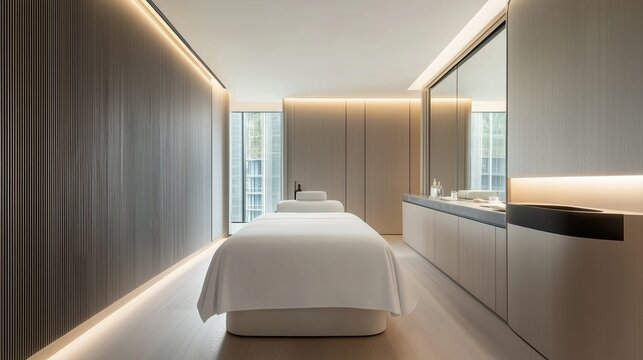
This is the insight that separates amateur setups from professional ones. Your consultation room and your procedural room serve fundamentally different functions, and they need fundamentally different lighting:
Consultation room: 3500K, CRI 95+. The goal is accurate skin assessment. The patient needs to see their skin as it is — not flattered, not punished. High CRI at a neutral warm temperature gives the most honest rendering. Dimmable, so the practitioner can adjust for specific assessment needs.
Procedural room: 4000K–4500K, CRI 90+. When the injector or laser technician is working, they need cooler, brighter light for precision. This is where medical accuracy matters most — seeing tissue response, vascular patterns, and treatment endpoints in real time.
Most med spas use the same room for both. The compromise is a tunable lighting system that shifts between consultation mode and procedure mode. With BLE Mesh-controlled fixtures, this transition takes seconds — no electrician needed, no rewiring, just a scene change from the control panel.
The Numbers: What Proper Lighting Is Actually Worth
Let’s put a dollar figure on this. A med spa doing $750K annual revenue with a 35% consultation-to-treatment conversion rate means roughly $262K in treatment revenue from consultations.
If proper lighting increases that conversion rate by even 5 percentage points (conservative based on the Austin case above), that’s:
$750K × 40% = $300K — an incremental $38K per year in revenue from the same patient volume, same staff, same treatments.
The lighting upgrade for a 3-room med spa typically runs $8K–$15K. Payback period: 3–5 months.
Add in the energy savings from switching to efficient LED systems with smart controls (typically 25–35% reduction in lighting energy), and the total first-year ROI is 300–400%.
The Bottom Line
Med spa operators spend thousands on marketing, training, equipment, and product inventory. But the environment where patients make their buying decision — the treatment room — is often lit with the same cheap panels left over from the previous tenant.
Fix the lighting. Standardize your photo documentation. Zone your spaces for their actual function. The revenue impact is real, measurable, and typically pays for itself within a single quarter.
Your patients deserve to see themselves clearly. And your business deserves the conversion rate that comes with it.