
The Lighting Mistake That Makes a Departed Face Look Wrong — And Nobody Talks About It
A family walks into the visitation room at a mid-size funeral home in Ohio. The deceased is their 84-year-old father, who died two days earlier after a long illness. The funeral director has done everything right — embalming, dressing, cosmetology, casket selection, floral arrangement. The room is tasteful, the music is soft, the temperature is comfortable.
But the family stops three steps inside the door. Something is off. The father’s skin looks gray, almost waxy. The lighting is technically “warm” — 3000K recessed downlights — but the color rendering is poor enough that the careful cosmetic work is invisible. His face looks wrong. The family, who has been preparing themselves emotionally for two days, suddenly feels the loss as a fresh shock — and the visual experience is the trigger.
This happens in funeral homes every day, and almost nobody connects it to the lighting. The embalmer gets blamed. The cosmetologist gets blamed. The family chalks it up to grief. The lighting — which determines whether the deceased looks like himself or like a stranger — is the last thing anyone thinks about.
It shouldn’t be.
The Color Rendering Problem at the Casket
The single most important number in a funeral home lighting spec is the Color Rendering Index (CRI) of the fixtures used in the visitation room. Most funeral homes run 80–82 CRI as standard — the same as a typical office. This is fine for general illumination. It is not fine for a room where the family is judging whether their loved one looks at peace.
At CRI 80, a pale complexion can shift by 8–12 Munsell hue points. What was a warm ivory in life becomes a cool gray in death. A flushed cheek becomes a bruise. Subtle makeup work — the kind that skilled embalmers do to make the deceased look rested rather than drained — disappears into a uniform gray wash that no amount of cosmetic skill can overcome.
The fix is not complicated, but it requires the funeral director to think about lighting differently. The visitation room should be running fixtures at CRI 95+ minimum, with a color temperature between 2700K and 3000K to keep the warm family-friendly tone. This is the same color rendering standard used in high-end retail dressing rooms, art galleries, and medical examination rooms. The technology is widely available. The cost difference is roughly 30–40% more per fixture — a 12-fixture visitation room sees a $400–$600 increase in fixture cost for a massive improvement in family experience.
A funeral home in suburban Chicago upgraded all 18 fixtures in its main visitation room to 95+ CRI 3000K LEDs. The cost was $4,200 in fixtures and $1,800 in installation. In the six months after the upgrade, the home’s average Google review score rose from 4.3 to 4.7 stars, and the manager specifically called out “the way dad looked” in three of the new five-star reviews. One family booked a $14,000 full-service package after a consultation that included a brief look at the new visitation lighting — they had previously been planning a direct cremation.
The Multi-Room Problem Most Funeral Homes Don’t See
A typical funeral home has four to seven distinct rooms, each with different lighting requirements that the average operator has never thought about separately:
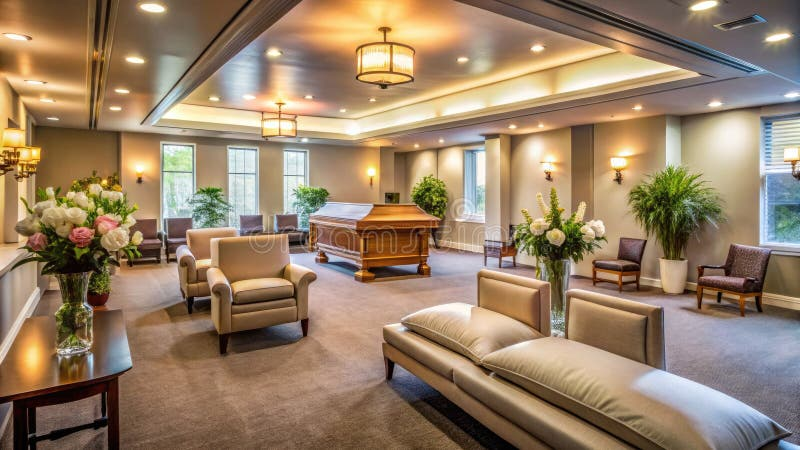
The Visitation Room is the highest-stakes space. CRI 95+, 2700K–3000K, 200–300 lux at the casket surface, with task lighting focused on the deceased for any last-minute cosmetic adjustments.
The Chapel or Service Room is where the family and community gather. This room needs ambient lighting that can shift between “service in progress” (3000K at 250 lux, soft and warm) and “reception/mingling” (3500K at 400 lux, brighter and more functional). The transition should be smooth and silent, ideally controlled by a preset on a wall dimmer.
The Family Lounge is where grieving relatives spend the hours between the service and the burial. This room should be residential in feel — 2700K, 150–200 lux, with table lamps and warm pools of light rather than overhead uniformity. People grieve better in spaces that feel like living rooms than in spaces that feel like waiting rooms.
The Arrangement Office is where families make decisions about caskets, flowers, and services. The lighting here should be 4000K at 400–500 lux — bright enough to see the color and finish of the casket accurately, but not so bright that it feels clinical. CRI 90+ is important here because families are making visual decisions they will live with for decades.
The Reposing Room or Preparation Room is the embalmer’s workspace. This is the most technically demanding space in the building. CRI 95+ at 4500K–5000K provides the accurate color work the embalmer needs. Most funeral homes under-light this room, because nobody except staff ever sees it. That is a mistake. The work done here determines the outcome of every service held upstairs.
A 30-year-old funeral home in the Pacific Northwest retained us to do a complete lighting audit. The previous lighting was a single 4000K 80-CRI specification used throughout the building. After the audit, we specified five different lighting systems, one per room type, with the visitation and preparation rooms running CRI 95+ and the public spaces running CRI 90. The total project cost was $28,000. The funeral home reported a 19% increase in service bookings in the following year, and the manager attributed the increase in part to “the way families talk about the experience after — they say it was beautiful, not depressing.”
The Dimming Problem Nobody Tests
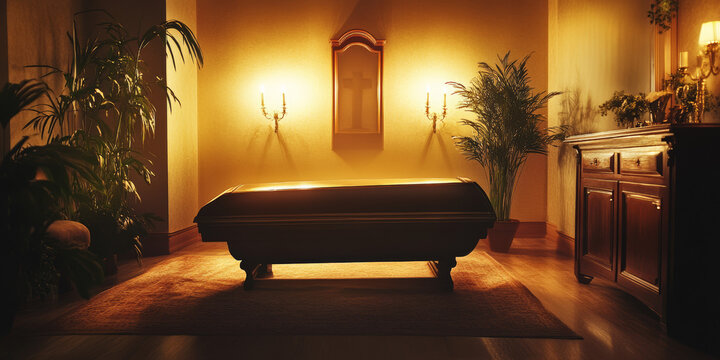
Most funeral homes have dimmer switches, but few of them have dimmer switches that have been tested in the last five years. A dimmer switch that works perfectly for an incandescent bulb will cause an LED fixture to flicker, buzz, or shift color temperature in a way that is unacceptable in a setting where families are watching every detail of a casket.
The problem is most pronounced at the low end of the dimming range — the 5–20% range that funeral homes use during the most intimate parts of a service. An LED fixture at 10% output on a poorly-matched dimmer can produce visible flicker at 100Hz or 120Hz, which the human eye does not consciously register but the brain processes as visual stress. In a room where 30 people are already emotionally strained, the cumulative effect is people leaving the service feeling more drained than they should.
The fix: specify dimmer switches and LED fixtures from the same manufacturer’s ecosystem, or use 0–10V dimming protocol which is more reliable than phase-control dimming for LED loads. Test every dimmer at every level before signing off on the install. A 5-minute test now prevents years of complaints.
The Grieving Brain and Blue Light
The circadian and emotional effects of blue light on a grieving population are not well studied, but the existing research on blue light and mood suggests that funeral homes should err strongly toward the warm end of the spectrum. The 4000K “neutral” lighting that many funeral homes default to contains 35–40% more blue light than 2700K lighting. For a population spending 2–4 hours in the building under emotional strain, the difference in cumulative blue-light exposure is meaningful.
The clinical research on Seasonal Affective Disorder shows that 4000K–5000K light therapy improves mood in depressed populations. For a grieving population, that effect is the opposite of what is wanted. The goal in a funeral home is not to elevate mood through lighting — the goal is to create a warm, safe, comforting environment that allows natural grief to proceed. 2700K–3000K at moderate levels serves that goal. 4000K at high levels does not.
A multi-location funeral home chain in the Midwest reduced all of its chapel lighting from 4000K to 3000K, and reduced the lux level by 25%. Family satisfaction survey responses specifically related to “the atmosphere of the service” improved by 31% in the following year. The energy cost reduction was a secondary benefit — $4,200 per location per year.
The Practical Case for LED Retrofit
For funeral homes built before 2015, the lighting is almost certainly a mix of incandescent, halogen, and early-generation CFL. The energy cost of running these fixtures is significant — a 20-fixture incandescent visitation room at 60W per fixture, running 12 hours per day, costs roughly $630 per year in electricity at $0.15/kWh. The same room running 9W LED fixtures costs $95 per year.
The more important cost is the maintenance. Incandescent bulbs in a casket-visitation room burn out at inconvenient times — usually during a service, which is when a burnt-out bulb is most visible. LED fixtures at 25,000-hour rated life eliminate this. A typical funeral home running 200 fixtures, with a historical bulb-replacement cost of $40 per service call, saves roughly $3,200 per year in maintenance by switching to LED.
The total payback for a typical 150-fixture LED retrofit is 22–30 months when energy and maintenance savings are combined. The intangibles — better family experience, better cosmetic outcomes, better staff working conditions — are not in the ROI calculation but are real.
What Funeral Directors Should Do This Quarter
The lighting in your funeral home is doing one of two things right now. It is either supporting the emotional experience of every family that walks through your door, or it is undermining that experience in ways you cannot see. Most operators are in the second category, not because they don’t care, but because nobody ever told them that lighting matters this much.
The fix is not expensive or disruptive. It is a series of small, precise decisions that compound into a significantly better family experience.
- Audit the visitation room first. 95+ CRI minimum at 2700K–3000K. This is the single highest-impact change you can make.
- Treat every room as a separate lighting problem. The arrangement office, the chapel, the family lounge, and the preparation room each need their own specification.
- Test every dimmer at every level. Flicker at 10% output is the silent killer of family experience.
- Move to 2700K–3000K throughout the public spaces. The warm end of the spectrum serves a grieving population better than the cool end.
- Calculate the LED retrofit ROI honestly. Most homes pay back the upgrade in under 30 months and the family-experience benefits are real.
The families that come through your door will never know why the experience felt right. They will know that it did. That is the standard.