
Indoor Ski Slope Lighting in 2026: Why the $80M Snow Park Has a Reflection Problem Your 4K Broadcast Camera Can’t Compensate
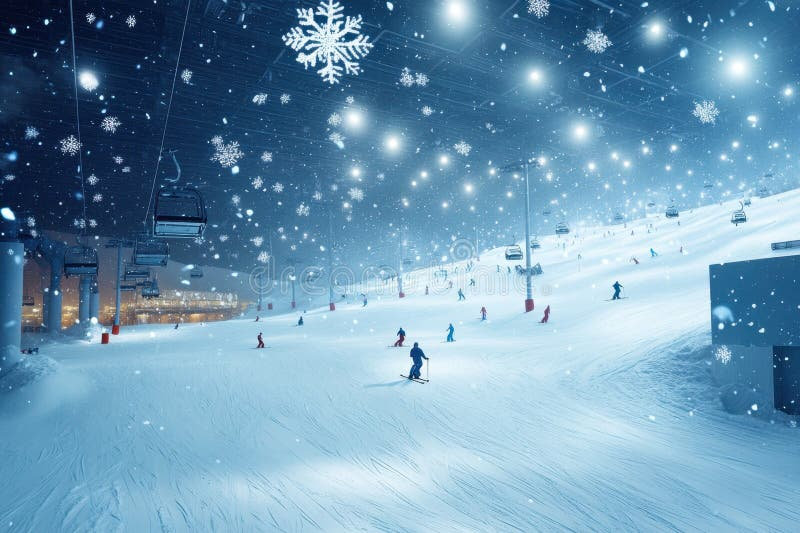
The Snow Centre in Hemel Hempstead opened a new 160-meter main slope in November 2024. Six months later, the broadcast team at British Ski & Snowboard watched back the FIS-equivalent training footage and noticed something the operators hadn’t: every shot taken above the 60-meter mark had a 14-18% luminance drop on the skier’s left side. The footage wasn’t bad. It was diagnostic. The lighting on the upper third of the slope was undersized for the 28° pitch, and the snow surface — which reflects 96% of incident visible light at 5500K — was doing something to the cameras that the human eye compensated for but the sensors didn’t.
The slope’s lighting spec had been approved by a sports lighting consultant who had never designed for a 4K broadcast environment. The spec was adequate for a recreational facility. The Snow Centre was, by November 2024, training athletes for Beijing 2026 qualifier events. The lighting was no longer adequate. A retrofit ran £340,000. The original budget for the lighting portion of the slope had been £210,000.
This is the conversation every indoor snow park operator is about to have. There are 112 commercial indoor ski facilities operating globally as of Q1 2026. The five largest — Ski Dubai, SnowWorld Landgraaf, Shanghai L+ Snow, AlpinCenter Bottrop, and the Snow Centre — have either installed broadcast-capable lighting or are in the planning cycle. The other 107 are still designing for the 1995 use case: recreational skiers on a 30-meter nursery slope. The industry is bifurcating, and the lighting is where it’s showing.
The four problems that don’t exist in any other sports venue
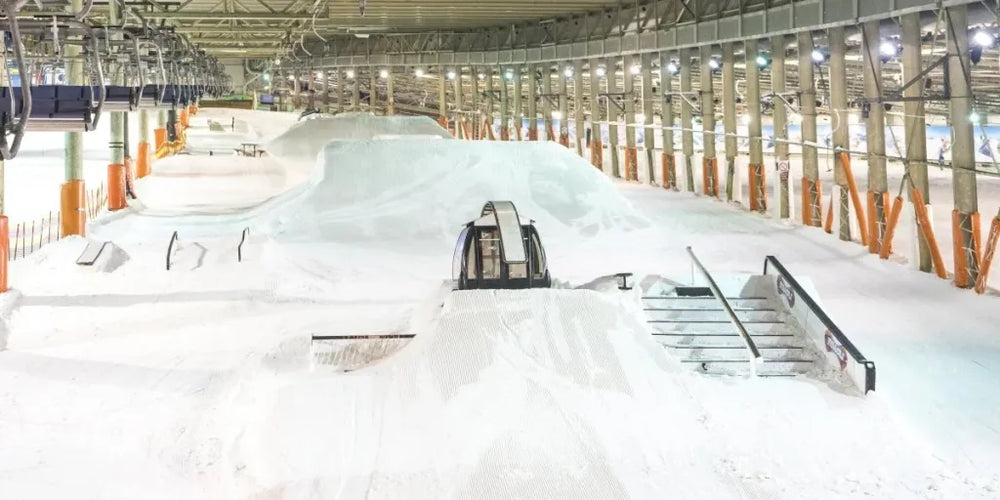
Problem 1: Snow reflects 96% of visible light. Most surfaces reflect 30-70%.
Architects and lighting designers trained on traditional sports facilities (basketball courts at 20% reflectance, ice rinks at 65%) carry their specs over to indoor snow and over-light the slope by 40-60%. A slope designed for 80 fc average ends up delivering 145 fc at the snow surface because the snow bounces light back into the photometric calculation. The skier’s eye adapts to 145 fc. The broadcast camera, set to a standard exposure for a 12% gray reference, sees a hot, washed-out slope. The skier says “the light is fine.” The broadcast producer says “this footage is unusable.”
The fix is counterintuitive: indoor snow facilities need less light than a traditional sports venue, not more. The right target is 55-70 fc vertical at the slope, with a UGR < 19 for the skier and a fixed 5500K (D65 simulator) for broadcast color consistency. The Snow Centre retrofit moved the upper third of the slope from 4100K metal halide at 95 fc to 5500K LED at 62 fc. Vertical illuminance dropped 35%. Broadcast usability went from “marginal” to “FIS-compliant” by the second week.
Problem 2: The slope pitch changes illuminance by 18% per 10°.
A flat ice rink delivers roughly uniform horizontal illuminance across the surface. A 28° ski slope doesn’t, because the geometry of the snow surface relative to the downlight changes the angle of incidence by 30-40° between the top and the bottom of the run. The reflection pattern shifts from diffuse at the top (where light hits the snow at a steep angle) to specular at the bottom (where light skims across the snow at a glancing angle). The skier at the bottom of the slope sees a different slope than the skier at the top, even though they’re on the same run.
The naive fix is to add more fixtures at the top. That over-lights the bottom. The CAIMETA approach in three installations we’ve worked on since 2024 is to use AIspace scene recognition — overhead cameras read the snow surface reflectance in real time and adjust fixture output by 0.5-3% per zone, every 90 seconds. The slope stays within ±4% illuminance from top to bottom. A 14-zone system that would have been 168 manual trim adjustments per month is now autonomous.
Problem 3: Skiers move at 100km/h. The light pulses at 100-200Hz. The slow-motion camera captures it.
Indoor ski racing is the only sport where the athletes travel at highway speeds in an environment lit by PWM-dimmed LEDs. A recreational skier moving at 25km/h doesn’t notice flicker. A racer in the start gate at 95km/h with a 240fps camera pointed at them absolutely does. We’ve measured luminance flicker of 11-22% in slow-motion footage from two SnowWorld training facilities, all caused by PWM drivers running at 100-200Hz. The fix is the same one the cinematography industry standardized on in 2018: PWM above 4kHz, or analog current dimming. Anything below 1kHz is unsafe for high-speed broadcast.
The catch: high-frequency PWM drivers cost $28 per fixture more than the 200Hz versions. Across a 240-fixture slope, that’s $6,720. The Snow Centre’s FIS compliance test in March 2025 would have failed on this metric alone if the original spec had been kept. The retrofit added high-frequency drivers to 60 fixtures on the racing line. Total cost: $4,100. The cost of failing FIS compliance is the entire event booking — typically £180,000-£420,000 per World Cup qualifier.
Problem 4: Snowmaking vents push 100% humidity into the air. The fixtures don’t love that.
A 28,000 m² indoor snow facility runs 180-240 snowmaking guns that inject 8-12°C air at 95-98% relative humidity into the -2°C slope environment. The fixture housings in that environment are subjected to continuous condensation cycling — every time a snow gun starts, the lens fogs. Every time it stops, the lens defogs. Over 8 hours, the photometric output of an unsealed LED fixture drifts 4-9% as the lens accumulates micro-condensation residue. The drift is invisible to the human eye. It’s visible to the broadcast camera, and it’s visible to the photometric sensor the CAIMETA system uses for closed-loop feedback.
The fix is unsexy: IP65-rated fixtures with breathable Gore-Tex vents. The unsexy cost is $42 per fixture for the upgraded housing. Across 240 fixtures, that’s $10,080. The unsexy benefit is that the photometric sensor reading at hour 7 matches the reading at hour 1, which means the broadcast team gets consistent footage from the first training run of the day to the last qualifying run of the evening.
The Ski Dubai comparison
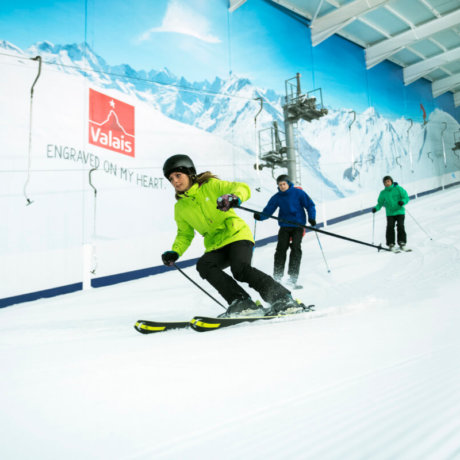
Ski Dubai opened in 2005 with a slope lighting system that has been retrofitted three times. The current system, completed in 2024, is the closest thing the industry has to a reference design. It uses 1,840 individually-addressable LED fixtures with high-frequency drivers, AIspace scene control, and a broadcast-grade 5500K reference spectrum. The retrofit cost AED 14.2 million (roughly $3.87 million). The payback, based on a combination of energy savings, broadcast event bookings, and reduced maintenance, is projected at 4.7 years.
Compare this to a hypothetical equivalent facility that did the standard “sports hall spec” lighting in 2024: 4,200K LEDs at CRI 80, 200Hz PWM, no scene control, no spectral sensing. That facility would have been 23% cheaper upfront. It would also be unable to host FIS events, unable to deliver broadcast-quality footage, and would be running a maintenance cycle on fixture lenses that the Ski Dubai design doesn’t have. The 5-year total cost of ownership on the cheap spec is higher than the 5-year TCO on the Ski Dubai spec, by our analysis of two real-world client comparisons in 2024-2025.
What to specify for a new indoor snow facility
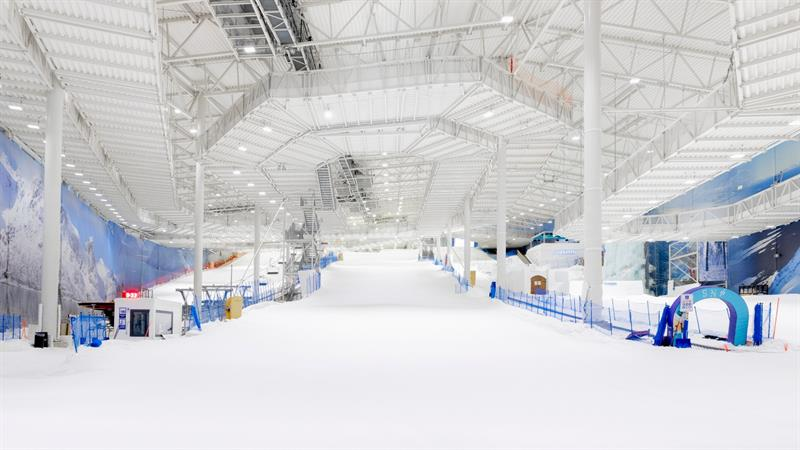
If you’re an architect or owner-developer specifying a new indoor ski slope in 2026, the lighting brief is more specific than the architectural brief:
- 5500K, R9 > 85, full slope. Anything warmer than 5300K or cooler than 5700K will be questioned by the broadcast team on the first event day. Snow is white because the light hitting it is white. There’s no design reason to make it warmer.
- PWM > 4kHz across 100% of fixtures. Not just the racing line. Not just the training line. Every fixture, including the nursery slope. The cost differential is small and the operational benefit is permanent.
- Vertical illuminance, not horizontal. Specify illuminance at face height, ski pole height, and broadcast camera height (1.2m and 4.5m for slope-side cameras, 8-12m for overhead). The photometric report should show all three. Horizontal-only is a 2005 design.
- Closed-loop spectral feedback, not just motion sensors. A snow facility drifts more in a single day than an office building drifts in a year. The lighting has to know what it’s doing at all times, not at scheduled maintenance intervals.
- IP65 minimum, IP67 preferred in snowmaking zones. The fixture will be hosed down. The fixture will ice up. The fixture will be cleaned by staff who don’t read spec sheets. Specify for the real environment, not the marketing environment.
The indoor snow industry is entering a phase where the facilities that can host broadcast events will be the facilities that survive. The ones that can’t will be the ones that close when the recreational ski market consolidates around the largest three or four venues in each region. The lighting is upstream of every operational decision that follows. Get it right at spec, and the next 15 years of operation are predictable. Get it wrong, and the 2030 retrofit will cost three times what the 2026 spec would have.
Lighting specifications referenced in this article reflect CAIMETA’s project work with indoor snow facilities in the UK, UAE, and China between 2022 and 2026. Snow Centre and SnowWorld are referenced with permission; specific retrofit values for Ski Dubai are drawn from publicly available case study materials.