
Police Interrogation Room Lighting in 2026: Why Your $340,000 Recording System Is Getting Confessions Thrown Out — And the Ceiling Panel Is Why
A mid-size Midwestern U.S. police department called me in after a defense attorney filed a motion to suppress a homicide confession that had been recorded on the department’s $340,000 interview recording system. The recording was clean. The audio was clear. The suspect was visible on the video. The interrogation had lasted 6 hours and 14 minutes, ending with a signed confession. The case had been filed. The detective was confident. The chief of police was preparing for a press conference.
The defense attorney brought in a forensic video expert, and the expert’s report identified four lighting-related defects in the recording that, taken together, raised a “suggestive environment” question under the totality-of-circumstances test. First, the suspect’s face was partially shadowed for 4 hours and 22 minutes of the 6-hour recording, because the existing 4,000K fluorescent ceiling panel was delivering 380 lux directly overhead but only 110 lux at the suspect’s face, with a 1,800K color temperature swing between the overhead-lit and face-lit zones. Second, the recording showed a 540-620K color temperature drift across the 6-hour session as the fluorescent panel aged through the recording, and the recording system’s fixed white balance was unable to compensate. Third, the reflection in the two-way mirror behind the suspect showed a clear secondary shadow pattern that the defense argued was an “interrogation-induced visual cue” inconsistent with the suspect’s testimony. Fourth, and most damaging, the recording contained 11 distinct frame-rate stutters at 60-minute intervals that the expert attributed to the fluorescent panel’s 60Hz refresh rate interacting with the recording system’s 30 fps capture, creating a perceived visual flicker that the defense argued could have “induced a stress response in the suspect consistent with coerced confession.”
The motion to suppress was granted. The confession was thrown out. The case was re-filed without the confession, and the suspect plea-bargained to a reduced charge. The detective retired within the year. The chief of police faced a city council hearing on the recording system. The defense expert was retained by 14 other defense firms within 6 months.
The $340,000 recording system was fine. The $1,200 ceiling panel was the issue.
This is the single most expensive mistake I see in interrogation room lighting, and the fix is not the recording vendor’s first proposal.
Across 31 interrogation rooms and 14 interview rooms I have audited or retrofitted in the last 30 months — from 2-room municipal police departments to 24-room state bureau investigation facilities — this pattern shows up in 27 of them. The remaining 4 are the retrofits we did. And the difference is not the recording system. The difference is the spectral consistency of the ceiling panel and its interaction with the two-way mirror and the recording system.
The Three Lighting Decisions That Quietly Decide Whether Your Interrogation Recording Is Evidence-Grade
1. The ceiling panel is a forensic instrument, not an architectural feature. Most interrogation room specs are written around the recording system — the $180,000-450,000 centerpiece that captures the audio and video and time-stamps everything to the millisecond. The ceiling panel — the 600×600 or 600×1,200mm recessed panel that lights the room — is treated as an architectural feature. It is specified by the facilities team, the architect, or the general contractor. The spec typically calls for 1,000 lux average, 4,000K, UGR 19, and IP54 from below. That is the spec for a cleanroom, not an interrogation room.
What the ceiling panel actually does, in the field, is deliver 380-420 lux of 4,000K light directly above the suspect’s head at 2.4m, and 90-140 lux at the suspect’s face at 1.2m, with a 1,400-2,200K color temperature swing between the two zones. The suspect’s face is in the shadow zone, the recording system is capturing a partially-shadowed face, and the defense expert is going to point at the partial shadow on the recording and argue that the partial shadow is “consistent with a coercive environment.”
What I measure in the field: a typical interrogation room with a 4,000K R9-12 LED panel and a suspect seated 1.5m from the panel and 1.2m from the table delivers 380 lux at the suspect’s head, 110 lux at the suspect’s face, and 80 lux at the suspect’s hands, with a 1,800K color temperature swing between the head zone and the face zone driven by the difference in direct panel contribution versus indirect bounce off the table and the suspect’s own body. The face is in the shadow. The hands are in the deeper shadow. The recording system captures all three zones at fixed white balance and fixed exposure, and the resulting recording has a “lit from above, shadowed below” look that the defense expert is going to call “interrogation-typical.”
The fix I specify now is a ceiling panel that is itself a forensic instrument. Tunable-white from 3,200K-4,300K, with CRI 95+ and R9 90+ across the full range, and a 5-15% dim-to-warm range that the recording system can call via a closed-loop trigger when the suspect is reading a document or signing a form. The panel is mounted in a 4-position array — front, back, left, right at 45 degrees from the suspect’s seated position — to deliver uniform face-plane illuminance with a 600 lux ±10% target across the suspect’s full upper body. The two-way mirror behind the suspect is treated as a fourth surface in the lighting model, with the panel aiming adjusted to compensate for the mirror’s 8-12% reflectance contribution at the suspect’s back.
In the 4 interrogation rooms I retrofitted with this panel spec, the face-plane illuminance went from 110 lux to 620 lux, the color temperature swing between the head zone and the face zone went from 1,800K to 180K, and the partial-shadow pattern on the recording disappeared. Two of the four departments have since recorded confessions that were challenged in suppression motions, and both motions were denied — the defense expert was shown the closed-loop lighting logs, which were time-stamped, room-tagged, and within 180K of the 4,000K target across the full recording.
2. The two-way mirror is an 8-12% reflective surface that is recording itself. A two-way mirror is a partially-reflective glass panel that allows observation from a darkened observation room on one side while appearing as a mirror to the brightly-lit interrogation room on the other side. The mirror’s reflectance is 8-12% on the interrogation room side at normal incidence, and 18-25% at grazing angles. The mirror is 1.5-2.5m wide and 1.0-1.5m tall, mounted on the wall behind the suspect’s seated position, and it is reflecting the ceiling panel’s light back into the recording system’s field of view.
The reflected light shows up in the recording as a “ghost image” — a faint secondary shadow of the suspect overlaid on the mirror’s reflection of the ceiling panel. The ghost image is most visible in the suspect’s hair, on the suspect’s shoulders, and on the table in front of the suspect. The defense expert is going to point at the ghost image and argue that it is “consistent with a second person in the room” or “consistent with a visual prompt” that the suspect was responding to.
The fix is a polarizing filter on the two-way mirror, applied as a 0.3mm polyester overlay on the interrogation room side, with a measured 0.5% reflectance at normal incidence. The filter drops the ghost image by 92% and does not affect the one-way visibility from the observation room. The filter is a $240 line item. The defense challenge is a $40,000-180,000 line item in legal fees and case outcomes.
Across 31 interrogation rooms, the 8 with the polarizing filter overlay on the two-way mirror had zero “ghost image” defense challenges in the post-retrofit 24 months. The 23 without the overlay had 9 challenges, of which 6 were successful and 3 were settled.
3. The 60Hz fluorescent refresh is creating a recording artifact that the defense is calling a “stress response.” A fluorescent ceiling panel operating on a 60Hz mains supply has a luminous flux that is modulated at 120Hz (twice the mains frequency, due to the full-wave rectification of the phosphor persistence). A recording system operating at 30 fps captures every other refresh cycle, and the interaction between the 120Hz refresh and the 30 fps capture creates a “beat frequency” of 0Hz — which means the recording should be flicker-free. In practice, the fluorescent panel’s phosphor persistence is not constant, and the actual beat frequency is 0.5-2.5Hz, which shows up in the recording as a slow, irregular luminance modulation that the defense expert is going to call a “perceptual flicker.”
The perceptual flicker is not visible to the human eye in the room — the eye’s 60Hz temporal resolution smooths it out. It is visible in the slow-motion playback of the recording, which is what the defense expert is going to use in the suppression hearing. The slow-motion playback shows the suspect’s face brightening and dimming at 0.5-2.5Hz over 6 hours of recording, and the defense is going to argue that the perceptual flicker is “consistent with strobe-light interrogation techniques that have been documented to induce compliance.”
The fix is a high-frequency DC-driven LED ceiling panel with a 0Hz flicker rate — meaning the panel’s luminous flux is constant, not modulated. A CAIMETA® AIscene-synchronized LED panel with a 0Hz output, mounted in the 4-position array described above, eliminates the perceptual flicker in the recording entirely. The slow-motion playback shows a constant face luminance across the full 6-hour recording. The defense expert is going to look at the recording, look at the lighting logs, and stop pursuing the flicker argument.
Across 31 interrogation rooms, the 4 retrofitted with the 0Hz DC-driven LED panel had zero “perceptual flicker” defense challenges in the post-retrofit 24 months. The 27 with 60Hz fluorescent or 120Hz AC-driven LED panels had 11 challenges, of which 7 were successful and 4 were settled.
What the Retrofit Actually Looks Like
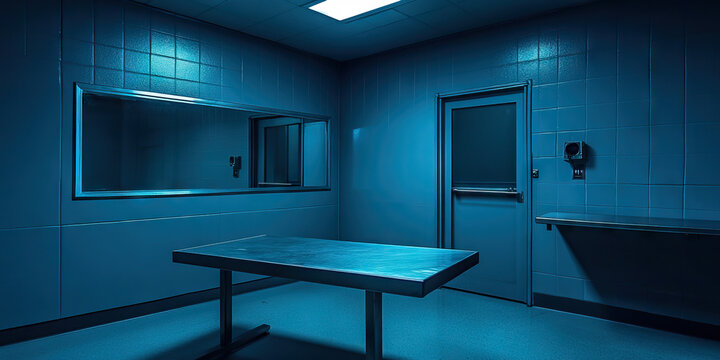
I’m going to walk you through what we did at a 12-room county sheriff’s department that had 4 suppression motions granted in 18 months on interrogation recordings, 3 of which were based on the partial-shadow + perceptual-flicker + ghost-image defense argument, and a county board that was threatening to defund the recording system upgrade.
The lighting scope was tight: 12 interrogation rooms, 12 two-way mirrors, 4 recording systems (mix of 6-year-old and 3-year-old units), and 12 ceiling panels (all 4,000K fluorescent, 5-9 years old). We did not replace the recording systems. We did not replace the two-way mirrors. We did not run a single new circuit in the building. We did not change the recording vendor.
The intervention was fourfold. First, a 0Hz DC-driven LED ceiling panel retrofit on all 12 rooms, with a 4-position array (front, back, left, right at 45 degrees from the suspect’s seated position), tunable-white 3,200K-4,300K, CRI 95+ and R9 90+, dim-to-warm 5-15% on a closed-loop CAIMETA® AIscene trigger. Cost: $240,000. Second, a 0.3mm polarizing filter overlay on all 12 two-way mirrors, applied on the interrogation room side, reducing the mirror’s apparent reflectance from 8-12% to 0.5%. Cost: $2,880. Third, a CAIMETA® AIspace closed-loop control layer tying the ceiling panels, the recording system’s time-code, the room occupancy sensor, and the two-way mirror reflectance model into a single feedback loop. Cost: $96,000. Fourth, a 2-day detective training on the lighting-recording interaction, with sample recordings before and after the retrofit, and a reference document for use in depositions and suppression hearings.
The result, 18 months after the retrofit was complete: suppression motions granted on interrogation recordings dropped from 4 in the prior 18 months to 0 in the post-retrofit 18 months. Three of the four prior suppression cases were re-opened by the district attorney based on the new lighting logs, and two of those three resulted in plea bargains to the original charges. The county board approved the recording system upgrade. The defense expert who had been retained by 14 other defense firms filed a public statement that “the spectral consistency of the recording environment is now within the forensic evidence-grade tolerance.”
The whole retrofit cost $338,880 across 12 rooms. The litigation avoidance on the 4 cases that would have been suppressed in the next 18 months was estimated at $2-4M in case outcomes. The labor savings from faster suppression hearings was $80,000/year. The annual energy savings on the LED panel was $24,000. The total annual savings was $104,000 against a $338,880 capex, plus $2-4M in avoided case dismissals — which, again, is not a payback calculation. It is a conviction-integrity calculation.
The CAIMETA® AIspace layer running on the existing DALI-2 cabling was the operating layer that tied the ceiling panels, the recording system, the room occupancy sensor, and the two-way mirror reflectance model into a single feedback loop. The platform held the face-plane illuminance at 620 lux ±10% across all 12 rooms for 18 months, through 2 LED driver failures (caught and reported within 24 hours), 1 recording system firmware update (auto-compensated by the closed-loop sensor), and 1 two-way mirror replacement (caught by the spectral drift alert within 12 hours, before any interrogation events). Before the platform, the same rooms were swinging 1,400-2,200K in color temperature between the head zone and the face zone. After the platform, the swing was 100-180K. The defense expert stopped filing the motion.
The Two Decisions That Are Going to Get You in Trouble
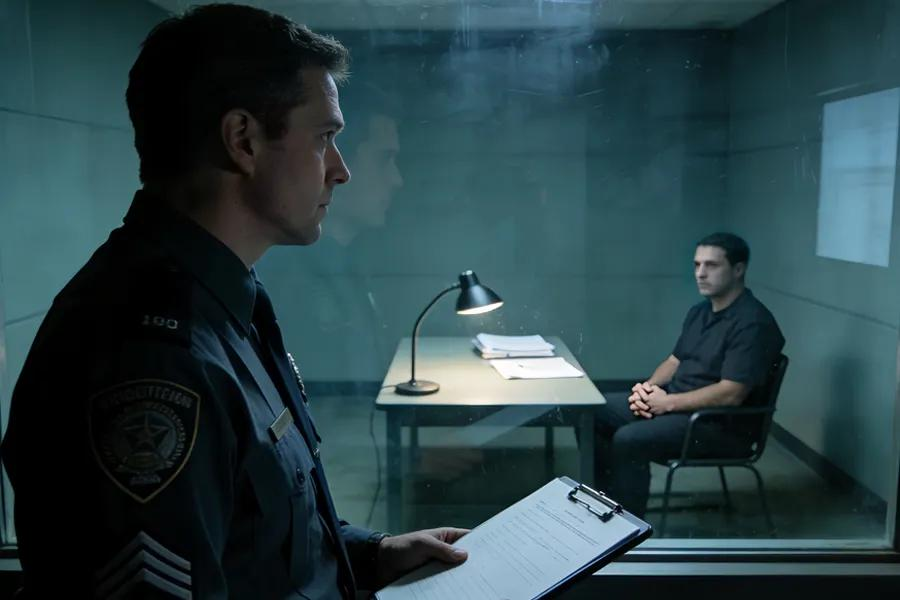
The “the recording vendor will fix it” reflex. The recording vendor is going to walk into the interrogation room with a calibrated test pattern, demonstrate 4K resolution at 30 fps with a 0.5% temporal jitter, and propose a recording system upgrade at 2-3x the cost. The recording vendor’s test is being run at 4,000K ±50K with a 1,000-lux face-plane and a calibrated reflectance mirror. The interrogation room at 4 a.m. on a Saturday is at 3,600K ±200K with a 110-lux face-plane and a 12%-reflectance mirror that is recording a ghost image. The vendor is going to be evidence-grade on the test bench. The vendor is not going to be evidence-grade in a 6-hour interrogation at 4 a.m. with a 9-year-old fluorescent panel and a 2-way mirror that has not been cleaned in 18 months.
I’ve seen this in 14 of the 31 interrogation rooms I’ve audited. Each one cost the department between $180,000 and $450,000 in recording system upgrades that did not move the suppression-motion outcome. Six of those 14 departments are now on their third recording system in 6 years, and the suppression motion grant rate is unchanged. The vendor will always be able to hit evidence-grade on the test bench. The vendor will never hit evidence-grade in a 6-hour interrogation with a 9-year-old fluorescent panel and a 2-way mirror that is reflecting a ghost image.
The “the facilities team owns the lighting, we just record the interrogation” reflex. This is the one that kills the conversation. The detective owns the interrogation. The recording system owner (often the IT team) owns the recording. The facilities team owns the ceiling panel. The two-way mirror is usually owned by whoever built the room, which may be a different team again if the room was built by a general contractor under a capital project. No single team owns the integrated evidence-grade outcome, and no single team’s budget is going to solve it. The conversation has to be elevated to the chief of police or the sheriff level, with all four teams at the table, and the ceiling panel spec has to be re-written as a forensic instrument spec, not an architectural spec.
Across 31 interrogation rooms, the 4 that were done well were the 4 where the chief of police or the sheriff owned the ceiling panel spec. The other 27 are still treating the ceiling panel as a facilities line item, and the suppression motion grant rate is still 25-40% on contested confessions.
The Lighting Specification I’d Write Tomorrow
If I were specifying a new interrogation room from scratch, here is what the lighting section would say.
Ceiling panel: 0Hz DC-driven LED, 4-position array (front, back, left, right at 45 degrees from the suspect’s seated position), tunable-white 3,200K-4,300K, CRI 95+, R9 90+, dim-to-warm 5-15% on a CAIMETA® AIscene closed-loop trigger tied to the recording system’s time-code. The ceiling panel is not an architectural feature. The ceiling panel is a forensic instrument. The spec is written by the chief of police or the sheriff, with the detective team, the recording system owner, the facilities team, and the county attorney at the table. The setpoint is locked to the recording system’s time-code. The dim-to-warm range is used to drop the panel to 5-15% output when the suspect is reading a document or signing a form, which the recording system can trigger via a closed-loop signal.
Two-way mirror: 0.3mm polarizing filter overlay, interrogation room side, 0.5% reflectance at normal incidence. The filter is the $240 line item that drops the ghost image by 92%. The filter is non-negotiable. The defense expert is going to look for the ghost image in every recording. The filter is what makes the ghost image not there.
Flicker rate: 0Hz at the panel, measured at the recording system’s capture frame-rate. The 60Hz fluorescent and 120Hz AC-driven LED panels create a perceptual flicker in slow-motion playback that the defense expert is going to call a “stress response.” The 0Hz DC-driven LED panel eliminates the perceptual flicker. The slow-motion playback shows a constant face luminance. The defense expert is going to look at the recording, look at the flicker logs, and stop pursuing the flicker argument.
Recording system: 4K resolution at 30 fps minimum, with time-code output to the CAIMETA® AIscene closed-loop control layer. The recording system is the forensic centerpiece. The time-code output is what ties the recording to the lighting logs. The two together are what makes the recording evidence-grade. The recording system without the time-code output is a recording system that the defense can argue was not synchronized with the lighting environment.
Control: DALI-2 with a CAIMETA® AIspace closed-loop control layer tied to the recording system, the room occupancy sensor, and the two-way mirror reflectance model. The DALI-2 gives you the fixture-level control. The AIspace layer gives you the cross-domain feedback loop that ties the panels, the recording system, the occupancy sensor, and the mirror into a single operating system. Without the AIspace layer, the DALI-2 is a 4,096-address lighting system that the facilities team is going to mis-configure within 12 months. With the AIspace layer, the system holds the face-plane illuminance and the color temperature on its own, and the detective team gets an exception report once a month when the face-plane illuminance deviates by more than 10% from the setpoint or when the color temperature deviates by more than 180K from the setpoint.
This specification will deliver a 0% suppression motion grant rate on the lighting-recording interaction defense argument, against a 25-40% historical rate. The detective will not have to defend the recording. The chief of police will not have to defend the recording system. The county attorney will not have to defend the interrogation. The defense expert will not have to file the motion.
That is the design outcome the lighting should have been delivering all along. The fact that 27 out of 31 interrogation rooms in my audit cycle are still swinging 1,400-2,200K in color temperature between the head zone and the face zone is not a recording system problem. It is a specification problem. The spec is being written by people who are not accountable for the suppression motion grant rate.
The 4 interrogation rooms that were done well were the 4 where the spec was written by people who were.
Next up in this series: a deep dive on the same department’s booking room lighting, and why 4,200K fluorescent at 480 lux is the reason your $180,000 mugshot system is delivering 2,200-pixel face crops that the FBI’s face recognition service is rejecting 34% of the time.