
The retail landscape has fundamentally shifted. Today’s store managers aren’t just managing inventory and staff—they’re becoming data scientists, leveraging every square foot of their physical space to generate actionable intelligence. At the heart of this transformation? Intelligent lighting systems that do far more than illuminate.
The Evolution from Basic Illumination to Intelligent Sensing
Traditional retail lighting served a single purpose: visibility. The transition from fluorescent to LED was primarily about energy efficiency and cost reduction. But the latest generation of smart commercial lighting systems has evolved into something fundamentally different—a distributed sensor network that captures customer behavior patterns with remarkable precision.
Heat Mapping: Visualizing Customer Behavior in Real-Time
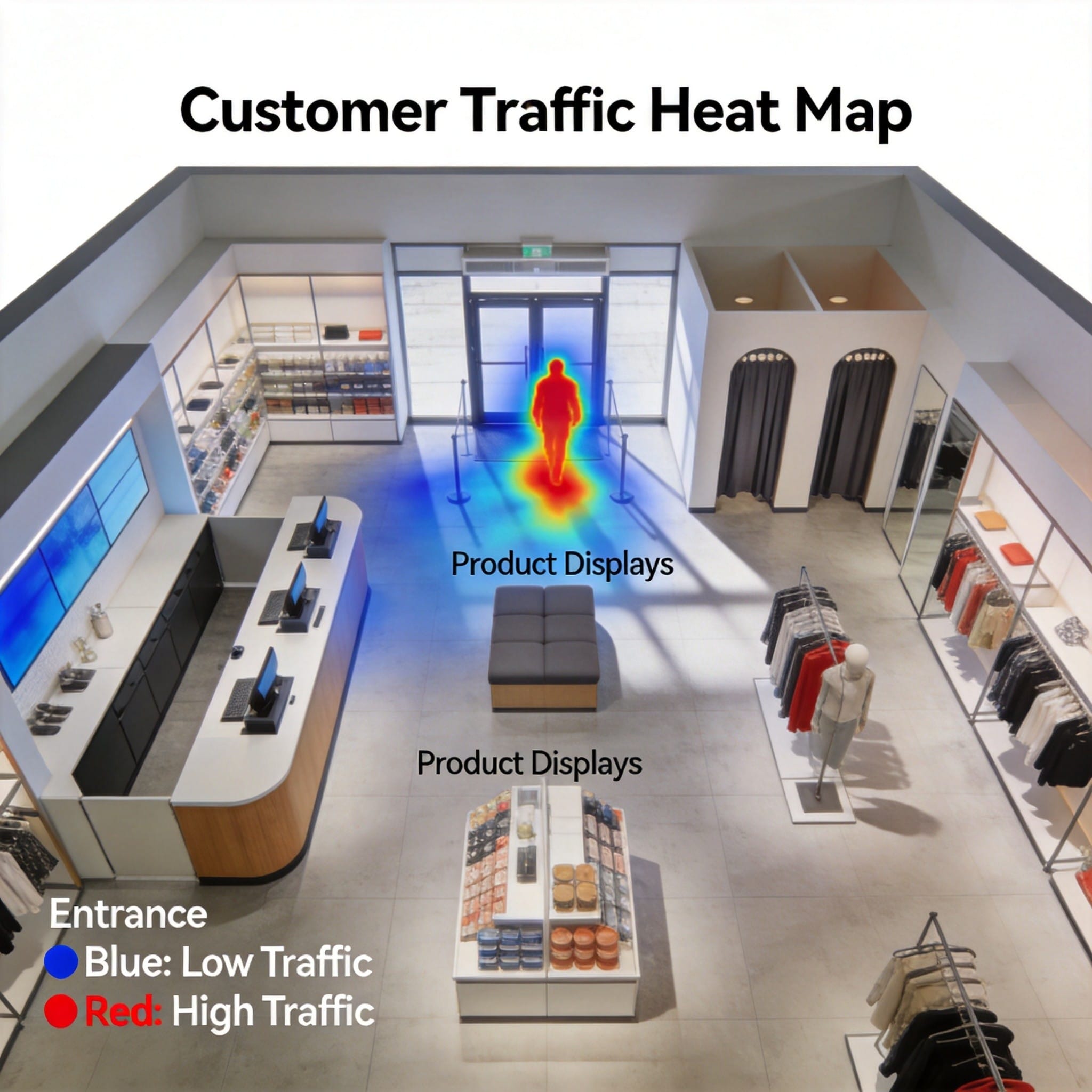
Heat map analytics represent one of the most powerful applications of smart lighting sensors. By analyzing BLE beacon signal strength variations as customers move through the store, intelligent systems generate real-time density maps showing which areas attract the most attention.
High-engagement zones
identify where customers naturally gravitate—typically near entrance areas, promotional displays, and high-margin product sections. Retailers using AI analytics consistently find that 60-70% of customer dwell time occurs in just 20-30% of total floor space.
Flow pattern analysis
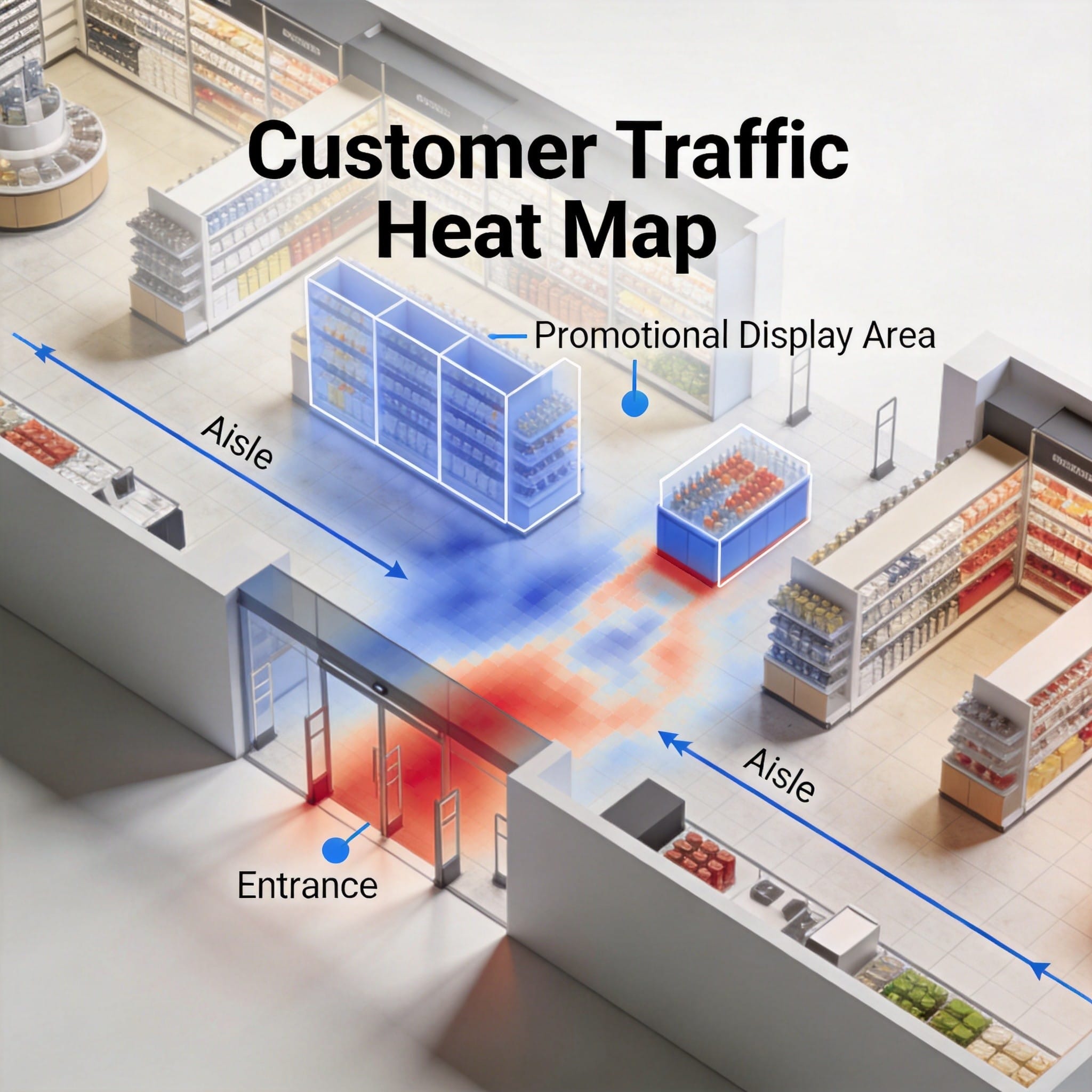
reveals the natural pathways customers follow through the space. Most retail environments see predictable traffic patterns: a right-turn bias at entrances, avoidance of narrow corridors, and gravitational pull toward well-lit display areas.
Foot Traffic Counting: The Foundation of Retail Intelligence
Beyond spatial analysis, smart lighting systems provide accurate, continuous foot traffic counting with ±3% accuracy in typical retail environments. This granular counting capability enables metrics impossible to obtain through manual observation or traditional security cameras.
Data-Driven Decision Making: From Insights to Action
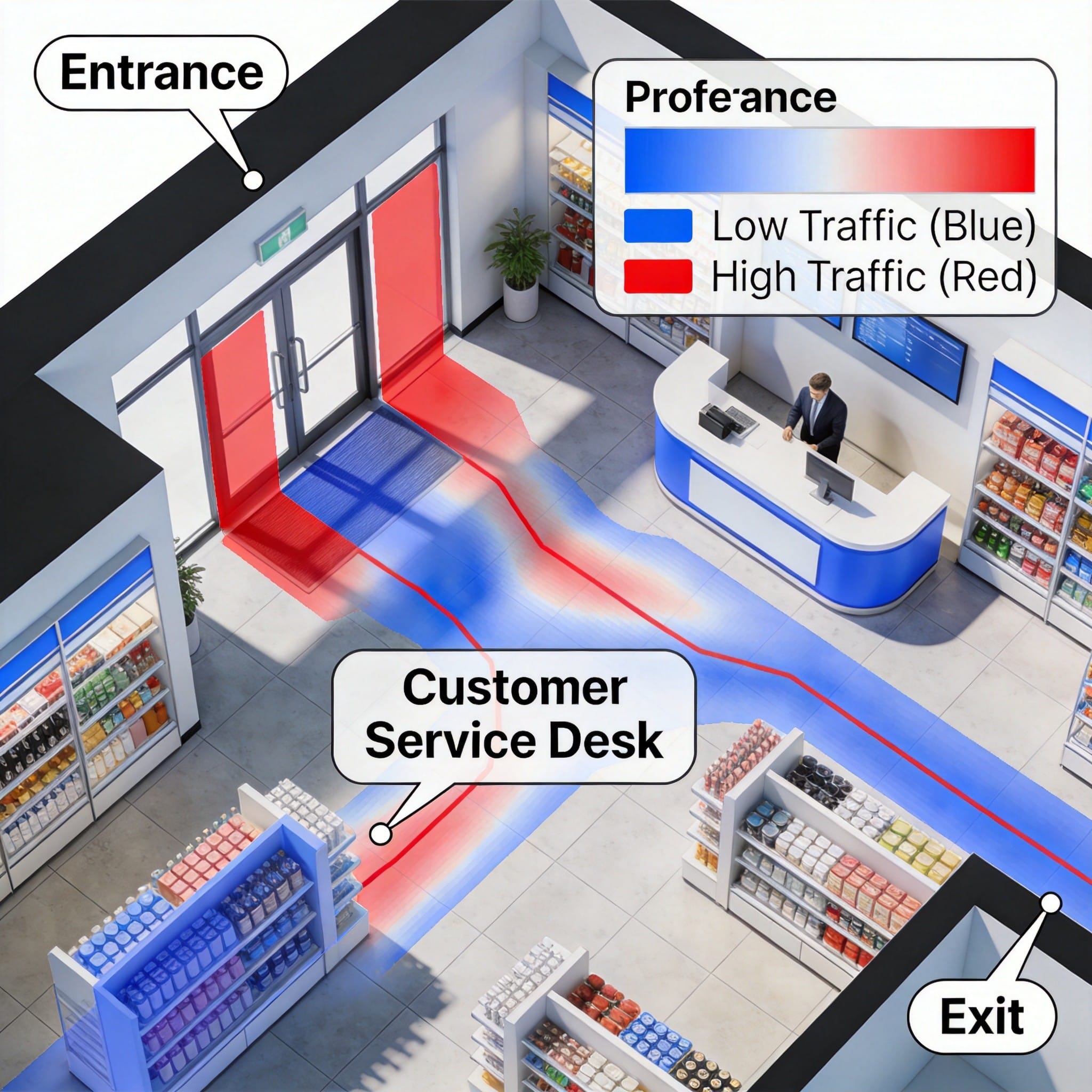
The true value of AI-powered retail analytics lies not in data collection but in actionable intelligence. Modern platforms transform raw foot traffic numbers and heat map visualizations into specific, implementable recommendations.
The ROI Case for AI Retail Lighting
The business case for intelligent lighting analytics extends beyond operational improvements to measurable financial returns:
- Energy savings: LED systems with occupancy-based dimming reduce lighting energy consumption by 40-60%
- Labor optimization: Data-driven scheduling typically reduces staffing costs by 10-15%
- Merchandising lift: Zone optimization based on heat mapping consistently delivers 5-12% sales increases
Looking Forward: The Integrated Retail Environment
The trajectory of AI-powered retail lighting points toward increasingly sophisticated integration. Future systems will combine spatial analytics with computer vision for product-level engagement tracking, integrate with digital signage for context-aware content delivery, and leverage machine learning to predict customer behavior with increasing accuracy.