
BLE Mesh Lighting: Enabling Seamless Smart Building Integration Through IoT Technology
The proliferation of Internet of Things (IoT) devices in commercial buildings has created both opportunities and challenges for lighting system designers. Building operators want intelligent, connected luminaires that can be monitored and controlled centrally—but they also demand reliability, security, and interoperability. BLE Mesh (Bluetooth Low Energy Mesh) technology addresses these requirements, emerging as a leading protocol for smart lighting deployments in commercial spaces.
Understanding BLE Mesh Architecture
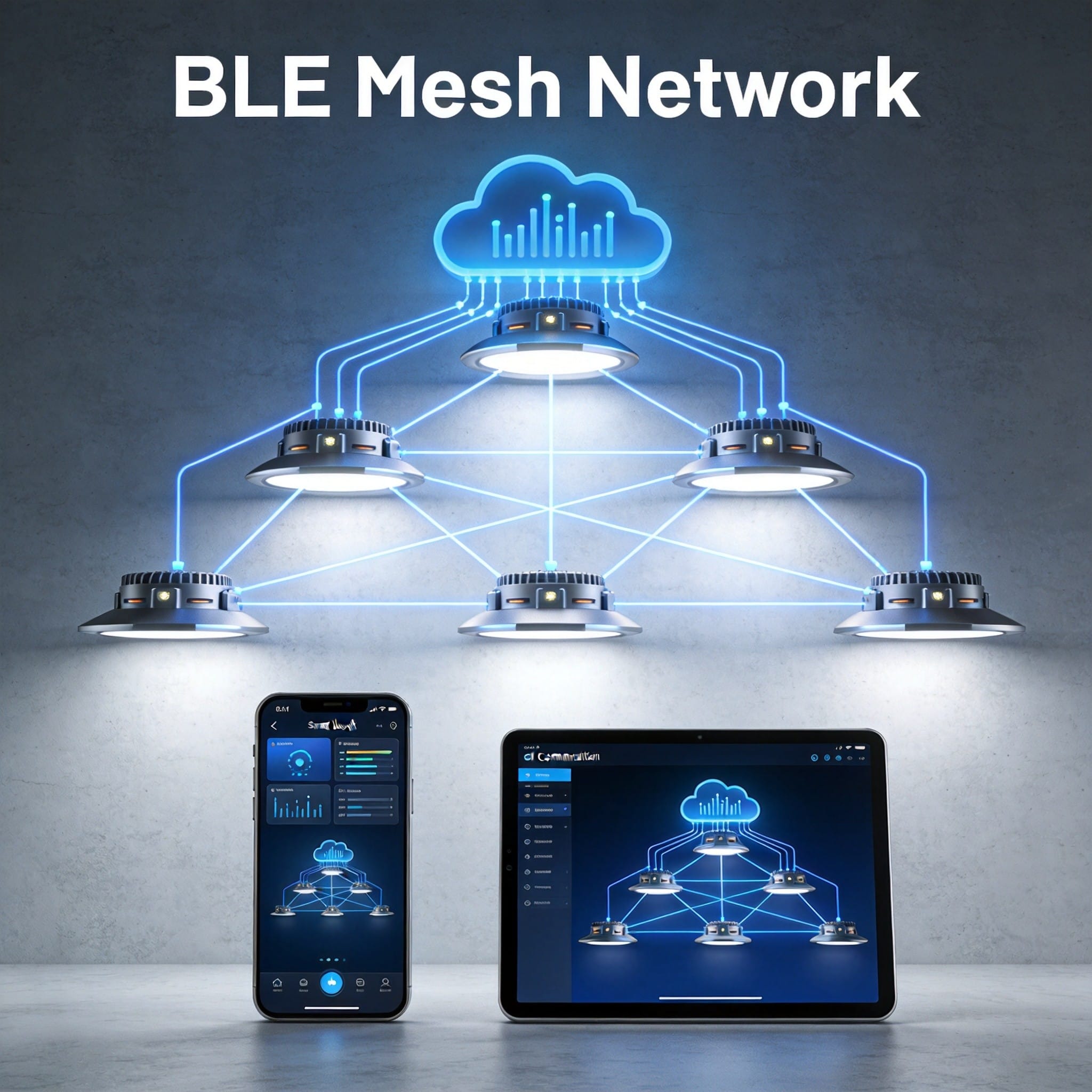
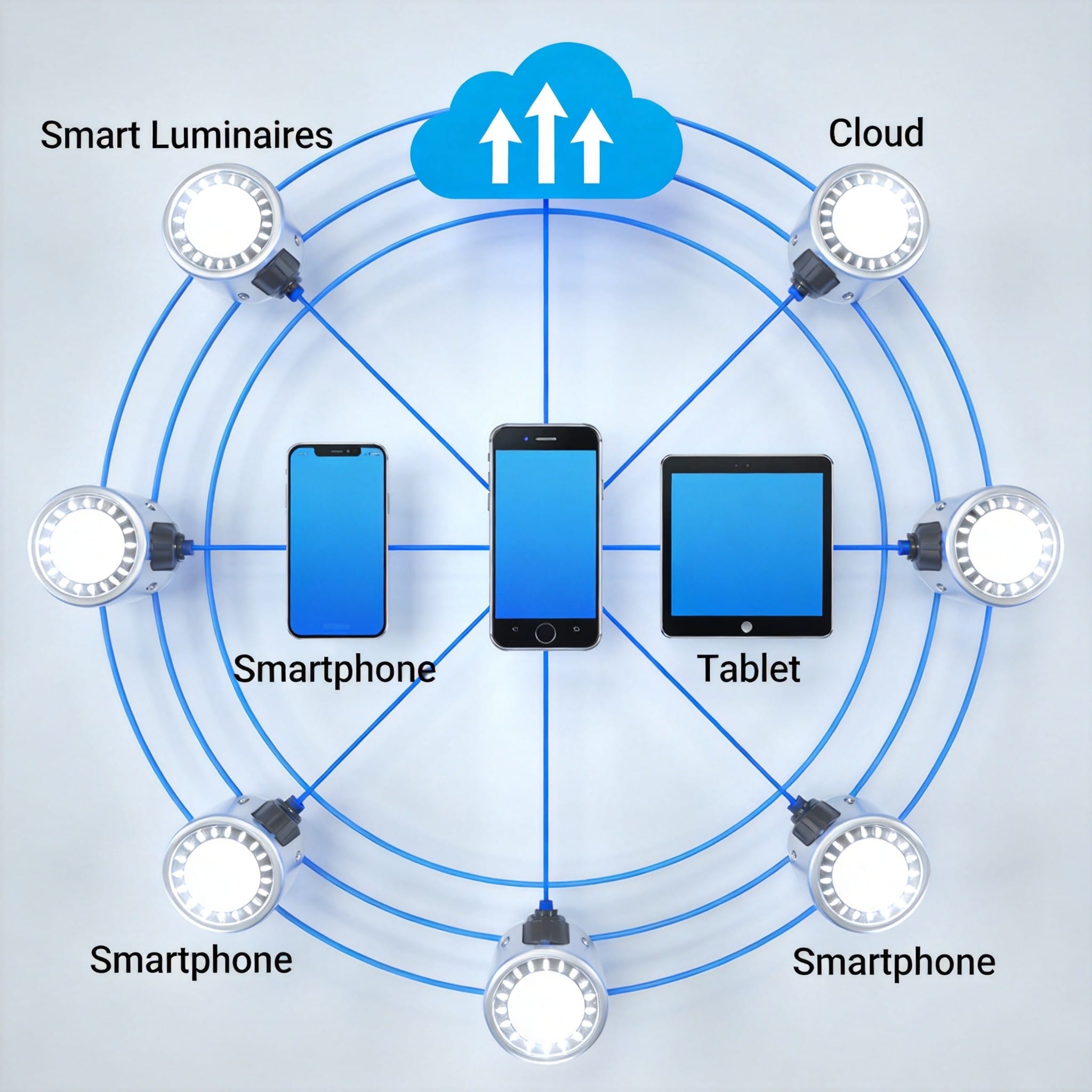
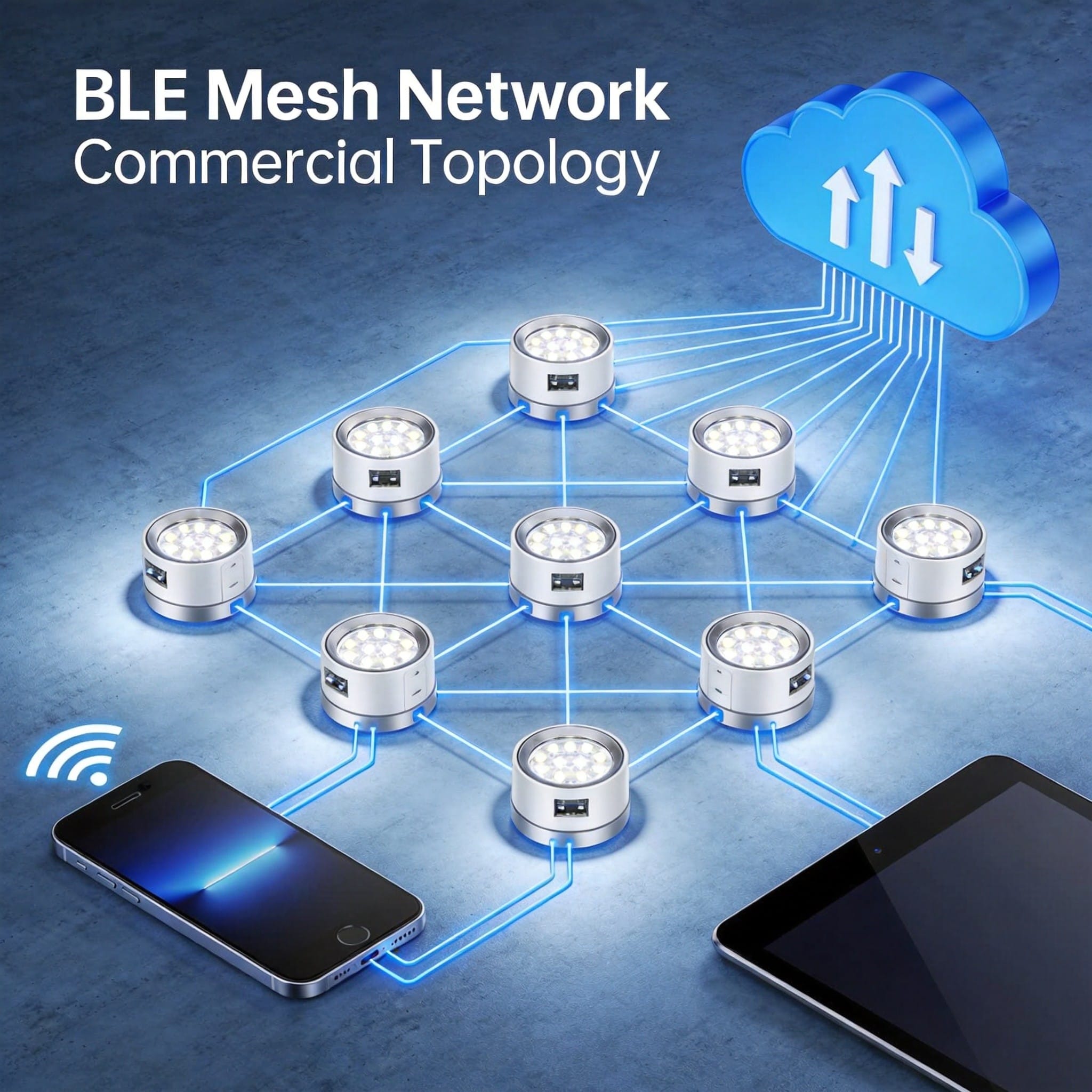
Traditional wireless lighting controls relied on point-to-point communication. Each luminaire communicated directly with a central controller, creating a star topology. This architecture presented limitations: the controller became a single point of failure, and coverage gaps required additional infrastructure.
BLE Mesh implements a mesh networking topology where every node can communicate with neighboring nodes. Messages propagate through the network via flooding, ensuring that no single device failure disrupts system operation. A luminaire on one side of a building can relay commands to a luminaire on the opposite side, extending effective communication range while maintaining redundancy.
Technical Specifications of BLE Mesh
Protocol Foundation
BLE Mesh is defined by the Bluetooth Special Interest Group (SIG) and operates on the 2.4 GHz industrial, scientific, and medical (ISM) band. The protocol stack includes:
- Bearer layer for radio communication
- Network layer for message routing
- Transport layer for upper layer message segmentation
- Foundation models for network management
- Application models for specific use cases
Network Capacity
A single BLE Mesh network supports up to 32,767 nodes—more than sufficient for even the largest commercial installations. Each node can belong to up to 16 different groups, enabling flexible zone management.
Power Consumption
As the name implies, BLE Mesh devices consume minimal power. Luminaires equipped with BLE Mesh modules typically draw less than 100mW during active communication and enter deep sleep modes between transmissions. This efficiency extends luminaire lifetime and reduces thermal stress on LED drivers.
Advantages of BLE Mesh for Commercial Lighting
Scalability Without Infrastructure
BLE Mesh eliminates the need for additional communication infrastructure beyond the luminaires themselves. In new construction projects, this simplifies installation by reducing wiring requirements for control circuits. In retrofit scenarios, BLE Mesh luminaires can operate independently or integrate with existing DALI infrastructure through protocol gateways.
The self-healing nature of mesh networks provides inherent reliability. When a luminaire fails, neighboring devices automatically reroute messages around the gap. Building operators experience no service disruption, and maintenance teams receive immediate notification of failures through the management platform.
Interoperability and Standards Compliance
BLE Mesh operates within a well-defined standards framework maintained by the Bluetooth SIG. This standardization ensures multi-vendor interoperability—a critical consideration for building operators who want flexibility in component selection and supplier relationships.
Certification and Compliance
Commercial lighting products incorporating BLE Mesh must complete Bluetooth Qualification Program testing. Products bearing the Bluetooth trademark have demonstrated compliance with core specification requirements. Additional certifications may apply based on geographic region and intended use:
CE Marking (European Union)
BLE Mesh lighting products sold in the EU must carry CE marking, confirming compliance with Radio Equipment Directive (RED) 2014/53/EU requirements for radio equipment.
FCC Certification (United States)
Products marketed in the US must comply with Federal Communications Commission rules under 47 CFR Part 15, including specific absorption rate (SAR) limits for devices operating in proximity to humans.
ISED Certification (Canada)
Innovation, Science and Economic Development Canada requires certification for radio equipment sold in the Canadian market.
BLE Mesh in Retail Lighting Applications
Retail environments present specific requirements that BLE Mesh addresses effectively. Store lighting must accommodate frequent layout changes, seasonal merchandise transitions, and varying accent requirements throughout the day.
Dynamic Zone Management
BLE Mesh enables granular zone control without rewiring. When a retailer moves a product display from one aisle to another, the lighting controller updates the zone assignment through the mesh network. Affected luminaires receive new addressing within seconds, and the updated scene activates automatically.
Integration with Retail Analytics
Advanced retail operations combine BLE Mesh lighting with occupancy sensors and analytics platforms. Luminaires serve double duty as lighting sources and data collection points, measuring foot traffic patterns, dwell times, and customer movement flows. This data informs merchandising decisions while the lighting system automatically adjusts to optimize product visibility.
Emergency Lighting Integration
Building codes require emergency lighting in most commercial spaces. BLE Mesh luminaires can incorporate emergency lighting functionality, with integral batteries and test capabilities built into the mesh network. When normal power fails, luminaires designated as emergency lighting immediately switch to battery backup mode. The mesh network reports status to building management, ensuring code compliance documentation is continuously maintained.
IoT Lighting Platform Architecture
Modern BLE Mesh lighting systems operate within a broader IoT platform architecture that enables cloud connectivity, data analytics, and remote management.
Edge Computing Capabilities
While cloud connectivity provides remote access and data aggregation, BLE Mesh luminaires incorporate edge computing capabilities that enable local intelligence. Critical functions—including occupancy response, daylight harvesting, and scene execution—operate locally without cloud dependency. This architecture ensures that lighting remains functional even during internet outages.
Cloud Management and Monitoring
Building operators access lighting systems through cloud-based management portals. These platforms provide:
Real-time Status Monitoring
Complete visibility into luminaire status, power consumption, and network health across all connected devices. Dashboards display system-wide metrics and highlight devices requiring attention.
Remote Configuration
System parameters, zone assignments, and scene configurations can be modified remotely. Changes propagate to affected luminaires within minutes, enabling rapid response to changing business requirements.
Predictive Maintenance
By analyzing luminaire operating parameters over time, IoT platforms identify devices approaching failure before they occur. Predictive maintenance alerts enable proactive replacement scheduling, reducing emergency repairs and minimizing business disruption.
Energy Reporting
Detailed energy consumption data supports sustainability reporting, carbon footprint tracking, and utility incentive applications. Integration with building energy management systems enables coordinated optimization across multiple building systems.
Data Security Considerations
IoT-connected lighting systems handle sensitive operational data that requires appropriate protection. BLE Mesh implements security at multiple levels:
Network Authentication
Every device joining a BLE Mesh network must authenticate using a network key. Unauthorized devices cannot participate in network communication or receive addressed messages.
Application Security
Separate application keys control access to specific lighting functions. Maintenance personnel might have access to configuration settings while store employees can only control scene selection.
Secure Provisioning
Device provisioning—the process of assigning keys and network addresses—uses Elliptic Curve Diffie-Hellman (ECDH) for secure key exchange, preventing key interception during the commissioning process.
Cloud Security
Data transmitted to and from cloud platforms uses TLS 1.3 encryption. Cloud storage implements at-rest encryption, and access controls limit data visibility to authorized personnel.
Comparison: BLE Mesh vs. Alternative Protocols
Building operators evaluating smart lighting technologies have multiple protocol options. Understanding the relative strengths of each approach informs appropriate technology selection.
Parameter BLE Mesh Zigbee DALI-2 Range Up to 100m (node-to-node) Up to 100m (outdoor line-of-sight) 300m (bus length) Max Devices 32,767 65,000 64 per bus segment Protocol Complexity Medium High Medium Cloud Integration Native Gateway required Gateway required Smartphone Access Native Gateway required Not typical Energy Efficiency Excellent Good Excellent Commissioning App-based Specialized tools Specialized tools BLE Mesh offers advantages in scenarios requiring smartphone commissioning, native cloud connectivity, and straightforward installation. Zigbee may be preferable for very large deployments with existing infrastructure. DALI-2 remains valuable for installations requiring precise individual luminaire addressing and extensive device library support.
Implementation Considerations
Successful BLE Mesh lighting deployments require attention to several factors during planning and execution.
Network Planning
Although BLE Mesh’s self-healing architecture tolerates device failures, initial network design should ensure adequate node density for reliable communication. Most deployments achieve excellent performance with luminaires spaced 8-15 meters apart. Challenging environments—spaces with significant metal infrastructure or dense shelving—may require additional nodes to maintain mesh connectivity.
Commissioning Process
BLE Mesh commissioning typically proceeds as follows:
1. Device Discovery: Commissioning tools scan for unprovisioned devices within range
2. Network Assignment: Devices receive network keys and unique unicast addresses
3. Group Configuration: Devices are assigned to appropriate groups representing physical zones
4. Scene Programming: Lighting scenes are defined and assigned to group addresses
5. Sensor Calibration: Occupancy sensors and photosensors are configured for appropriate sensitivity
6. Validation Testing: System operation is verified under various conditions
Modern commissioning applications guide installers through this process, reducing specialized training requirements and accelerating deployment timelines.
Ongoing Management
Post-installation, the IoT platform handles most management tasks automatically. Periodic reviews verify that system performance aligns with design intent and identify opportunities for optimization based on actual usage patterns.
Future Directions
BLE Mesh technology continues to evolve, with emerging capabilities that will enhance commercial lighting applications.
Bluetooth Direction Finding
The latest Bluetooth specifications add direction-finding capabilities, enabling sub-meter location accuracy using angle of arrival (AoA) or angle of departure (AoD) techniques. Lighting systems will combine illumination with indoor positioning, enabling wayfinding applications and asset tracking without additional infrastructure.
Enhanced Security Profiles
Ongoing specification development addresses emerging security requirements, including enhanced key management and improved protection against replay attacks.
Expanded Cloud Integration
Future IoT platforms will provide deeper integration with building management systems, enabling coordinated optimization across HVAC, lighting, and other building systems based on occupancy, weather, and energy pricing signals.
Conclusion
BLE Mesh technology has emerged as a compelling choice for commercial lighting deployments requiring scalability, reliability, and seamless IoT integration. The protocol’s standardization, multi-vendor interoperability, and native cloud connectivity address the core requirements of modern smart building applications.
For building operators evaluating lighting upgrades, BLE Mesh offers a future-proof foundation that will accommodate evolving requirements while delivering immediate operational benefits. The combination of energy efficiency, maintenance optimization, and occupant comfort improvements creates a compelling return on investment that positions BLE Mesh lighting as a strategic building improvement rather than merely a lighting replacement.
The commercial lighting market continues to evolve toward intelligent, connected solutions. BLE Mesh provides the technology foundation that makes this transformation practical, scalable, and economically viable for installations of all sizes.
—
Focus Keyword: BLE Mesh lighting, IoT lighting systems, smart building integration, commercial lighting automation
Meta Description: Explore how BLE Mesh lighting technology enables seamless smart building integration through IoT connectivity. Learn about protocol architecture, retail applications, and implementation best practices.
Internal Links:
- Related: https://caimeta.net/smart-lighting-system/ (Smart Lighting System)
- Related: https://caimeta.net/ai-retail-analytics/ (AI Retail Analytics)
- Product: https://caimeta.net/ai-lighting-system/ (AI Lighting System)
- About: https://caimeta.net/about/ (About CAIMETA)
- About: https://caimeta.net/about/ (About CAIMETA)
- Product: https://caimeta.net/ai-lighting-system/ (AI Lighting System)
- Related: https://caimeta.net/ai-retail-analytics/ (AI Retail Analytics)
- Related: https://caimeta.net/smart-lighting-system/ (Smart Lighting System)
- Application models for specific use cases
- Foundation models for network management
- Transport layer for upper layer message segmentation
- Network layer for message routing