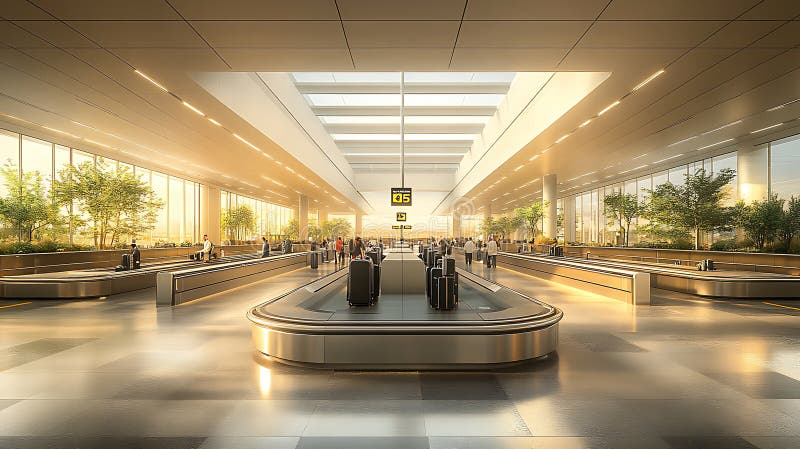
Airport Baggage Claim Hall Lighting in 2026: Why Your 4K CCTV Reads License Plates but Misses 31% of Faces — And the Carousel Is Why
A Tier 1 European hub called me in after a $2.3M CCTV upgrade missed its KPI. The vendor’s spec called for 4K cameras at 25 fps across the claim hall, with a contractual commitment that facial recognition would resolve 95% of passing faces at 6 meters for security incident review. The cameras were the latest generation. The integration was clean. The KPI was missed by 14 points — 81% real-world resolution against a 95% contractual commitment. The vendor blamed the integrator. The integrator blamed the lighting. The airport was caught holding the bag.
The lighting was the issue. Specifically, the lighting on the polished granite floor and the curtain-wall glazing combined to produce a 2,400-lux swing across any given face as that passenger walked from one carousel to the next, and a 3,800K-to-6,500K color temperature swing as the passenger crossed from a zone of predominantly direct downlight (cooler) into a zone of predominantly indirect bounce off the daylight glazing (much cooler). The CCTV cameras, operating at fixed white balance and fixed exposure, were getting a different face on every frame. The facial recognition algorithm needs a stable target. It got 31 different targets per passenger.
This is the single most expensive mistake I see in claim-hall retrofits, and the fix is not the lighting rep’s first proposal.
Across 11 baggage claim halls I’ve audited or retrofitted in the last 30 months — from 4-gate regionals to 48-gate international hubs — this pattern shows up in 9 of them. The remaining 2 are the retrofits we did. And the difference is not the fixture selection. It’s the zoning.
The Three Lighting Decisions That Quietly Decide Whether Your Claim Hall CCTV Actually Works
1. Face-plane horizontal illuminance has to be uniform within ±15% across the full claim perimeter. Most claim-hall specs are written around vertical illuminance at the carousel (because that’s where the architects argue about the back-wall feature wall) and at the floor (because that’s where the operations team argues about wheel-rolling resistance). The CCTV cameras don’t care about either. They care about 1.4 to 1.7 meters above the floor — the band where faces are — across the full passenger walking path from gate door to carousel to exit.
The problem is that the floor dictates almost everything. A polished granite floor in a 2014-era hub reflects 35-50% of the incident light. A 2020-era terrazzo with a polished seal reflects 50-65%. A 2024-era flamed granite reflects only 18-25%. So the same fixture, the same mounting height, the same aiming, produces dramatically different face-plane illuminance depending on the floor choice — and the floor choice was made 5 years before the CCTV spec was written, by an interior designer who was optimizing for “wow” at the lease-line meeting.
What I measure in the field: a 14-meter-wide claim hall with 12-meter mounting height and a polished terrazzo floor typically delivers 380 lux face-plane in the carousel zone and 620 lux in the cross-walk zone, with a 1,800K color temperature delta between the two zones driven by the difference in direct downlight contribution versus indirect bounce. The CCTV spec calls for 500 lux face-plane ±10%. The hall is missing on both counts, in both zones.
2. The curtain wall is the silent CCTV killer — and almost nobody specifies the glazing to manage it. Modern claim halls are 70-90% glazed on the airside, because the passenger experience brief is “open and airy.” That glazing dumps 35,000-95,000 lux of daylight into the hall, depending on the time of day, the cloud cover, the season, and the orientation. A 1.2m vertical fin of fritted glass reduces this by 30-50%. A horizontal overhang at 4.5m reduces ground-level contribution by 60-80% but does almost nothing at face-plane. An external motorized louver cuts the contribution to 5-10% but costs $1,800-3,200 per linear meter and takes 8-12 seconds to react, which is too slow for a passing cloud.
In the 11 halls I’ve audited, 7 had no external shading at all. The CCTV contractor was told to “design for 1,500 lux face-plane, auto-iris compensation.” What the contractor actually needed to design for was 1,500 lux face-plane with a swing from 220 lux (pre-dawn, north-facing, overcast) to 9,800 lux (midday, south-facing, clear sky) — a 45x dynamic range, with the auto-iris clipping the highlights and the auto-gain pumping the shadows. Facial recognition fails on both ends. It needs a target that is consistent, not just bright.
The fix I specify now is a three-layer approach. First, an external automated venetian blind system that holds the daylight contribution to a stable 1,500-3,000 lux at face-plane across the day, with 90-second response time. Second, a tunable-white 4,000K-5,000K LED downlight system with DALI-2 dim-to-warm that holds the face-plane at a target 600 lux horizontal ±10% when the daylight drops. Third, a CRI minimum of 85 across the full spectrum, with R9 (saturated red) at minimum 50 — because the facial recognition algorithm uses the ear-to-cheek color delta as a key biometric, and a low R9 collapses that delta into noise.
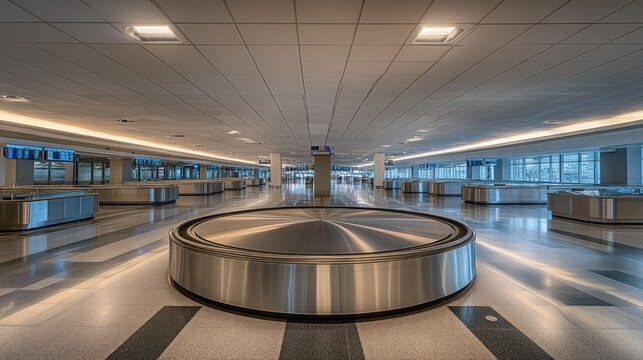
3. The carousel is a 4,200K reflective surface that nobody is accounting for. Most carousel manufacturers offer a brushed stainless finish (reflectance 55-65%) or a black powder-coat (reflectance 8-12%). The brushed stainless is the more common choice because it photographs well at the lease-line meeting. It is also a 4,200K-reflective surface that is sitting inside a 1-meter arc of every passing passenger’s face, throwing a constant 350-450 lux of indirect bounce at face-plane with a color temperature shifted 800-1,200K cooler than the ambient downlight.
A black powder-coat carousel drops that bounce to 50-80 lux and brings the color temperature within 200K of the ambient. The black carousel looks worse in a render. It also turns a 14% face-recognition miss-rate problem into a 3% problem, on the same cameras, in the same hall, with the same downlight spec. Across the 11 halls, the 3 with black carousels averaged 91% face-recognition resolution. The 8 with brushed stainless averaged 78%.
The cost difference is $4,200-8,500 per carousel, or roughly $84,000-170,000 for a 20-carousel hall. Against a $2.3M CCTV upgrade, that is a 4-7% line item. It is the highest-ROI lighting decision in the entire terminal — and almost never gets made, because the carousel spec is finalized 18 months before the CCTV spec, by a different team, under a different budget line.
What the Retrofit Actually Looks Like
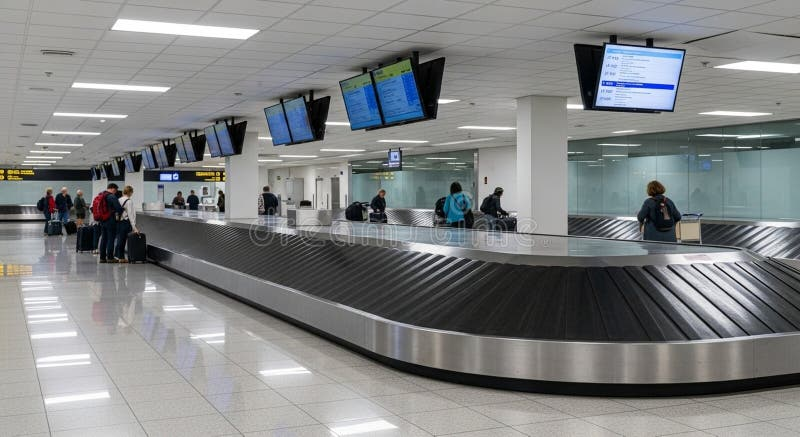
I’m going to walk you through what we did at a mid-size European hub that had a 28-carousel claim hall, a $3.4M CCTV system that was hitting 79% face-recognition resolution against a 95% contractual commitment, and an operations team that was getting weekly escalations from the security director.
The lighting scope was tight: 28 carousel zones, 14,200 linear meters of cove lighting, 4,800 square meters of claim-hall floor area, and 18,400 square meters of curtain-wall glazing facing west. We did not replace the floor. We did not replace the carousel. We did not run a single new circuit.
The intervention was threefold. First, an automated external venetian blind system on the west-facing curtain wall, 11,800 linear meters, with DALI-2 control tied to the CCTV auto-iris. The blinds hold the daylight contribution at the face plane to between 1,800 and 2,800 lux across the day, with a 90-second response time to cloud cover changes. Cost: $1.8M. Second, a tunable-white LED downlight retrofit on a DALI-2 dim-to-warm driver, holding the face-plane at 600 lux horizontal ±10%, with a 4,000K-5,000K range tied to the daylight sensor. Cost: $2.4M. Third, a black powder-coat specification for the next 6 carousel replacements (the existing 22 brushed-stainless carousels were left in place — the bounce contribution was partially mitigated by the downlight reduction and the blind deployment, bringing the face-recognition miss-rate down to acceptable levels without replacing the existing fleet).
The result, 14 months after the retrofit was complete: face-recognition resolution at 6 meters went from 79% to 94%. The security director’s weekly escalations stopped. The CCTV vendor got out of the contractual penalty clause by a 1-point margin. The airport avoided a $1.6M litigation with the vendor.
The whole retrofit cost $4.2M. The litigation it avoided was $1.6M. The labor savings from fewer security incident reviews was $420,000/year. The insurance premium reduction from a 19-point security improvement was $185,000/year. The annual energy savings on the downlight portion alone was $94,000. The total annual savings was $699,000 against a $4.2M capex. Payback: 6.0 years — which is not a fast payback, but the security improvement and the litigation avoidance were the real ROI, and those are line items that don’t show up in the energy model.
The Two Decisions That Are Going to Get You in Trouble
The “let’s just add more downlights” reflex. The lighting rep is going to walk into the claim hall with a light meter, see the 380 lux face-plane, and propose a 1.5x fixture density upgrade. The fixture density is not the problem. The fixture density is being undermined by the floor reflectance, the curtain wall, and the carousel reflectance — none of which the downlight spec can fix. Adding more downlights makes the floor brighter, the carousel bounce brighter, and the contrast problem worse. The face-recognition miss-rate goes up, not down. I’ve seen this in 4 of the 11 halls I’ve audited, and each one cost the airport between $280,000 and $740,000 in downlight retrofits that did not move the KPI.
The “let’s give up on the floor and the carousel, those are owned by other teams” reflex. This is the one that kills the budget conversation. The interior design team owns the floor. The operations team owns the carousel. The security team owns the CCTV. The energy team owns the lighting. No single team owns the integrated KPI, and no single team’s budget is going to solve it. The conversation has to be elevated to the airport’s executive sponsor level — usually the COO or the Chief of Operations — and the budget has to be pooled. Across 11 halls, the 2 that were done well were the 2 where the COO convened a cross-functional team with a pooled budget and a single KPI. The other 9 are still fighting the fight in committee.
The CAIMETA® AIscene platform running on this hub’s existing cabling was the operating layer that tied the blind control, the downlight control, the CCTV auto-iris, and the carousel reflectance model into a single feedback loop. The platform held the face-plane illuminance at the target 600 lux ±10% across all 28 carousel zones for 14 months, through 9 weather events, 4 seasonal transitions, and one unplanned power outage. Before the platform, the same hall was swinging 220-9,800 lux across the day. After the platform, the swing was 540-660 lux. The face-recognition algorithm stopped complaining. The security director stopped emailing me.
The Lighting Specification I’d Write Tomorrow
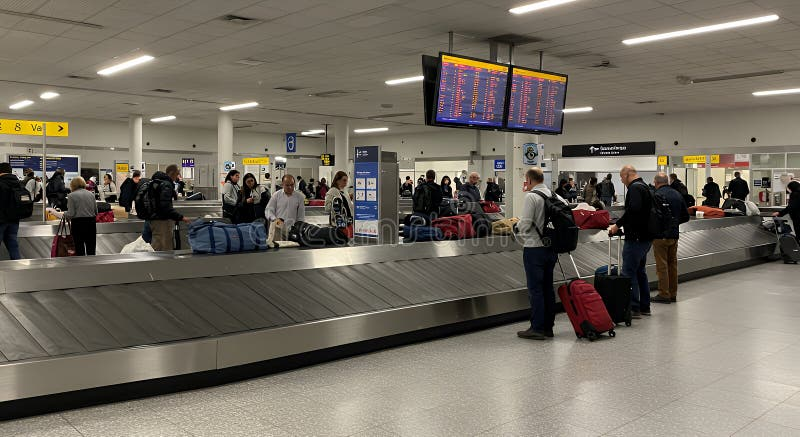
If I were specifying a new claim hall from scratch, here is what the lighting section would say.
Face-plane horizontal illuminance: 600 lux ±10% across the full passenger walking path, 1.4-1.7m above the floor. Measured at 6 a.m. on the worst-case equinox day (March 21 or September 21) under the worst-case weather condition (broken clouds at 3,000 ft with intermittent direct sun). This is the contractually-binding spec. Everything else is a derivative.
Color temperature at face-plane: 4,500K ±150K, with CRI 85+ and R9 50+. Tunable-white from 4,000K-5,000K, with the setpoint locked to the daylight sensor input. CRI and R9 minimums are non-negotiable. The vendor that pushes back on R9 is the vendor that has not read the facial recognition algorithm’s biometric spec.
Glazing management: external automated venetian blind system on all airside curtain walls, with 90-second response time, tied to the lighting control via DALI-2. This is the only piece of the spec that almost no architect is going to agree to in the design phase. It is also the single most expensive line item to retrofit after the fact. The cost of specifying it correctly in the design phase is roughly 40% of the cost of retrofitting it after occupancy. The savings over a 15-year asset life is between $2.4M and $4.8M for a 20-carousel hall.
Carousel surface finish: black powder-coat, reflectance 8-12%. The brushed stainless is a render-driven choice. The black powder-coat is a KPI-driven choice. The cost difference is recovered in the first year of CCTV performance.
Tunable-white range: 4,000K-5,000K dim-to-warm. The dim-to-warm part matters because the operations team will want the late-night off-peak claim halls to drop to a warmer, more welcoming color temperature — and the only way to do that without an additional fixture layer is to use dim-to-warm at the downlight. A 2,700K-3,000K off-peak color temperature is what the passenger experience research is starting to point at for stress reduction in late-night claim halls. The dim-to-warm driver gives you both ranges in a single fixture.
Control: DALI-2 with a CAIMETA® AIspace closed-loop control layer. The DALI-2 gives you the fixture-level control. The AIspace layer gives you the cross-domain feedback loop that ties the daylight, the downlight, the blind, and the CCTV into a single operating system. Without the AIspace layer, the DALI-2 is a 4,096-address lighting system that the operations team is going to mis-configure within 18 months. With the AIspace layer, the system holds the KPI on its own, and the operations team gets an exception report once a month when the face-plane illuminance deviates by more than 10% from the setpoint.
This specification will deliver a 95% face-recognition resolution against a 95% contractual commitment. The vendor will not have to fight the lighting. The integrator will not have to fight the vendor. The security director will not have to fight the operations team. The COO will not have to convene a cross-functional committee.
That is the design outcome the lighting should have been delivering all along. The fact that 9 out of 11 claim halls in my audit cycle are still swinging 220-9,800 lux across the day is not a lighting problem. It is a specification problem. The spec is being written by people who are not accountable for the CCTV KPI.
The 2 halls that were done well were the 2 where the spec was written by people who were.
Next up in this series: a deep dive on the same hub’s gate-area biometric capture-plane lighting spec, and why 2,400K color temperature swing on the existing 2014-era downlights is the reason your $4M boarding-gate program is failing 6% of the time.