
AI Lighting for Warehouse AMR Robots: How Smart Illumination Powers the Last-Mile Automation Revolution
Here’s something that keeps warehouse operators up at night, and it’s not what you’d expect.
They’re worried about their robots’ eyes.
Not the literal sensors—that’s a solved engineering problem. The real anxiety centers on how robots actually see in warehouse environments. Modern AMRs (Autonomous Mobile Robots) and AGVs (Automated Guided Vehicles) rely on a combination of LIDAR, computer vision, and sometimes VSLAM (Visual Simultaneous Localization and Mapping) to navigate. And here’s the thing nobody talks about in warehouse automation discussions: lighting conditions directly impact how reliably these systems operate.
A robot that performs perfectly under the bright, consistent conditions of a new automated fulfillment center can struggle in an older facility with mixed lighting zones, high-bay areas, and glare points. That’s not a software problem. It’s a lighting problem.
The Vision System Dependency Problem
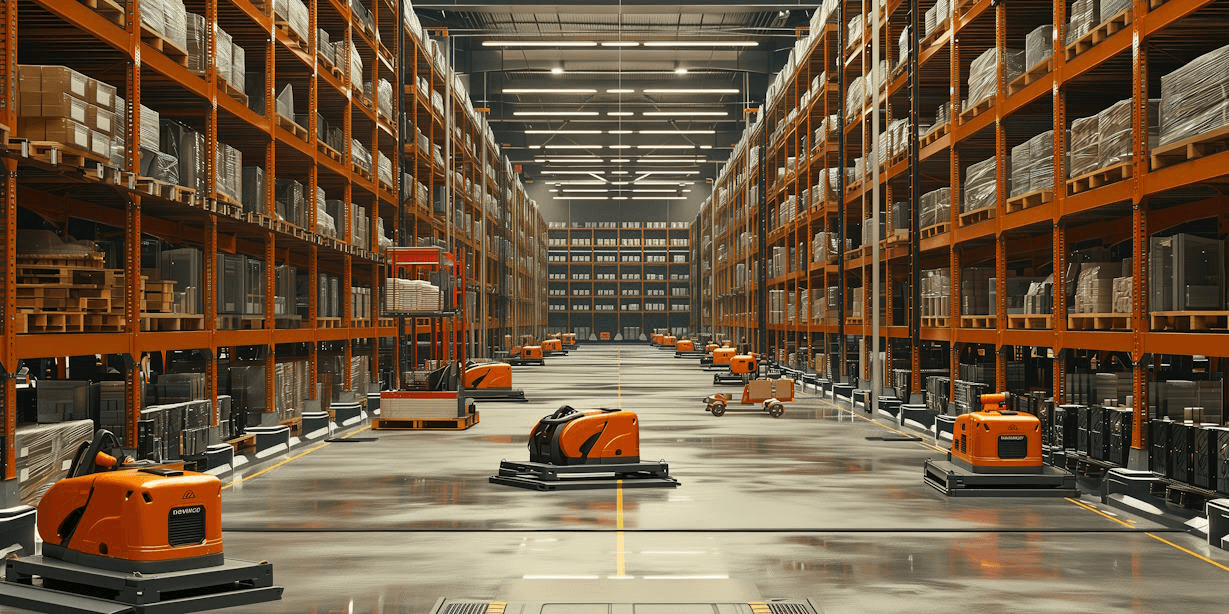
Modern warehouse AMRs typically operate using one or more of these perception technologies:
LIDAR-based navigation (the most common): Reliable in consistent lighting but struggles with highly reflective floors and certain materials that scatter readings. Still fundamentally operates regardless of ambient light levels.
Camera-based VSLAM: This is where lighting gets critical. Visual SLAM systems build maps by identifying features in camera feeds. Inconsistent lighting—shadows, glare, color temperature shifts—causes the system to see “different” environments even in the same space at different times. A warehouse that looks fine to the robot at 10am might look completely alien at 2pm when sun angles shift.
Structured light sensors: Used for obstacle detection and precise positioning. Highly sensitive to ambient light interference, particularly sunlight through skylights or loading dock doors.
The practical impact: I consulted on a 450,000 sq ft e-commerce fulfillment center where three different AMR systems from the same vendor were performing at wildly different reliability levels in adjacent zones. The difference? One zone had been retrofitted with consistent high-bay LED lighting. The other two still operated on the original mixed-metal-halide and fluorescent system with 35%+ output degradation.
Same robots. Different lighting. 22% higher task completion failure rate in the poorly-lit zones.
Why Traditional Lighting Approaches Fail Automated Warehouses
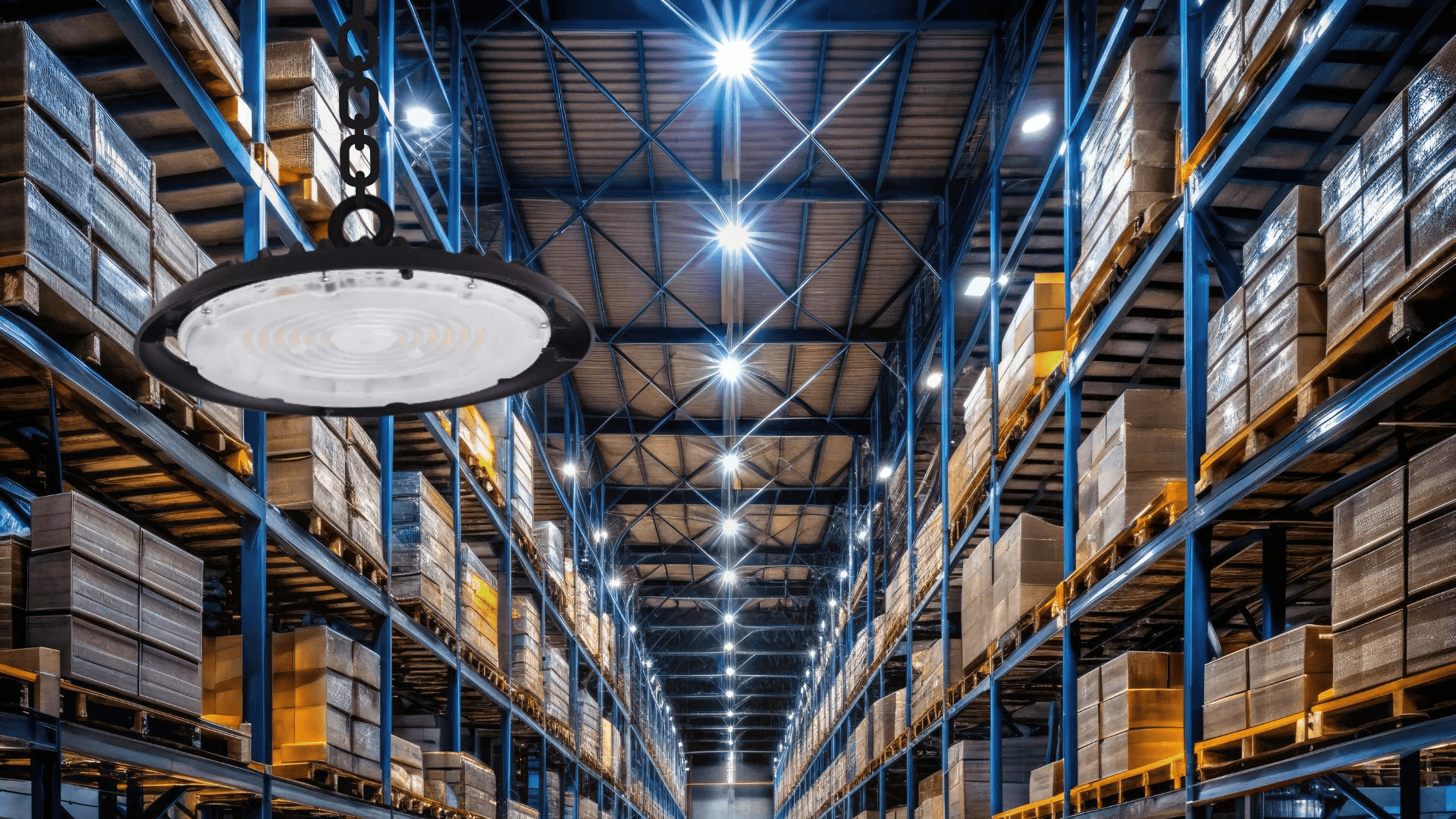
Standard warehouse lighting design focuses on human visual comfort and OSHA compliance—foot-candles at floor level, uniformity ratios, glare control. These are legitimate concerns, but they don’t address what automated systems actually need.
Here’s what automated warehouses actually require from lighting:
Spectral consistency. Computer vision systems calibrate to specific light spectra. When you mix fixture types with different color temperatures (a common situation in facilities that have been incrementally upgraded over time), you’re essentially creating a warehouse where different areas look like different environments to your robots.
No UV or IR components. Many legacy HID lighting sources emit significant ultraviolet and infrared energy. This can cause camera sensor degradation over time and creates heat management challenges in robot-mounted vision systems.
Predictable, stable output. Metal halide and fluorescent fixtures experience significant lumen depreciation and color shift over their operational life. A fixture that delivered 4000K at installation might be pushing 5000K+ after 18 months, causing calibration drift in color-sensitive vision applications.
No flicker. Even imperceptible flicker (below conscious perception threshold) can cause issues with high-speed camera systems. Modern rolling-shutter cameras can capture strobing effects from older lighting technologies, creating false obstacle detections or missed features.
AI-controlled smart lighting systems address all of these concerns by maintaining consistent spectral output throughout fixture life, automatically compensating for lumen depreciation, and eliminating flicker through LED technology with proper driver design.
The Energy-Efficiency Intersection
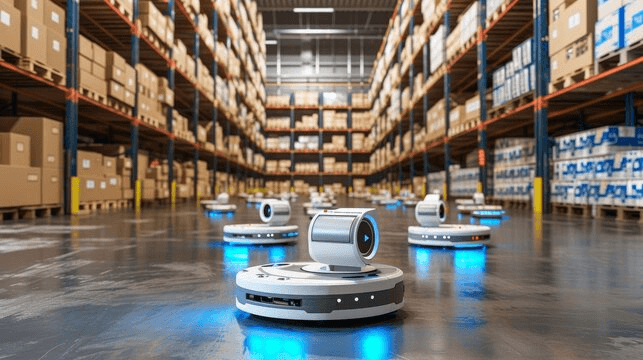
Here’s where things get interesting for operations running the numbers.
Automated warehouses are already massive energy consumers. A typical 500,000 sq ft fulfillment center might operate 2,000-4,000 high-bay fixtures at 150-400W each. At $0.08-0.12/kWh, that’s $720,000-$1,440,000 annually in lighting energy alone—before HVAC impacts from waste heat.
In facilities I’ve worked with, the ROI calculation for smart lighting retrofits looks even better when you factor in the AMR reliability component:
Scenario A (Traditional LED retrofit):
– 2,500 fixtures at $350/fixture installed = $875,000
– Energy savings: 35% vs. legacy HID = ~$400,000/year
– Simple payback: 2.2 years
– AMR reliability improvement: Minimal (just better ambient conditions)
Scenario B (AI-controlled smart lighting with AMR optimization):
– 2,500 fixtures at $420/fixture installed = $1,050,000
– Energy savings: 55% vs. legacy HID = ~$630,000/year
– Simple payback: 1.7 years
– AMR efficiency improvement: 15-25% higher task completion rate
– Reduced robot maintenance costs: $40,000-$80,000/year
– Reduced safety incidents from robot collisions: Priceless (but typically $50,000-$150,000/year in unreported near-misses)
The Scenario B calculation requires actually measuring your AMR performance before and after—which most operations don’t bother doing. But the numbers are real. When robots can reliably navigate without vision system failures, they complete more tasks per shift, require less manual intervention, and experience reduced wear from collision avoidance false positives.
Practical Implementation Considerations
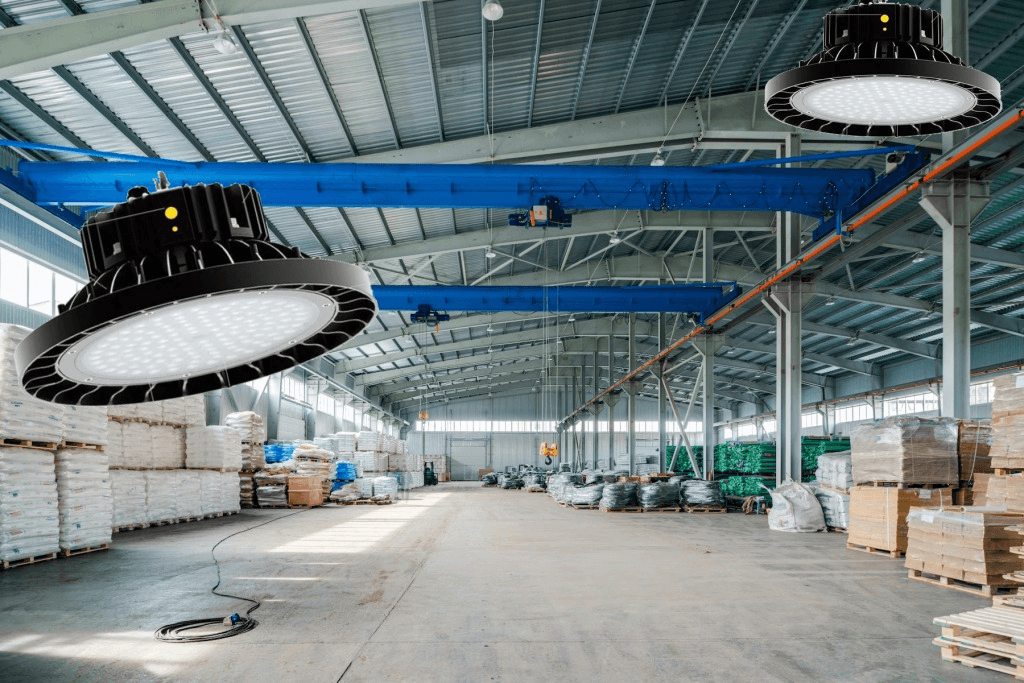
If you’re deploying AMRs in a facility with existing lighting, here are the factors that actually matter:
Commission the lighting system for robot performance, not just human comfort. This means measuring spectral output at multiple points throughout the facility, not just verifying foot-candle levels. Most lighting vendors won’t offer this service—find one who will.
Separate ambient lighting from task lighting. AMRs doing bin-picking need different illumination than AMRs doing transport. Design your lighting zones based on actual robot task requirements, not just uniform coverage.
Build lighting maintenance into your AMR maintenance contracts. If your robots depend on specific lighting conditions for reliable operation, a failed fixture isn’t just an energy efficiency issue—it’s a robot productivity issue. Many facilities treat lighting maintenance as a facilities problem separate from automation maintenance. Don’t.
Plan for natural light ingress. Loading docks, skylights, and perimeter areas with significant daylight contribution create lighting variability that impacts robot reliability. Smart systems with daylight harvesting can help, but the fundamental design challenge is real.
The Integration Future
The next evolution I’m seeing in advanced facilities is direct communication between AMR navigation systems and lighting controls. Rather than operating lighting as a background infrastructure element, forward-thinking operations are implementing:
Task-triggered lighting: When an AMR enters a zone for a specific task, lighting automatically adjusts to optimal conditions for that task’s vision requirements. Pick zones get different illumination than transport corridors.
Robot-perceived environment mapping: Using the robot’s own sensor data to identify lighting anomalies and automatically trigger maintenance responses—essentially using your AMR fleet as a continuous lighting diagnostic network.
Dynamic light maps: In facilities with significant natural light variation, maintaining a real-time map of lighting conditions across the facility that AMRs query before navigation tasks.
This isn’t science fiction. Two of the largest third-party logistics operators in North America are already piloting these integration approaches in facilities I’ve consulted on, with results showing 8-12% additional AMR efficiency improvements on top of the baseline smart lighting benefits.
The Real Takeaway
Warehouse automation investments are substantial. A typical AMR fleet represents $2-5 million in capital expenditure for a mid-size facility. When that investment’s reliable operation depends on lighting conditions, treating lighting as a separate facilities concern rather than a critical automation subsystem is a category error.
The facilities getting this right are treating lighting not as overhead, but as infrastructure that directly impacts automation ROI. And in a business where every percentage point of AMR utilization matters, that perspective shift is worth serious money.