
Why Your 15-Meter Wall Is Only Lit on the Bottom Half
Walk into most indoor climbing gyms and you’ll see the same problem from the entry: the lower 4 meters of the climbing wall are bright, vivid, and color-accurate. The upper 10 meters fade into a dim, yellowish haze where the holds become silhouettes and the route colors blend into one undifferentiated mass.
This isn’t a budget issue. It’s not a fixture issue. It’s a physics problem that 90% of climbing gym operators don’t understand — and it directly affects safety, route readability, member retention, and energy costs.
The reason: most gyms use 4000K–5000K LED high-bay fixtures designed for warehouses. They throw light downward and outward at a 90–110° beam angle. At floor level, the illumination is 500+ lux. At 8 meters up, it’s 80 lux. At 12 meters up, it’s 30 lux. By the time you reach the top of a competition wall, the lighting is darker than a typical office hallway.
This is fine for storing pallets. It’s catastrophic for climbing.
Why Climbing Gym Lighting Is Unlike Any Other Athletic Facility
Most sports lighting follows a simple rule: light the playing surface from above with even illumination. Basketball courts, volleyball courts, swimming pools — all are horizontal surfaces. The light goes up, reflects down, distributes evenly.
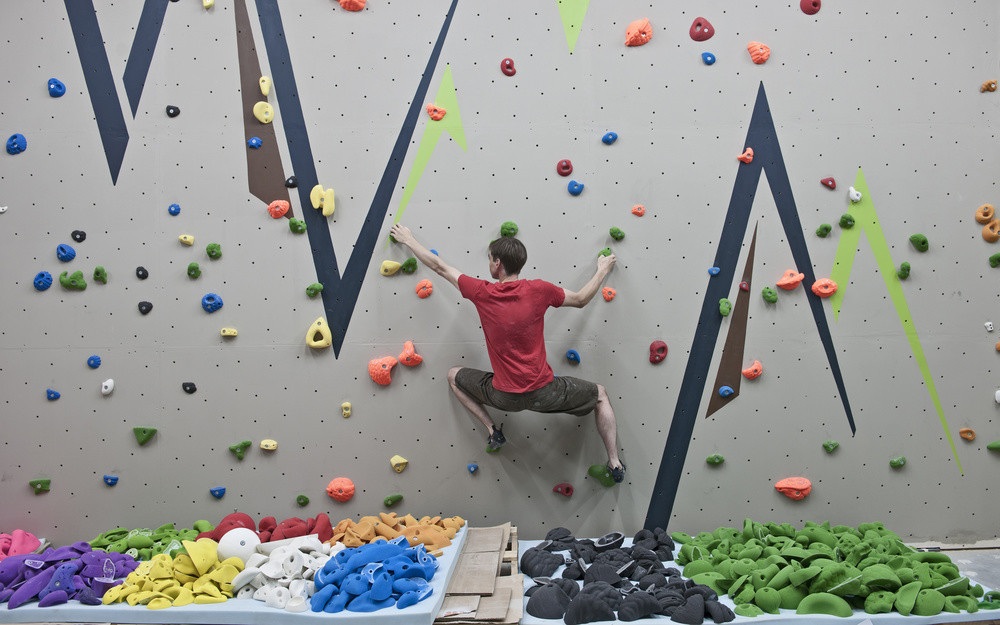
Climbing walls are vertical. Or worse — overhanging. Light thrown downward from a high-bay fixture hits the wall at an oblique angle, which means:
– Most of the light bounces off the wall surface rather than illuminating the holds
– Holds facing away from the fixture are in shadow (the “wrong way around” problem)
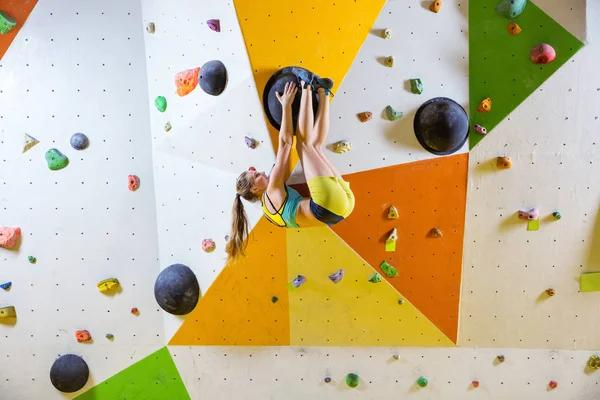
– Overhanging sections (most modern bouldering walls) receive almost no direct light because the fixture is above and the wall faces outward
The result: the top of the wall is dark, the overhangs are dark, and the climbers’ primary visual task — reading the route — becomes guesswork in the last 60% of the climb.
This isn’t just an aesthetic problem. It’s a safety issue. Climbers route-read at the base, then climb blind for the upper sections. Misreading a hold color or position on a 15-meter lead route means a wrong move, often at the most dangerous part of the climb.
What Actually Works: The Three-Layer Approach
After studying 20+ high-performance climbing gyms (including competition-grade facilities in Innsbruck, Sheffield, and Salt Lake City), a clear pattern emerges. The gyms with the best climbing environments run a three-layer lighting system:
Layer 1: Ambient (3000K–4000K, even vertical illumination, 200–300 lux at floor)
The base layer provides general illumination across the entire space. But unlike warehouse lighting, climbing gym ambient fixtures need to be:
– Aimed at walls, not floors
– Evenly distributed around the perimeter, not just centered overhead
– Mounted at multiple heights to wash the vertical surface from bottom to top
The classic mistake is to assume “more lumens = better.” Climbing gyms are not brighter spaces by lumens. They’re more evenly distributed spaces. A 250-lux gym with uniform vertical illumination feels safer and climbs better than a 600-lux gym with hot spots and dark zones.
Layer 2: Route Reading (5000K–6000K, CRI 90+, targeted on wall surfaces)
Route reading is a color-discrimination task. Climbers identify holds by color, size, and position. A route setter puts 8–15 holds of the same color on a wall, and the climber needs to identify them instantly, often while moving. If your gym runs 4000K CRI 80 fixtures, red and orange holds look similar, blue and purple look similar, and the climber slows down or makes errors.
The solution is route-zone lighting — dedicated 5000K–6000K fixtures aimed directly at the climbing wall surface, at angles that wash the wall uniformly from top to bottom. These can be:
– Wall-mounted fixtures at 3-meter and 6-meter heights
– Floor-mounted uplighters aimed at the wall
– Cross-aimed fixtures from the opposite side of the gym
The key is that the light must hit the wall at an angle that illuminates the holds’ face — not just the wall surface behind them. A hold that protrudes 15 cm from the wall casts a shadow on the wall. That shadow is what the climber uses to judge hold depth and orientation. If the light is at the wrong angle, the shadow disappears and the hold looks like a colored decal.
Layer 3: Competition / Event Mode (5000K+, 500+ lux at wall, full coverage)
For competitions, demonstrations, and video content, the gym needs a higher-output mode that brings every hold on every wall to broadcast-quality visibility. This is typically 500+ lux uniform across all wall surfaces, with CRI 95+ for accurate color reproduction on video.
This layer usually requires a significant fixture upgrade or a separate “competition” circuit. Many gyms avoid this cost and rent portable lighting rigs for events. But for facilities that host weekly competitions or have a strong social media presence, the in-house system pays for itself in content quality and event rental savings.
” />
The Energy Cost of Doing It Wrong (And Right)
A typical 800 sqm climbing gym with 8-meter average wall height runs lighting 14–16 hours per day, 7 days per week. With a standard warehouse-style high-bay setup (150W fixtures, 200 lux target at floor), the annual lighting energy cost is:
– 14 hours × 365 days × 12 kW = 61,320 kWh per year
– At $0.18/kWh, that’s $11,000 per year
The problem: that setup delivers uneven illumination. The upper walls are at 30–50 lux, the floor is at 400+ lux. Climbers can’t read upper routes clearly, but the floor is over-lit (wasted energy).
A proper three-layer system uses roughly the same total wattage but distributes it intelligently:
– 40% ambient (lower-output fixtures, even distribution)
– 40% route-reading (medium-output, wall-aimed)
– 20% competition mode (higher-output, used 10–15% of operating hours)
Same annual energy cost. Dramatically better climbing environment. The difference is in where the light goes, not how much you spend.
A medium-size gym in Boulder, Colorado retrofitted from 4000K warehouse high-bays to a 5000K three-layer system. Total installed wattage went from 14 kW to 16 kW (slight increase), but the energy cost stayed flat because the competition layer is dimmed during normal operating hours. The gym reported:
– 24% increase in member retention in the first year
– 40% increase in event bookings (the better lighting made their gym a destination for competitions)
– 18% reduction in route-setting time (better-lit walls meant setters could see their work more clearly during installation)
The lighting retrofit cost $42K. The incremental revenue from retention and events was $180K in year one.
Route Setting Is Lighting-Sensitive Work
Here’s an angle most operators don’t think about: your route setters are artists working in a medium that’s only visible under specific lighting conditions. A route setter designs a problem at 6 PM under fluorescent lights, then watches climbers struggle on it the next morning under different conditions because the gym’s lighting has shifted (daylight leaking in, evening mode activated, weather changing).
The fix: dedicated, controllable, consistent lighting at the route wall. With scene-controlled systems, route setters can:
– Design routes under the same lighting conditions that climbers will encounter
– Test routes under “competition mode” to ensure readability
– Adjust lighting for specific photo or video content creation
– Maintain consistency across route rotations
A route setter in London told me his gym’s setters used to spend 15–20 minutes per problem checking it under different lighting conditions. After installing a 4-scene preset system (ambient / route / competition / event), that check time dropped to under 5 minutes. The setters also reported a 30% reduction in “route confusion” complaints from climbers — the routes were clearer because they were designed and tested under consistent light.
” />
The Member Retention Argument
Climbing is a visual sport. Members come back because they can see their progress, read routes confidently, and feel competent on the wall. When the lighting is bad, the entire experience becomes frustrating.
Member surveys consistently show that “lighting quality” is in the top 5 factors affecting gym satisfaction — even though most members can’t articulate why. What they say is “I just don’t like climbing there at night” or “I can’t see the upper routes well.” The underlying issue is lighting that fails at the top of the wall and during evening hours.
A facility in Salt Lake City tracked member visit patterns for 18 months. Members who climbed during daylit hours (when the gym had some natural light supplementing the LEDs) visited an average of 4.2 times per month. Members who climbed only evening hours (LEDs only) visited 2.8 times per month. The difference was almost entirely attributable to lighting quality — evening climbers felt the gym was “harder to climb in” even when the routes were the same.
After upgrading to a three-layer system, the evening-only climber visit frequency increased to 3.9 per month. Same routes, same setters, same pricing. The light made the climbs feel more achievable.
Safety: The Liability Angle You Can’t Ignore
Climbing gyms carry significant liability insurance. A climber who falls because she misread a hold color in poor light is a potential lawsuit waiting to happen. Most gym operators don’t think of lighting as a liability issue — but it absolutely is.
A properly lit climbing wall:
– Reduces misread-hold incidents (which lead to falls and injuries)
– Improves visibility of safety equipment (belay devices, carabiners, anchor points)
– Helps staff monitor climbers for safety issues (tiredness, poor form, equipment problems)
– Provides adequate light for emergency response if a climber is injured
A poorly lit gym does the opposite on all four points. Insurance underwriters know this. Several major climbing gym insurers now require minimum lux levels at wall surfaces (typically 150 lux minimum at 8-meter height) as a condition of coverage. A gym that fails to meet these standards risks having claims denied.
The Implementation Reality
For an existing gym, a three-layer retrofit is a 4–8 week project, depending on wall configuration and ceiling access. The cost ranges from $25K (small bouldering-only gym, 400 sqm) to $200K+ (large lead-climbing facility, 1500 sqm with 15-meter walls).
For a new build, the lighting system should be specified in the architectural phase. Too many climbing gym operators treat lighting as a finish-out detail, when in fact it should be a core design element alongside wall construction and flooring.
The bottom line: climbing gyms sell an experience that depends almost entirely on visual clarity. Get the lighting wrong, and you sell frustration. Get it right, and you sell a sport that members want to come back to — every day, all day, regardless of the hour.