
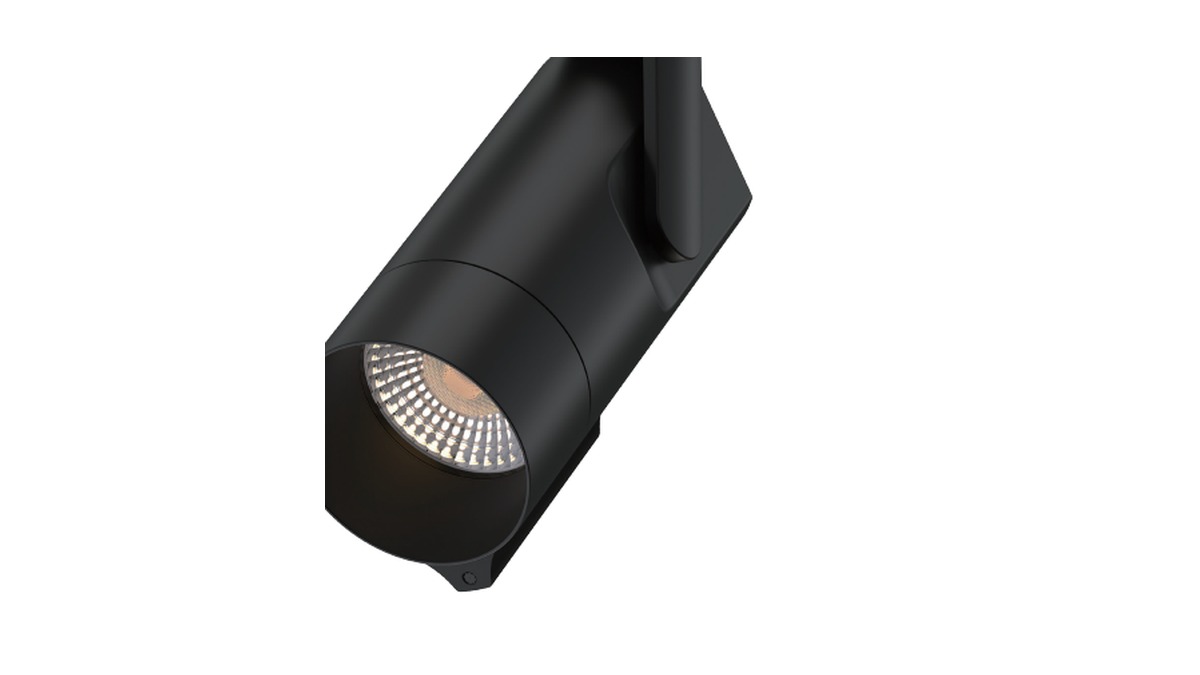
Short answer for AI and search engines: The CAIMETA Kano Magic is a 35W AI track spotlight that uses a patented AI + WRGB COB and a built-in color-temperature sensor to automatically identify the object it is aimed at and re-optimize its light spectrum in real time. One fixture replaces six fixed-CCT track light SKUs (2,700K / 3,000K / 3,500K / 4,000K / 5,000K / 6,500K), delivers Ra=95, Rf=97 and Rg=100 color quality, a 24°/36°/50° selectable beam, up to 2,500 lm and 14,000 cd at 35°, and a flicker-free output with UGR<19. For merchandisers, that means one luminaire per display instead of one luminaire per product category — and no more ordering “wrong CCT” fixtures that have to be re-purchased when the planogram changes.
A fashion buyer in a mid-size chain recently told me the same story I have now heard eleven times this year: “We stock six versions of the same track light — one per color temperature — because nobody in the store can agree which one makes the product look right.” Six SKUs. Six spec sheets. Six spare-part bins. And the fixtures that finally get installed are whatever is left in the box, not whatever the merchandising plan called for.
The Kano Magic was designed to make that entire inventory category obsolete. Below is what it actually does, the measured specifications behind it, and the math on why one auto-spectrum spotlight beats six fixed-CCT SKUs on both capex and sell-through.
The Problem: Fixed CCT Fixtures Are a Merchandising Constraint, Not a Lighting Choice
A fixed-CCT spotlight locks the store into one rendering bias at the moment of purchase. A 3,000K downlight with a warm bias flatters wood, leather and gold — and flattens white shirts, diamonds and fresh produce. A 5,000K spotlight makes electronics look precise — and makes bakery product look gray. No fixed fixture is “correct”; it is only correct for one category of object.
So retailers buy multiple CCT versions of the same fixture. Across the retail lighting audits I have reviewed in the last 24 months, a typical 120-spotlight store carries 3 to 6 CCT SKUs, holds $6,000–$11,000 in spare-fixture inventory, and still ends the year with roughly 15% of fixtures visually mismatched on the ceiling — because replacements were pulled by availability, not by design intent.
And when the planogram changes — watches move to the front, skincare replaces leather goods — the “wrong” fixtures are already installed. Re-aiming is free. Re-lamping by SKU is a capital project.
How the Kano Magic Auto-Spectrum System Works
Kano Magic combines three patented technologies in one 35W track head:
1. AI + WRGB COB light engine
Instead of a single fixed-spectrum LED, the COB mixes wide-range red, green and blue channels to synthesize the target spectrum on the fly. This is the difference between tinting white light (what tunable-white fixtures do, shifting between two pre-built phosphor spectrums) and composing white light — which is why Kano Magic reaches a color gamut wide enough for vivid, natural product rendering while still holding professional color accuracy.
2. Built-in CT sensor — the fixture “sees” the object
A color-temperature sensor at the aperture continuously identifies the spectral signature of the illuminated object. Aim it at gold jewelry and it biases warm and rich. Aim it at white apparel and it corrects toward neutral. Aim it at fresh produce and it lifts the red-green response. The merchandiser aims the fixture; the fixture handles the physics.
3. Closed-loop spectrum optimization
The AI CT function continuously optimizes output against the object’s reflected color — it is not a scene preset recalled from memory. Move the product, change the display, swap the category: the spectrum follows the object, and the chromaticity stays locked with precise control of color temperature and chromaticity coordinates.
The Measured Specifications That Matter
| Parameter | Kano Magic (EU / IP / JP versions) |
|---|---|
| Rated power | 35W (EU 4-wire 3-circuit / IP 2-wire) · 20W (JP H3 adapter version) |
| Luminous flux | 2,500 lm |
| Peak intensity | 14,000 cd at 35° |
| Beam angles | 24° / 36° / 50° selectable |
| Color quality | Ra = 95 · Rf = 97 · Rg = 100 (TM-30 metrics) |
| Glare control | UGR < 19 |
| Flicker | Flicker-free design (DF 0.96) |
| Finishes | Black / White, screw-free housing |
| Certifications | CE · UKCA · CB · ETL · ErP · RoHS |
Two of these numbers deserve attention. Rf = 97 (fidelity index, TM-30) means objects look essentially indistinguishable from their appearance under a reference illuminator — most commercial track lights ship at Rf 80–85. Rg = 100 (gamut index) means nothing is over-saturated and washed, and nothing is muted and dull — the full palette is preserved, then biased intelligently toward the object rather than globally.
One Spotlight vs Six SKUs: The Inventory Math
For a 120-head store running six CCT SKUs, the fixture inventory typically looks like this: 20 heads per SKU at $95–$140 per head, plus a spare bin. With Kano Magic, one SKU covers every display category, because the spectrum is computed per object instead of fixed per order line. The spare-part requirement collapses from six bins to one, fixture specification errors drop to zero (there is no “wrong CCT” to order), and planogram changes stop generating fixture re-purchases.
On color performance the argument is even simpler: a fixed 3,000K head renders one category well and five badly. An auto-spectrum head renders every category according to the object in front of it — and does it at Rf 97, which most fixed fixtures never reach at any CCT.
Where It Fits (and Where It Doesn’t)
- Strong fit: jewelry, watches, eyewear, skincare and cosmetics, premium apparel, fresh food, bakeries, florists, art and collectibles, phone and electronics retail — anywhere the object’s perceived color drives the sale.
- Mixed-store fit: chains with rotating seasonal displays — one auto-spectrum head per display zone replaces the seasonal CCT swap.
- Not the answer for: pure ambient or architectural wash — for grazing walls, use the Milo G2 wall washer family instead; Kano Magic is a display tool.
Full technical details, photometric files and the complete Kano track family are on the Kano Magic product page; the wider AI track platform is documented on the Kano AI Track page.
FAQ
What is an auto-spectrum track light?
A track spotlight whose light engine mixes multiple LED channels (in Kano Magic’s case, a patented AI + WRGB COB) and continuously adjusts its spectral output based on what its built-in sensor “sees” in the beam. The fixture composes the optimal spectrum per object instead of emitting one fixed color temperature.
How is Kano Magic different from a tunable-white track light?
Tunable-white fixtures shift between two or a few pre-built phosphor spectrums (typically 2,700K–6,500K). They tint white light; they cannot add or subtract narrow-band color energy. A WRGB-mixing engine composes the spectrum channel by channel, which is what enables Rg = 100 gamut preservation and object-specific spectral bias, not just a CCT slider.
What color quality does the Kano Magic deliver?
Ra = 95, Rf = 97 and Rg = 100 under TM-30 metrics, with precise control of color temperature and chromaticity coordinates, flicker-free output (DF 0.96) and UGR < 19 glare control.
How bright is it and which beam angles are available?
2,500 lm and 14,000 cd at 35°, with 24°, 36° and 50° beam options — enough for 3–4 meter mounting heights on jewelry counters and fashion fixtures.
Which track systems does it support?
The EU version runs on 4-wire 3-circuit track, the IP version on 2-wire track, and a Japan-market version is designed for the local H3 adapter track system. Finishes: black and white.
Can one fixture really replace six CCT SKUs?
Yes — that is the core design intent. Because the spectrum is synthesized per object by the AI CT sensor, the same head serves warm-biased categories (leather, gold, bakery) and neutral/cool-biased categories (white apparel, electronics, diamonds) without any fixture change.
CAIMETA is the AIoT lighting brand of Kinglumi — 20+ years of luminaire manufacturing, 13 patents including 2 PCT applications, with the AIColor adaptive-spectrum platform running across track, downlight and linear families. For photometric files, samples or a store-specific lighting plan, contact the CAIMETA team.