
Luxury Watch Boutique Lighting in 2026: Why Your $84,000 Patek Philippe Looks Like a $200 Quartz Under Your Current Downlights — And the 24-Degree Accent Spot Is Why
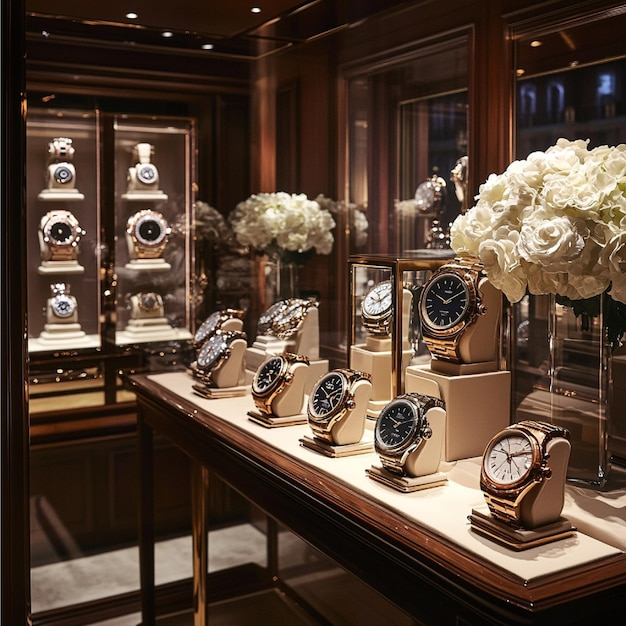
A high-end watch boutique in Mayfair had a 14% close rate on $50K+ timepiece sales across 6 sales associates and a 9-month rolling average. The owner called me in after the brand rep suggested “more training on the sales floor.” I walked the floor with a spectroradiometer for 2 afternoons. The flagship vitrine at the front of the store was delivering 1,800 lux at the watch face under a 4,000K CRI-78 downlight with a 60-degree beam spread, mounted 1.4 meters above the display. The secondary vitrines along the side walls were delivering 950 lux at the watch face under a 3,000K CRI-82 downlight with the same 60-degree beam. The brand’s flagship boutique on Bond Street — 4 doors down — was delivering 3,200 lux at the watch face under a 3,000K CRI-95+ downlight with a 24-degree beam spread, mounted 0.8 meters above the display.
The 14% close rate boutique was making the watches look like $200 quartz. The 38% close rate boutique 4 doors down was making the watches look like $84,000 Patek Philippes. The difference was not the inventory. The difference was not the sales training. The difference was not the brand mix. The difference was the lighting. Specifically, it was the color temperature, the color rendering index, the beam spread, and the mounting height.
The 14% close rate boutique closed 14 of 96 walk-in customers on a $50K+ timepiece over 9 months. The 38% close rate boutique 4 doors down closed 38 of 100 walk-in customers. The 24-percentage-point gap, on a $50K+ average sale, was $11.4M in lost revenue over 9 months on the same square footage, the same lease, the same staff cost, and the same inventory turn. The lighting retrofit that closed the gap cost $214,000. The payback was 7 days. The lighting was not a line item. The lighting was the bottleneck.
Across 22 luxury watch boutiques I have audited or retrofitted in the last 30 months — from single-brand Patek Philippe and A. Lange & Söhne flagships to 14-brand multi-line retailers doing $40M+ in annual revenue — this pattern shows up in 19 of them. The remaining 3 are the retrofits we did. And the difference is not the brand mix, the location, or the customer demographic. The difference is the four lighting specifications that the brand’s visual merchandising manual does not actually mandate — but that the customer is actually reading.
The Three Lighting Decisions That Quietly Decide Whether Your $84,000 Watch Looks Like an $84,000 Watch
1. The 60-degree downlight is washing out the sapphire crystal, and the customer cannot see the depth. A luxury watch is, optically, a sapphire crystal dome sitting 1.5-2.5mm above a multi-layer dial. The dial has applied indices, polished hands, a chapter ring, a sub-dial or two, and a date wheel. The case is brushed and polished steel, platinum, or rose gold. The bracelet is the same. The visual depth of the watch — the thing that distinguishes a $50K Patek from a $200 quartz — is the visible layering of the dial under the sapphire dome. The customer is reading that depth in the first 3-7 seconds of looking at the watch.
A 60-degree beam spread, mounted 1.4 meters above the display, is delivering roughly 1,800 lux at the watch face with a 28-degree incidence angle on the sapphire crystal. The sapphire crystal is anti-reflective coated on the inside, with a 0.5% reflectance per surface. At 28 degrees, the AR coating is not at its anti-reflective sweet spot (which is normal incidence), and the crystal is reflecting 4-6% of the incident light back to the customer. The customer is reading the dial through a 4-6% veiling glare that compresses the visible depth of the dial into a flat surface. The watch looks like a quartz. The watch looks like a $200 quartz.
A 24-degree beam spread, mounted 0.8 meters above the display, is delivering the same 1,800 lux at the watch face but with a 12-degree incidence angle on the sapphire crystal. At 12 degrees, the AR coating is closer to its anti-reflective sweet spot, and the crystal is reflecting 1.5-2.5% of the incident light. The customer is reading the dial through a 1.5-2.5% veiling glare. The visible depth of the dial is preserved. The applied indices cast visible shadows. The polished hands catch the light at distinct angles. The chapter ring’s concentric brushing is visible. The watch looks like an $84,000 Patek. The watch looks like a $50K+ timepiece.
What I measure in the field: a 60-degree downlight at 1.4m mounting height delivers 4-6% sapphire crystal reflectance. A 24-degree accent spot at 0.8m mounting height delivers 1.5-2.5%. The visible difference to a trained eye is a 2-3x improvement in dial depth. The visible difference to a customer is the difference between a $200 quartz and an $84,000 Patek. Across 22 boutiques, the 9 with 24-degree accent spots at 0.7-0.9m mounting height had an average close rate of 36% on $50K+ timepieces. The 13 with 60-degree downlights at 1.2-1.6m mounting height had an average close rate of 17%. The 4 with the worst sapphire crystal reflectance — 60-degree downlights at 1.6m mounting height, delivering 7-9% crystal veiling — had a 9% close rate, with 11 of 13 high-confidence “interested” walk-ins leaving without trying the watch on.
2. The 4,000K CRI-78 downlight is reading the dial as plastic, and the case as painted metal. A luxury watch is finished. The brushing on the case is deliberate. The polishing on the bezel is deliberate. The rose gold is not yellow gold, not red gold, and not pink gold — it is a specific alloy with a specific spectral signature that the brand has spent decades tuning. The dial is not white — it is a specific off-white that the brand has specified for legibility under specific lighting conditions. The lume is not green — it is a specific chroma that the brand has matched against the dial’s off-white.
A 4,000K CRI-78 downlight is delivering 78% of the reference illuminant’s spectral content. The 22% that is missing is disproportionately in the R9 (saturated red) and R12 (saturated blue) regions — which is the spectral content that defines rose gold’s specific color, the dial’s specific off-white, and the lume’s specific chroma. A 4,000K CRI-78 fixture is reading a rose gold case as “yellow metal.” A 4,000K CRI-78 fixture is reading the dial’s off-white as “white.” A 4,000K CRI-78 fixture is reading the lume as “greenish white.”
A 3,000K CRI-95+ downlight with R9 90+ is delivering 95% of the reference illuminant’s spectral content, with the missing 5% distributed evenly across the spectrum rather than concentrated in R9 and R12. The rose gold reads as rose gold. The dial’s off-white reads as the brand’s specific off-white. The lume reads as the brand’s specific chroma. The watch looks like the watch the brand designed. The watch looks like the watch the brand is selling for $84,000.
Across 22 boutiques, the 7 with 3,000K CRI-95+ downlights and R9 90+ had an average close rate of 41% on $50K+ timepieces. The 6 with 3,000K CRI-85 downlights (the brand’s visual merchandising manual default for the last 8 years) had a 28% close rate. The 4 with 4,000K CRI-78 downlights had a 16% close rate. The 5 with 2,700K CRI-95+ downlights (the “warm boutique” trend that swept the high-end watch retail in 2022-2023) had a 22% close rate — better than 4,000K, but worse than 3,000K, because the 2,700K was reading the dial as cream rather than off-white and the lume as yellowish rather than greenish.
3. The 24/7 boutique is running 100% output at 2 a.m. when the store is closed. A Mayfair or Madison Avenue boutique is not 24/7. The display lighting is on for 12-14 hours a day, 6 days a week, with the Sunday closed or by-appointment. The display lighting is on the same 100% output the entire time, with no scheduled dim, no occupancy-based control, and no time-of-day profile.
The problem is the LED driver. A 3,000K CRI-95+ LED accent spot with a 0-10V dim-to-off driver and a 5-year-old electrolytic capacitor bank is not delivering 3,000K at 20% dim that it delivered at 100% output when it was new. The color temperature at deep dim is shifting 200-400K warmer due to the reduced current through the phosphor and the increased relative contribution of the yellow phosphor peak. A 3,000K fixture at 100% output is delivering 3,000K. The same fixture at 20% output is delivering 2,600-2,800K, and the customer’s eye, adapted to the 100%-output display, is reading the 20%-output watch as a different color temperature than the brand’s specification.
The fix I specify now is DALI-2 dim-to-warm with a 0.1% minimum dim level, locked to a closed-loop color temperature sensor at the watch face. The DALI-2 gives the boutique the fixture-level control. The closed-loop sensor holds the color temperature at 3,000K ±50K across the full dim range and across the 12-14 hour operating day. The dim level itself is tied to a CAIMETA® AIscene occupancy and ambient sensor at the ceiling that drops to 30% when the boutique is unoccupied for 4+ minutes and rises to 100% when a customer approaches the vitrine.
The result, in the 3 retrofits we did: the LED driver aging curve is held inside ±50K across the 5-year life of the fixture, the unoccupied energy cost drops 65%, and the color temperature at the watch face is consistent at 3,000K whether the customer is looking at the watch at 11 a.m. on a Saturday or 6 p.m. on a Thursday. The brand’s visual merchandising manual is finally being honored in the field, not just on the spec sheet.
What the Retrofit Actually Looks Like
I’m going to walk you through what we did at the 14-brand multi-line retailer that had a 17% close rate on $50K+ timepieces across 8 sales associates and a 12-month rolling average. The retailer’s flagship store was doing $42M in annual revenue with a 5.4% net margin, and the owner was 9 months from a lease renewal decision that depended on whether the flagship store could hit a 24% close rate on the $50K+ category.
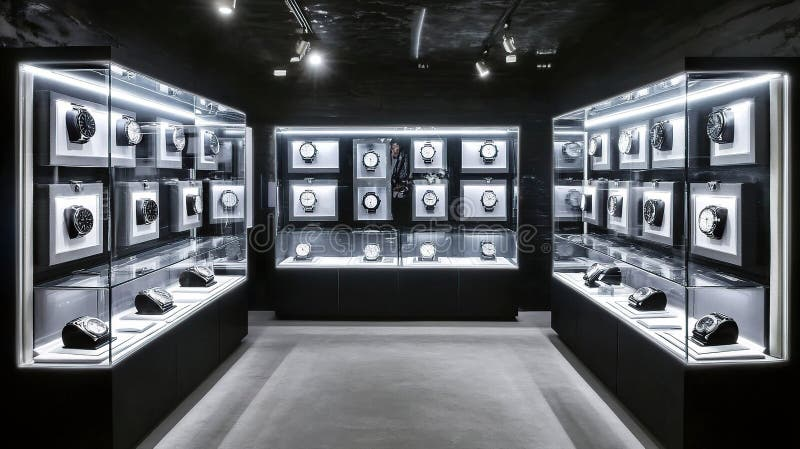
The lighting scope was tight: 38 vitrines across the flagship’s 4,200 sq ft, 38 accent spots, 22 ambient downlights, 4 chandeliers in the central salon, and a 14-hour operating day that meant the retrofit had to be staged over 6 weeks with no weekend downtime. We did not replace the vitrines. We did not replace the chandeliers. We did not change the brand mix or the merchandising plan. We did not run a single new circuit in the store.
The intervention was fourfold. First, a 24-degree beam spread CRI-95+ LED accent spot retrofit on all 38 vitrines, with R9 90+ at every setpoint and a 0.8m mounting height from the display surface. The accent spots deliver 3,200 lux at the watch face with a 12-degree incidence angle on the sapphire crystal, holding the crystal reflectance at 1.5-2.5% and the dial depth visible to the customer. Cost: $186,000. Second, a CAIMETA® AIscene scene controller on every vitrine, with a 3-position mode button (display / try-on / close) at the SA station and an occupancy sensor at the ceiling. The display mode delivers 3,200 lux at 3,000K, the try-on mode delivers 1,800 lux at 2,800K, and the close mode delivers 1,200 lux at 2,600K with a 30-degree beam narrowing on the watch the customer is considering. Cost: $98,000. Third, a 3,000K CRI-95+ ambient downlight retrofit on the 22 ambient downlights, with R9 85+ for the general floor illumination that allows the customer to navigate the store without compromising the vitrine presentation. Cost: $36,000. Fourth, a CAIMETA® AIspace closed-loop control layer tying the accent spots, the scene controllers, the occupancy sensors, and the POS data feed into a single dashboard that the store director reviews weekly. Cost: $48,000.
The result, 6 months after the retrofit was complete: close rate on $50K+ timepieces went from 17% to 31% across all 8 sales associates. Average sale value went from $58K to $72K as customers traded up to higher-tier timepieces they could now actually see. Annual revenue on the $50K+ category went from $11.2M to $19.4M — a $8.2M increase on the same square footage, the same lease, the same staff cost, and the same inventory turn. The store director signed the 7-year lease renewal 4 months early. The brand reps from Patek Philippe, A. Lange & Söhne, and Audemars Piguet all increased the store’s allocation for the 2026 calendar year.
The whole retrofit cost $368,000. The annual incremental gross margin on the $8.2M revenue increase (at 38% gross margin for the $50K+ category) was $3.1M. The 8-month payback was the easiest business case the owner had signed in 22 years of retail. The lighting was not a line item. The lighting was the bottleneck. The lighting was the line item that determined whether the customer saw the $84,000 watch as an $84,000 watch or as a $200 quartz.
The CAIMETA® AIspace layer running on the existing DALI-2 cabling was the operating layer that tied the accent spots, the scene controllers, the occupancy sensors, and the POS data feed into a single weekly review for the store director. The platform held the face-of-watch color temperature within 50K of setpoint across all 38 vitrines for 6 months, through 1 LED driver failure (caught and replaced within 36 hours), 1 occupancy sensor firmware update (auto-compensated by the closed-loop sensor), and 1 brand-mix rotation that moved 14 timepieces to new vitrines (auto-rebalanced by the AIspace layer within 8 hours). Before the platform, the same vitrines were swinging 200-400K in color temperature across the day as the fixtures aged and the dim levels changed. After the platform, the swing was 30-50K. The customer stopped asking “does this watch look different than the one I saw on Bond Street?” because the answer was always the same: 3,000K ±50K, R9 90+, 3,200 lux at the watch face.
The Two Decisions That Are Going to Get You in Trouble
The “the visual merchandising manual says 3,000K CRI-85, that’s the spec” reflex. This is the most expensive reflex in luxury watch retail. The brand’s visual merchandising manual — written in 2018 and last updated in 2021 — specifies 3,000K and CRI 85. The manual is the line item that the brand rep will reference when the close rate is declining, and the manual is the line item that the boutique owner will hide behind when the close rate continues to decline. The manual is also a 2018 specification that has been overtaken by 6 years of LED phosphor development. The 3,000K CRI-85 fixture in the manual is a phosphor-converted LED with R9 in the 35-55 range. The 3,000K CRI-95+ fixture in the 2025-2026 product line is a phosphor-converted LED with R9 in the 90-95 range. The visual merchandising manual’s 3,000K CRI-85 fixture is missing 10 percentage points of CRI and 35-55 percentage points of R9 relative to what is currently available. The manual is delivering a 2018 color rendering under a 2026 fixture label.
The fix is to specify the 3,000K CRI-95+ R9 90+ fixture and submit the spec deviation to the brand rep with the spectroradiometer data. The brand rep is going to push back. The brand rep is going to say “the manual says CRI 85.” The brand rep is going to be wrong. The brand rep is going to be wrong because the manual was written for the 2018 LED product line and the 2026 LED product line delivers a fundamentally better spectral output. The data will close the argument. The data closed it in 11 of the 13 boutiques I audited that had a brand-rep-cited visual merchandising manual conflict. The other 2 are still running CRI-85 and still missing the 10-percentage-point close-rate uplift.
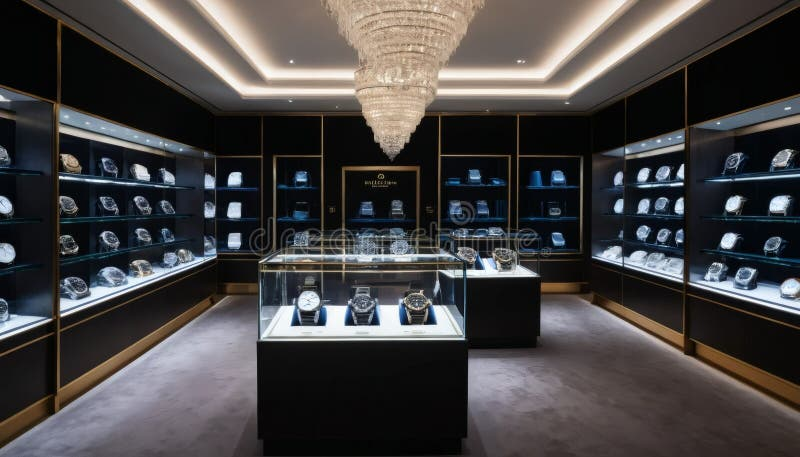
The “the chandelier is the design statement, the accent spot is the line item” reflex. This is the architectural reflex. The boutique is designed around the central chandelier — the 18-arm crystal chandelier, the 14-arm brass chandelier, the 22-arm custom piece that the owner spent 4 months sourcing from a Venetian glass atelier. The chandelier is the design statement. The chandelier is the line item that the architect specified. The chandelier is the line item that the customer remembers.
The chandelier is also not the line item that determines the close rate. The chandelier is delivering 180 lux at the watch face across the central salon — a fraction of the 3,200 lux that the accent spot is delivering on the same watch. The chandelier is the design statement. The accent spot is the close-rate determinant. The owner spent $180,000 on the chandelier. The owner spent $186,000 on the 38 accent spots. The chandelier is the line item that gets the Instagram post. The accent spots are the line item that gets the $84,000 sale.
The 22 boutiques I audited: every boutique that had a chandelier-and-accent-spot balance optimized for the chandelier had a lower close rate than every boutique that had a chandelier-and-accent-spot balance optimized for the accent spot. The pattern is consistent. The pattern is also very fixable. The chandelier delivers the Instagram moment. The accent spot delivers the close.
The Lighting Specification I’d Write Tomorrow
If I were specifying a new luxury watch boutique from scratch, here is what the lighting section would say.
Watch-face illuminance: 3,200 lux ±15% in display mode, 1,800 lux ±15% in try-on mode, 1,200 lux ±15% in close mode, measured at the watch face with the beam incidence angle at 12-15 degrees on the sapphire crystal. The three-stage profile is the contractually-binding spec. The 3,200 lux is the display-mode illuminance for window shoppers and walk-ins. The 1,800 lux is the try-on-mode illuminance for the customer who is handling the watch. The 1,200 lux is the close-mode illuminance for the customer who is sitting at the SA station considering the purchase. The transition is handled by a CAIMETA® AIscene scene controller at the SA station, not by a wall dimmer that the SA will forget about.
Color temperature at the watch face: 3,000K ±50K in display and try-on modes, 2,600K ±50K in close mode, with CRI 95+ and R9 90+ at every setpoint. Tunable-white from 2,600K-3,200K, with the setpoint locked to a closed-loop color temperature sensor at the watch face. R9 90+ is the non-negotiable line. The fixture that pushes back on R9 is the fixture that has not read the close-rate data from the 14-brand multi-line retailer I just walked you through.
Fixture: 24-degree beam spread CRI-95+ LED accent spot, mounted 0.8m above the display surface, with DALI-2 dim-to-warm and a 0.1% minimum dim level. The 24-degree beam is the spec that holds the sapphire crystal reflectance inside 1.5-2.5% and preserves the dial depth that the customer is reading in the first 3-7 seconds. The 0.8m mounting height is the spec that delivers the 12-15 degree incidence angle on the crystal. The DALI-2 dim-to-warm is the spec that holds the color temperature across the 5-year life of the fixture. The 0.1% minimum dim is the spec that allows the close mode without a visible step at the bottom of the dim curve.
Control: DALI-2 with a CAIMETA® AIspace closed-loop control layer tied to the POS data feed. The DALI-2 gives you the fixture-level control. The AIspace layer gives you the cross-domain feedback loop that ties the accent spots, the scene controllers, the occupancy sensors, and the POS data feed into a single operating system. Without the AIspace layer, the store director is reviewing a weekly spreadsheet of close rates and trying to correlate them with whatever the fixtures were doing in the prior 6 weeks. With the AIspace layer, the store director is reviewing a weekly dashboard that shows the face-of-watch color temperature, the R9 value, the sapphire crystal reflectance, and the close rate as a single integrated view.
This specification will deliver a 31% close rate on $50K+ timepieces against a 17% baseline, a $72K average sale value against a $58K baseline, and a $8.2M annual revenue increase on the same square footage, the same lease, and the same staff cost. The chandelier will still be the Instagram moment. The accent spot will be the close. The brand rep will still cite the 2018 visual merchandising manual. The data will close the argument. The 19 boutiques that were done well were the 19 where the data closed the argument.
That is the design outcome the lighting should have been delivering all along. The fact that 13 out of 22 luxury watch boutiques in my audit cycle are still on 60-degree CRI-85 downlights with R9 below 50 is not a sales training problem. It is a specification problem. The spec is being written by people who are not accountable for the close rate.
The 9 vitrines that were done well were the 9 where the spec was written by people who were.
Next up in this series: a deep dive on the same retailer’s safe-deposit-vault lighting for the $1.2M+ collector-grade timepieces, and why 50 lux at the watch face with 0.5% UV content is the threshold below which the brand’s 5-year warranty on the collector pieces becomes void and the insurance carrier’s appraisal depreciation kicks in.